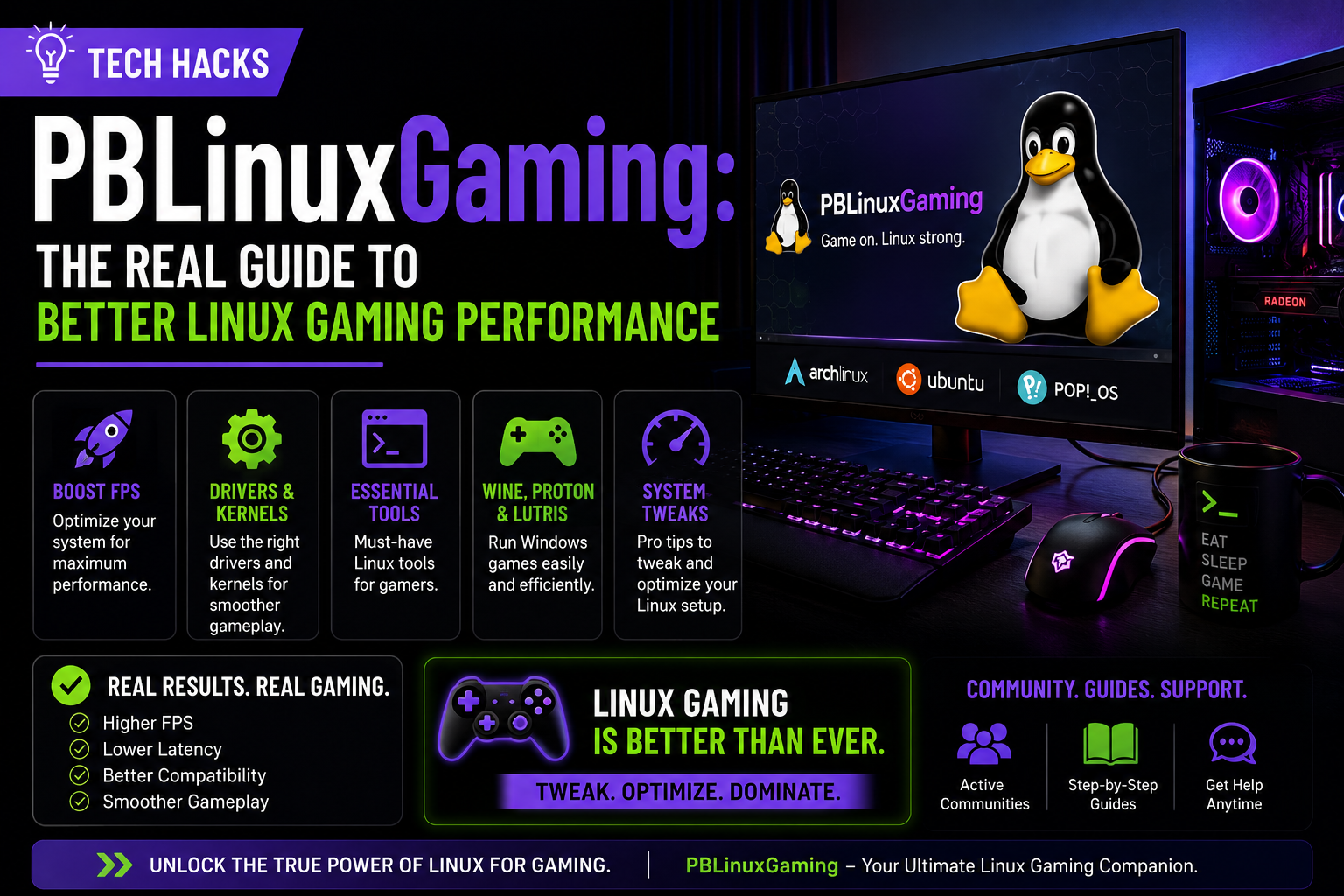
Tech Hacks PBLinuxGaming: The Real Guide to Better Linux Gaming Performance
- 1 What PBLinuxGaming Actually Refers To
- 2 The Core Tech Hacks That Actually Work
- 2.1 1. Start With the Right Distribution
- 2.2 2. Correctly configure Proton and Proton GE
- 2.3 3. Enable GameMode
- 2.4 4. Keep GPU Drivers Updated
- 2.5 5. Monitor Performance with MangoHud
- 2.6 6. Close Background Processes Before Gaming
- 2.7 For Advanced Users: Going Deeper
- 2.8 Quick Troubleshooting Reference
- 3 Final Thought
The world of game development has come a long way with Linux. Just a few years ago, the idea of Linux as a gaming platform was considered a joke. Today, the Steam Deck has proven that Linux is capable of serious gaming, and Proton has made it possible to play Windows games on open-source platforms — completely changing the conversation.
That’s the world “tech hacks PBLinuxGaming” resides in, where a bunch of workable optimisations that have been tested in the community and have proven to be efficient workarounds for getting the most from gamers’ hardware without switching to a different OS.
This guide demystifies all of those hacks, explains which are important and which aren’t, and shows you how to use them properly.
What PBLinuxGaming Actually Refers To
PBLinuxGaming is a small gaming portal that covers Linux gaming topics such as performance tips, game compatibility, and system optimizations for everyday users. It is not software you install or a driver you download. It is a collection of practical tweaks that, when applied together, can significantly improve your gaming experience on Linux.
This post is not about cheating or exploiting unfair shortcuts. These are legitimate system-level optimizations: configuring compatibility layers, setting your CPU governor, managing drivers, and choosing the right software stack. Most serious Linux gamers find these tweaks on their own eventually, but PBLinuxGaming gathers them all together in one place for you.
Why Linux Gaming Still Needs Optimization in 2026
Despite all the advances, Linux doesn’t offer the same “game out of the box” feature as Windows.
But why does optimization still matter:
- But most of the Windows games come with DirectX, which is not natively supported by Linux. There are layers such as DXVK and VKD3D that are able to translate, but they must be configured correctly.
- The default Linux distribution is not optimized to play games. Background processes, conservative CPU scaling, and default power profiles all take their toll on performance.
- The problem with driver setup is that the NVIDIA, AMD, or Intel version will behave differently depending on the OS, and most people who have trouble with frame rates on Linux have the wrong driver setup.
The following hacks make much more sense if you understand this context.
The Core Tech Hacks That Actually Work
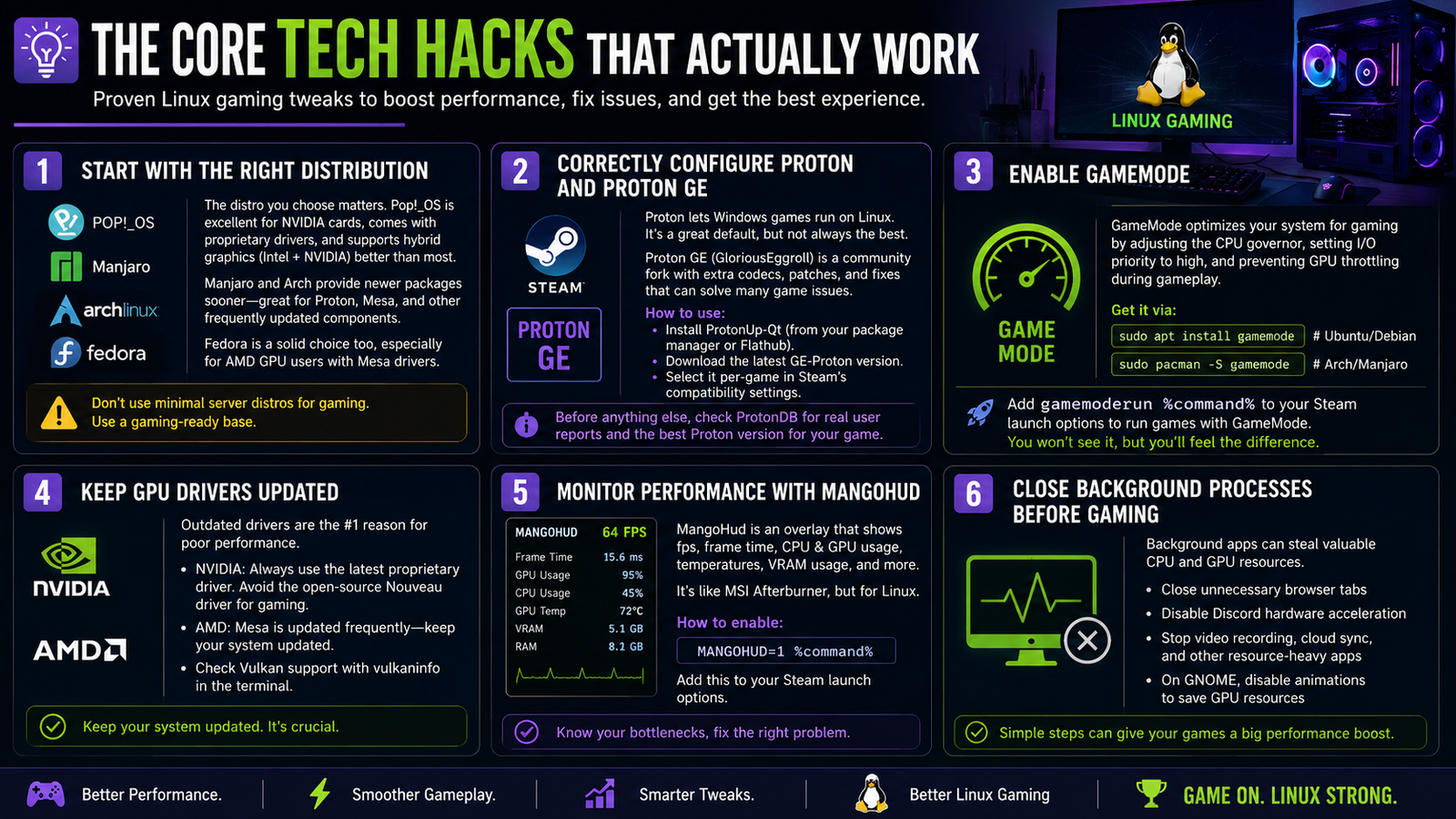
1. Start With the Right Distribution
Many people fail to realize the importance of the distro you choose. Pop!_OS is probably the easiest way to start with the NVIDIA cards, and it is also good for gaming, which is a plus considering it comes with the proprietary drivers for the graphics cards installed & supports hybrid graphics (Intel + NVIDIA) better than most other options. Systems based on Manjaro and Arch provide newer packages sooner, especially those that need frequent updates, like Proton and Mesa. As for Fedora, it can still be a good choice, particularly for AMD GPU users with Mesa drivers.
Don’t install a minimal server distro and run games on it. Use a gaming base that is ready to go.
2. Correctly configure Proton and Proton GE
Valve’s compatibility layer that enables Windows games to run on Linux via Steam. For most titles, it is a very good default, but it is not necessarily the best version.
Proton GE or GloriousEggroll is a community fork that contains extra codecs, patches, and fixes that have not been integrated into the official release. Switching to Proton GE can often resolve the issue for games that have the above-mentioned issues once they’re launched.
How to use: install ProtonUp-Qt from your package manager or Flathub, download the latest GE-Proton version, and then use it, per-game, under Steam’s compatibility settings. Before anything else, look in ProtonDB; it will display actual user feedback on the game’s performance and what Proton version works best.
3. Enable GameMode
One of the most undervalued aspects of Linux gaming is the use of GameMode. This tool, once enabled, will alter your CPU governor temporarily in performance mode, set I/O priority to highest, and let your GPU know to stop throttling all during the run of a game.
Get it via:
sudo apt install gamemode # Ubuntu/Debian
sudo pacman -S gamemode # Arch/Manjaro
Simply add gamemoderun %command% to the Steam launch options of any game to run it with GameMode. You will not see it running, but you will certainly see the difference in frame pacing and input response.
4. Keep GPU Drivers Updated
The fact that your OS is running old drivers is most likely the main reason for your performance problems going unnoticed. Hence, the best thing to do is to download the latest proprietary driver from NVIDIA, if this is the case that you are using their cards for gaming. Nevertheless, since the open-source Nouveau driver is not dedicated to gaming performance, the choice of getting it should not be made. Although Mesa is updated quite often, AMD’s system updates make the majority of the changes. The most important thing, however, is to have your system updated at all times.
Besides, you can also check if your GPU supports running Vulkan by using vulkaninfo in the terminal.
5. Monitor Performance with MangoHud
If you don’t see what your system is doing, you won’t be able to optimize it. MangoHud is an overlay that provides an instant display of fps, frame time, GPU and CPU usage, temperature, and VRAM consumption, among other things. In a way, it is like the MSI Afterburner overlay but for Linux.
Just put MANGOHUD=1 %command% as the game launch options in Steam to activate it. Once you figure out exactly when you are getting slowed down, it becomes a lot easier to work out the right solutions.
6. Close Background Processes Before Gaming
Though it sounds very simple, this actually can bring a noticeable change to mid-range systems. Different browser tabs, Discord hardware acceleration, video recording, and cloud synchronization programs are all competing for GPU and CPU resources. So before starting a heavy game, it’s better to close them. GNOME desktop users, for instance, can also save some GPU resources by turning off animations.
For Advanced Users: Going Deeper
If the above changes have already been implemented, here are three more advanced optimizations for you to look into:
Fsync/Esync: These minimize CPU usage during intensive multi-threaded game loading by optimizing the handling of synchronization events. Most of the modern versions of Proton support Esync automatically, and Fsync requires kernel support. Check if your kernel supports it with uname -r and if it is version 5.16 or higher.
Custom Kernels: The Liquorix kernel is specifically designed to improve latency in gaming and make the desktop more responsive. It adopts a totally different approach to scheduling compared to a regular kernel, which notably benefits a competitive game situation where there is a lot of hectic activity.
Shader Pre-Caching: Generally, in games, the main cause of stutters is the fact that shaders are being compiled on the fly. In the case of bigger games, it might be a good idea to find out if Steam or disk space is used for caching shaders, but for Vulkan shaders, Steam manages it automatically.
Also Read- Is Kaspersky Safe to Use? Here’s What I Found After 3 Weeks
Quick Troubleshooting Reference
| Problem | Most Likely Fix |
| The game won’t launch | Try a different Proton version or Proton GE |
| FPS lower than expected | Enable GameMode, check the CPU governor is in performance mode |
| Audio crackling | Switch the audio server to PipeWire if still using PulseAudio |
| Screen tearing | Enable compositor sync or switch to Wayland |
| Game crashes at startup | Check ProtonDB for known fixes and required launch flags |
Final Thought
The difference between Linux and Windows games is not as big as it’s ever been. The “hacks” for PBLinuxGaming aren’t hacks; these are educated decisions made by seasoned Linux gamers to maximize their gaming experience. Do that with Proton GE and GameMode, add more from there, and your system will be able to run more than you imagined.