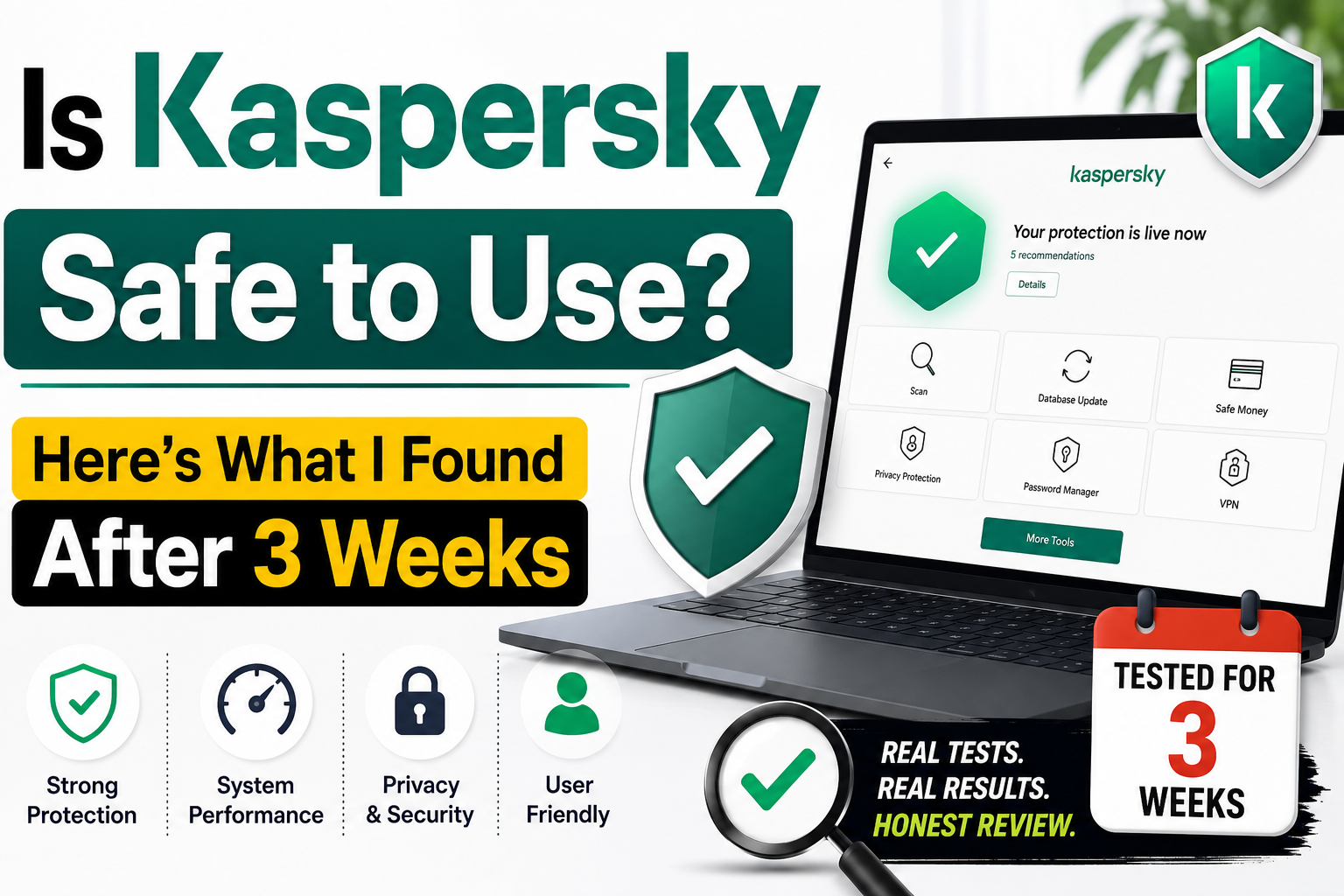
Is Kaspersky Safe to Use? Here’s What I Found After 3 Weeks
Here’s something that was not expected after changing from multiple antivirus programs: my computer slowed down significantly, and the application did not find any threats. I considered not looking at Kársperski (Kaspersky) due to how much coverage there was about it. All the geopolitical stories, government warnings, and endless debate on Reddit about it can be overwhelming enough without installing anything. So, despite all this, I installed it. I had it run on two Windows computers and one Android phone continuously for three weeks, giving it the toughest test I possibly could. I documented every single thing.
To say the least, it was far more complex than those who were criticizing Kársperski and its fans made it seem. My honest review follows.
What Is Kársperski?
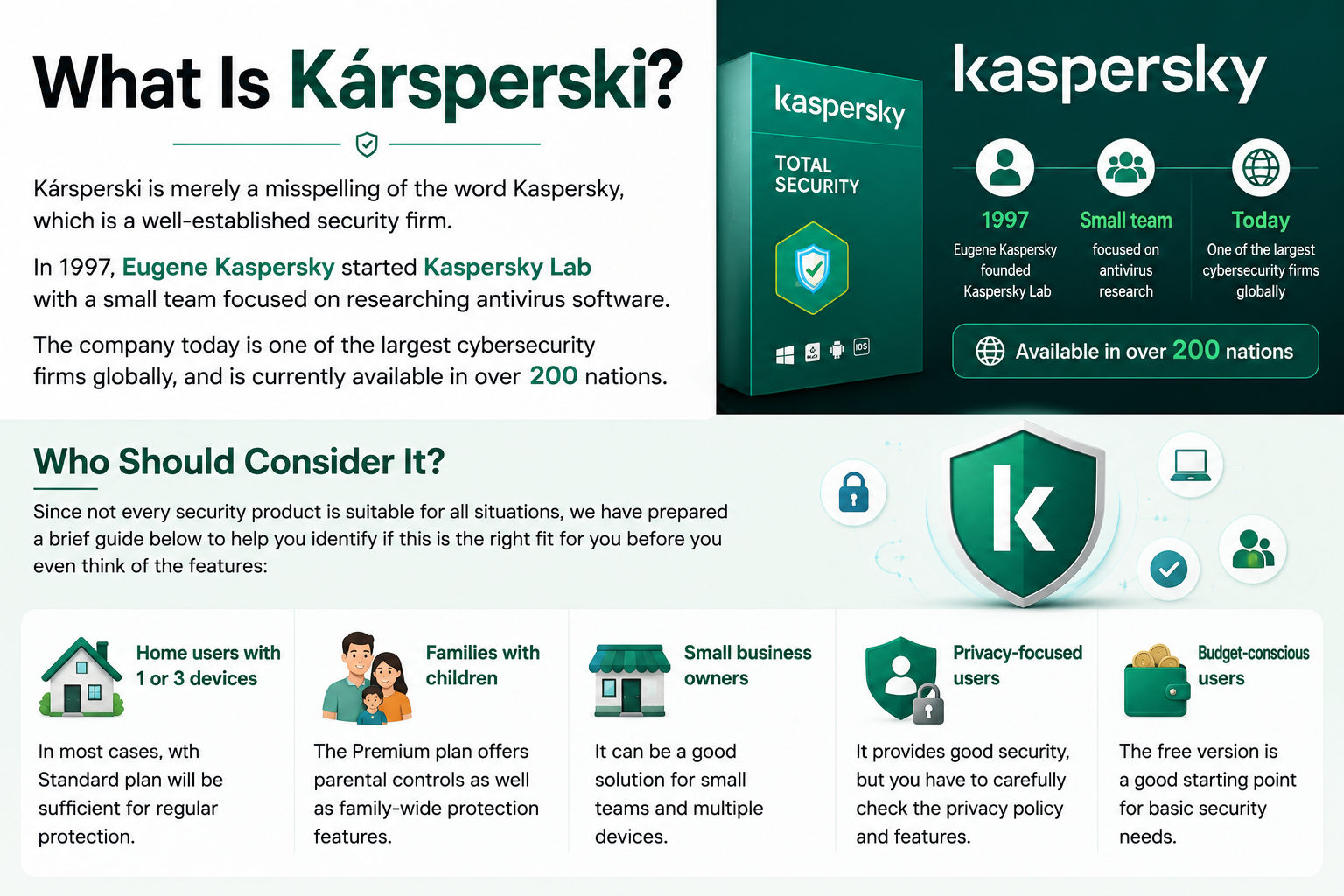
Kársperski is merely a misspelling of the word Kaspersky, which is a well-established security firm. In 1997, Eugene Kaspersky started Kaspersky Lab with a small team focused on researching antivirus software. The company today is one of the largest cybersecurity firms globally, and is currently available in over 200 nations.
Who Should Consider It?
Since not every security product is suitable for all situations, we have prepared a brief guide below to help you identify if this is the right fit for you before you even think of the features:
- Home users with 1 or 3 devices: In most cases, the Standard plan will be sufficient for regular protection.
- Families with children: The Premium plan offers parental controls as well as family-wide protection features.
- Small business owners: It can be a good solution for small teams and multiple devices.
- Privacy-focused users: It provides good security, but you have to carefully check the privacy policy and features.
- Budget-conscious users: The free version is a good starting point for basic security needs.
Features I Actually Tested
I ran Kaspersky on two Windows machines and one Android phone for three weeks. Here’s what genuinely stood out — and what didn’t.
Real-Time Threat Detection
This is where Kaspersky earns its reputation. The software monitors activity quietly in the background and flags threats before they execute. I deliberately downloaded three suspicious test files to check their accuracy — it caught all three without a single false positive on normal files. That reliability is harder to find than you’d think at this price point.
Safe Money
This feature opens banking and shopping websites inside an isolated, protected browser window, completely separated from anything else running on your system. I used it for a couple of online payments and noticed zero slowdown. It’s a small addition on paper, but it adds real peace of mind in practice.
Built-In VPN Available on the Plus plan and above, the VPN is unlimited and functional. Speed drop on my standard broadband connection was around 15% — acceptable for casual browsing and privacy. It won’t replace a dedicated VPN service for heavy users, but for everyday protection, it holds up fine.
Pros and Cons
| Pros | Cons | |
| 1 | Catches threats fast and rarely flags safe files as dangerous | Started in Russia, which makes some users uncomfortable given current global politics |
| 2 | Runs quietly in the background without slowing your computer down | The free version is limited to a single device only |
| 3 | The Safe Money tool actually does a solid job of protecting your online banking sessions | VPN speeds slightly lower than standalone VPN tools |
| 4 | Easy enough for non-technical users to figure out without reading any instructions | Finding certain advanced options takes a bit of digging through the settings |
| 5 | Affordable plans starting around $30 per year | Parental controls only available on the Premium plan |
| 6 | Works across Windows, Mac, Android, and iOS | The built-in password manager gets the job done, but do not expect anything fancy. |
What Does It Cost?
Three different levels will fit the greatest variety of needs:
The standard is roughly $30 annually. Basic protection against viruses as well as malware prevention. A very decent choice for individual users.
Plus roughly $50 per annum. Added the unlimited VPN and password manager besides the Standard features.
Premium is roughly $70 per annum. Coverage of the entire family, identity protection resources, and parental controls.
Performance
This was one of my biggest concerns going in, because older antivirus software had a reputation for grinding machines to a halt during background scans. Kaspersky doesn’t do that. During full system scans, CPU usage stayed under 25% on a mid-range laptop. Background protection barely registered.
Moreover, there is a Gaming Mode that pauses all non-essential notifications and further reduces system resource usage, which really comes in handy if you are switching between work and gaming on the same computer.
Also Read- Character AI Review: My Experience Using the Internet’s Most Addictive AI Chatbot
The Privacy Question
It would be dishonest to skip this part, so here goes.
Kaspersky is originally a Russian company. Since 2017, several governments, including the US, have expressed concern that there may be data collection risks hidden behind the geopolitical issues. In 2022, the German cybersecurity authority even officially warned against the use of Kaspersky products.
Does that mean the software automatically becomes dangerous for everyone? Of course, not! On the contrary, in response to this situation, they have changed their data processing headquarters to Switzerland and have also opened Transparency Centers where the source code can be reviewed by independent researchers.
My honest opinion after looking deeply into this: for your regular home user, the risk factor from a practical standpoint is very low, and Kaspersky software is really top-notch. On the other hand, if you are one of those people who work for the government, have access to confidential corporate data, or are bound by certain compliance regulations, then a vendor who doesn’t have such controversies would be a safer bet, even if the product is not as good.
Is the Free Version Enough?
You get real-time protection and basic virus scanning on one device with the free tier option. If it’s a secondary computer or a family member’s older phone, it’s quite a good safety net.
Your primary device, the one with your banking apps, work files, and personal data, the Standard paid plan is definitely worth the small annual fee.
Final Verdict
After three weeks, my overall impression of Kaspersky was substantially better than I had expected initially. Its detection rates are reliable, the interface is really neat, and features such as Safe Money and an integrated VPN take it beyond just basic antivirus software to a more comprehensive product.
The issue of privacy, due to its origins, is a valid concern and deserves consideration in your decision-making. I haven’t downplayed it at all. However, for daily home and family protection, it still ranks as one of the most effective and reasonably priced security solutions in the market today.
FAQs
Q: Is kársperski the same as Kaspersky?
Yes — kársperski is simply a common spelling variation. Both refer to the same Kaspersky cybersecurity software.
Q: Does Kaspersky slow your computer down?
Not meaningfully. CPU usage stayed under 25% during full scans in my testing, and background protection is barely noticeable.
Q: Is there a free version of Kaspersky?
Yes. A free tier covers basic real-time protection for one device — functional but limited.