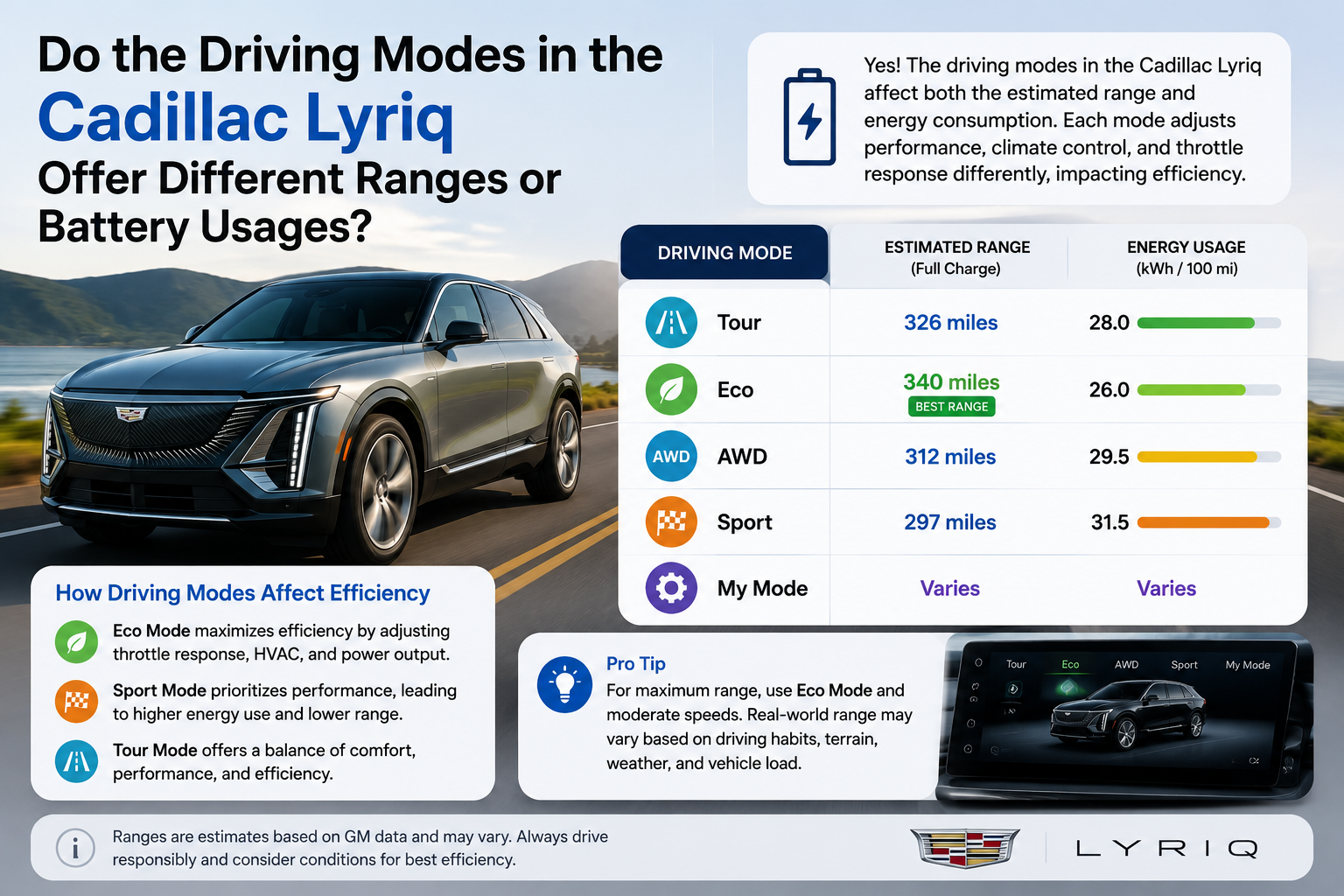
Do the Driving Modes in the Cadillac Lyriq Offer Different Ranges or Battery Usages?
- 1 How the Lyriq’s 102 kWh Battery Actually Works Across Modes
- 1.1 Mode-by-Mode Breakdown: Real Range Impact
- 1.2 Tour Mode
- 1.3 Sport Mode
- 1.4 Snow/Ice Mode
- 1.5 My Mode
- 1.6 AWD vs RWD: Does the Mode Affect Them Differently?
- 1.7 What Actually Hurts Range More Than Mode Selection
- 1.8 How to Actually Maximize Range: One-Pedal Driving + Regen on Demand
- 2 Final Verdict
Short answer: yes, but the way you think is generally different.
The 102 kWh Ultium battery itself is the same in all modes. Not a single kWh changes. Actually, what changes is the way the car gets energy from the battery, and that difference is more important than it seems.
On a long highway trip, I experienced it firsthand. Tour Mode gave me a stable and consistent range estimate the entire time. As soon as I switched to Sport, the miles started to diminish at a faster rate. That instinct is supported by the actual figures: Tour is about 2.5 mi/kWh, whereas Sport is closer to 2.1 mi/kWh. With a full charge, that difference silently accounts for 50 to 65 miles being taken away from your journey.
Mode Comparison Table
| Driving Mode | Efficiency | Approx. Range (RWD) | Best For |
| Tour | ~2.5 mi/kWh | ~326 miles | Daily commuting, highway driving, and maximum efficiency |
| Sport | ~2.1 mi/kWh | ~261–276 miles | Spirited driving and performance-focused situations |
| Snow/Ice | ~2.3 mi/kWh (Estimated) | ~290–305 miles | Winter roads and slippery or icy conditions |
| My Mode | Variable | Depends on settings | Custom balance between efficiency and performance |
How the Lyriq’s 102 kWh Battery Actually Works Across Modes
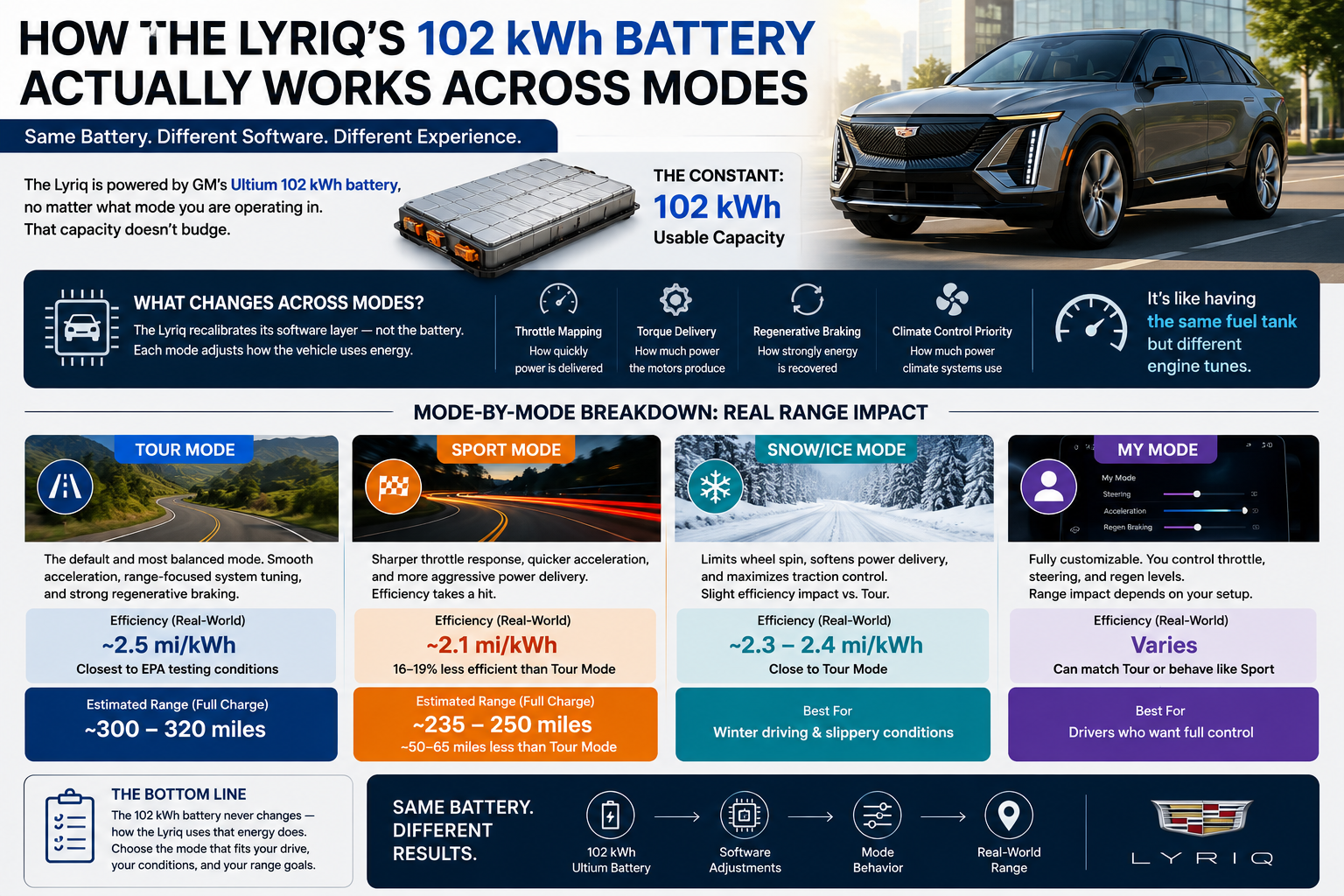
The Lyriq is powered by GM’s Ultium 102 kWh battery, no matter what mode you are operating in. That capacity doesn’t budge. In actuality, what it does is to recalibrate the software layer — throttle mapping, how much torque to deliver, how hard to regenerate, and the priority of the climate control system on power.
It’s kind of like having the same fuel tank but different engine tunes. Tour Mode instructs the car to be measured and smooth. Sport Mode will reduce the governor and allow the motors to get more aggressive. Equal amounts of energy are used, but at vastly different rates.
Mode-by-Mode Breakdown: Real Range Impact
Here is the mode-wise breakdown.
Tour Mode
The default mode is called Tour Mode; in a manner of speaking, this mode is the best. Acceleration is relatively mild, the car stops, the system is often geared towards range, and regeneration is a key factor in slowing the car down, not giving it thrills. Feedback from the owners of the Cadillac Lyriq shows that the efficiency of the Tour Mode comes to around 2.5 mi/kWh, the number that most closely matches EPA testing conditions.
Sport Mode
Sport Mode is really another story. Response to the accelerator pedal becomes much quicker, the car can reach speed in less time, and the power delivery overall sounds to be more pressed for time. The downside is the lowering of efficiency to almost 2.1 mi/kWh, a 16-19% difference in favor of the Tour. Doing the full battery charge will lead you to roughly 50-65 miles less than the Tour. In case you are making a long trip by road and decide to use the Sport mode for the highway section, it will definitely affect the scheduling of your charging stops.
Snow/Ice Mode
Snow/Ice Mode is a bit like an average person. It limits the spinning of wheels, makes the release of power hiccup a little, and strengthens the function of traction control. Efficiency loss is small if compared with the Tour; the main concern here is safety, not speed. This mode is perfect for a winter commuter and also doesn’t drain the battery the way Sport does.
My Mode
When things are really getting started, it’s time for My Mode. The influence on range is totally up to the rider’s setup, as the throttle response, steering reaction, and regen power are fully adjustable. You can configure it to be comfortable and efficient, and it can act nearly like a tour. If you make it performance-oriented, it will be more of a Sport type.
AWD vs RWD: Does the Mode Affect Them Differently?
No one’s talking about this, but it’s pretty important. The 2026 Lyriq Rear Wheel Drive (RWD) offers an EPA-estimated range of 326 miles, compared to 319 miles for the All Wheel Drive (AWD) version with dual motors. The AWD model in Sport Mode is active with both motors, while the regular model is active with only one motor, meaning that the energy loss is actually greater. The RWD model’s Sport Mode will cost you about 50- 65 miles of driving, while under aggressive driving conditions, the AWD model will suffer by that penny, if at all.
What Actually Hurts Range More Than Mode Selection
The really unexpected thing about this, and in fact the one most useful thing that I can share, is that the driving mode isn’t even the biggest factor impacting the range. Owner data from a large-scale study of Lyriq complaints indicates that 22-inch wheel fitment is the cause of 15.9% of range problems, whereas Sport Mode was blamed for only 1.1% of the cases. Tire pressure, ambient temperature, and highway speed have a much greater effect on your real-world miles than mode selection alone.
During frigid weather, battery chemistry inherently restricts output, and the vehicle uses more energy to heat the cabin. Sport Mode usage in winter essentially adds two efficiency drags, one on top of the other. Under such circumstances, Tour Mode or a conservatively set-up My Mode is nearly always the wiser choice.
Also Read- SFM Compile Guide: How I Fixed Model Errors and Compiled Custom Models Successfully
How to Actually Maximize Range: One-Pedal Driving + Regen on Demand
Lyriq’s two regenerative methods, One-Pedal Driving and Regen on Demand with the steering wheel paddle, have a more significant impact on real-world range than just changing modes. A member of the r/CadillacLyriq forum shared that with the use of only One-Pedal Driving in Tour Mode and good conditions, the car achieved 378 miles from a single charge. That is much higher than the EPA figure.
In urban driving situations, One-Pedal Driving stores energy during every slowing down instead of losing it through the friction brakes. When traveling on highways, using the Tour Mode along with keeping a slow speed (around 65- 70 mph) is the most effective and simplest combination. On the other hand, with Regen on Demand, a quick press of the paddle when you spot the stop is akin to putting miles in instead of losing them as heat.
Final Verdict
Driving modes really do change the distance the Cadillac Lyriq can cover — only this time it’s not the battery that you’re touching. The 102 kWh remains unchanged; it’s just the way the car uses it that varies. When driving every day,
The obvious answer is Tour Mode. It is measured, efficient, and it always gets you closest to 326 miles per EPA gallon.
Sport Mode is a thing, but you should do it with the knowledge that you’ll be trading in about 50–65 miles for the experience. But if you adhere to these three measures consistently, the Lyriq will really blow you away with respect to range.
FAQs
Does Sport Mode damage the Lyriq’s battery long-term?
No. It just makes the energy consumption higher, but GM’s Ultium battery composition and size do not change. Continual use of Sport Mode has absolutely no adverse effect on the battery’s structure.
Can I switch modes while driving?
For sure, changing the driving modes while at standard driving speeds is possible through the Lyriq’s 33-inch center touchscreen.
Does cold weather increase the range loss from Sport Mode?
Yes, quite a bit. Cold weather physically impacts battery performance by affecting the battery chemistry, and at the same time, the demand for heating, ventilation, and air conditioning (HVAC) goes up. Adding Sport Mode to the mix results in a combined efficiency penalty.
What’s the maximum real-world range owners have reported?
378 miles, attained by performing One-Pedal Driving consistently in Tour Mode and under ideal temperature and speed conditions.