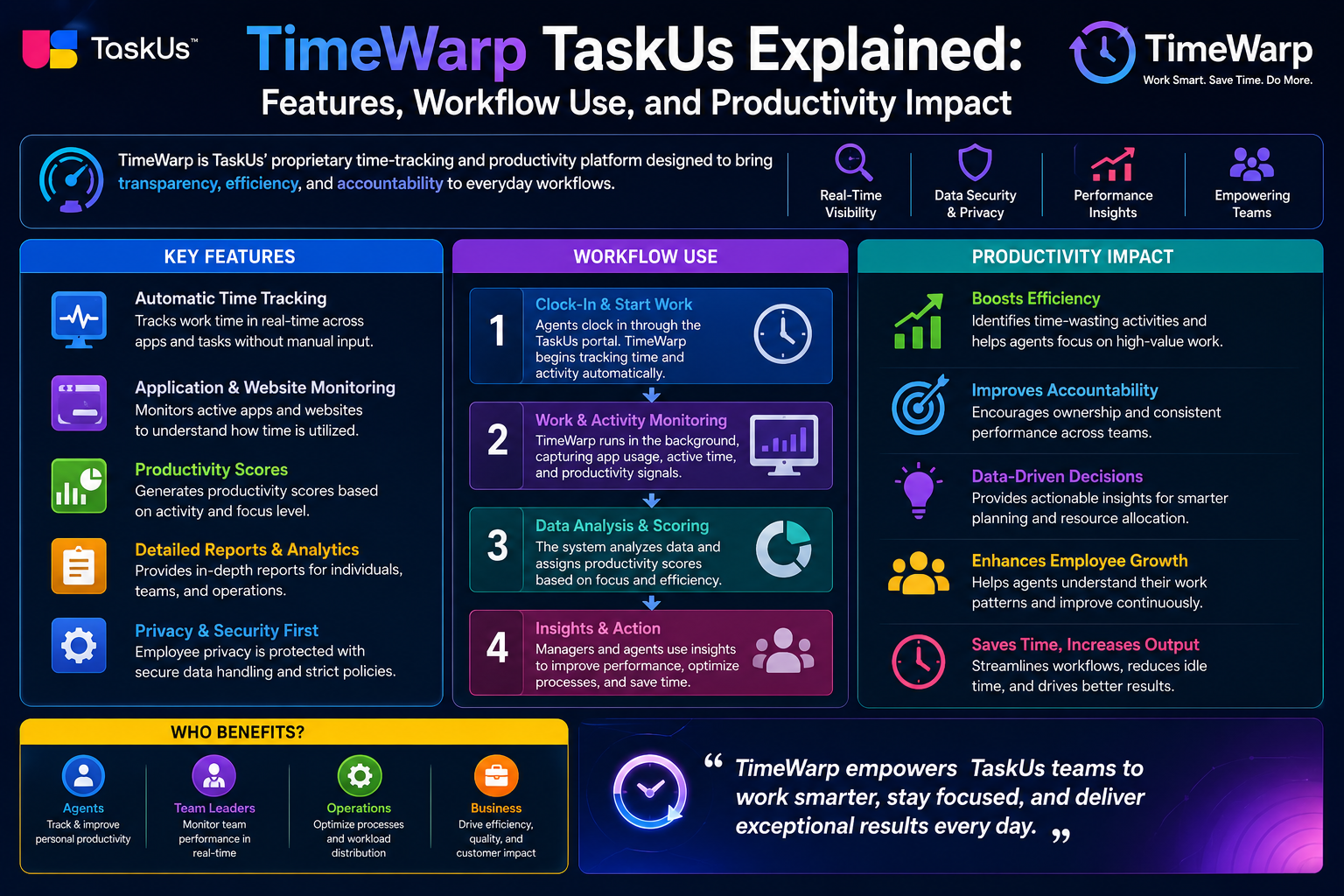
TimeWarp TaskUs Explained: Features, Workflow Use, and Productivity Impact
- 1 What Is TimeWarp TaskUs?
- 1.1 Why Is TimeWarp TaskUs Getting Attention?
- 1.2 How Workflow Systems Are Used in TaskUs-Style Operations
- 1.3 Features Commonly Associated With TimeWarp TaskUs
- 1.4 Productivity Benefits and Workplace Concerns
- 1.5 Is TimeWarp TaskUs a Real Platform or an Internal Workflow Concept?
- 2 Final Verdict
To understand TimeWarp, it helps to understand how workflow management typically works inside large BPO and support operations. Agents handle high volumes of interactions — chats, calls, tickets — and the time spent on each one gets tracked meticulously. Workforce optimization tools measure average handle time, after-call work, idle periods, and task transitions.
TaskUs is really a major business process outsourcing (BPO) company that provides customer support, content moderation, and digital services for some of the biggest technology brands in the world.
This post explores what TimeWarp TaskUs probably is, what it does, and why it is important for anyone thinking about modern BPO companies and how they manage their workforce.
What Is TimeWarp TaskUs?
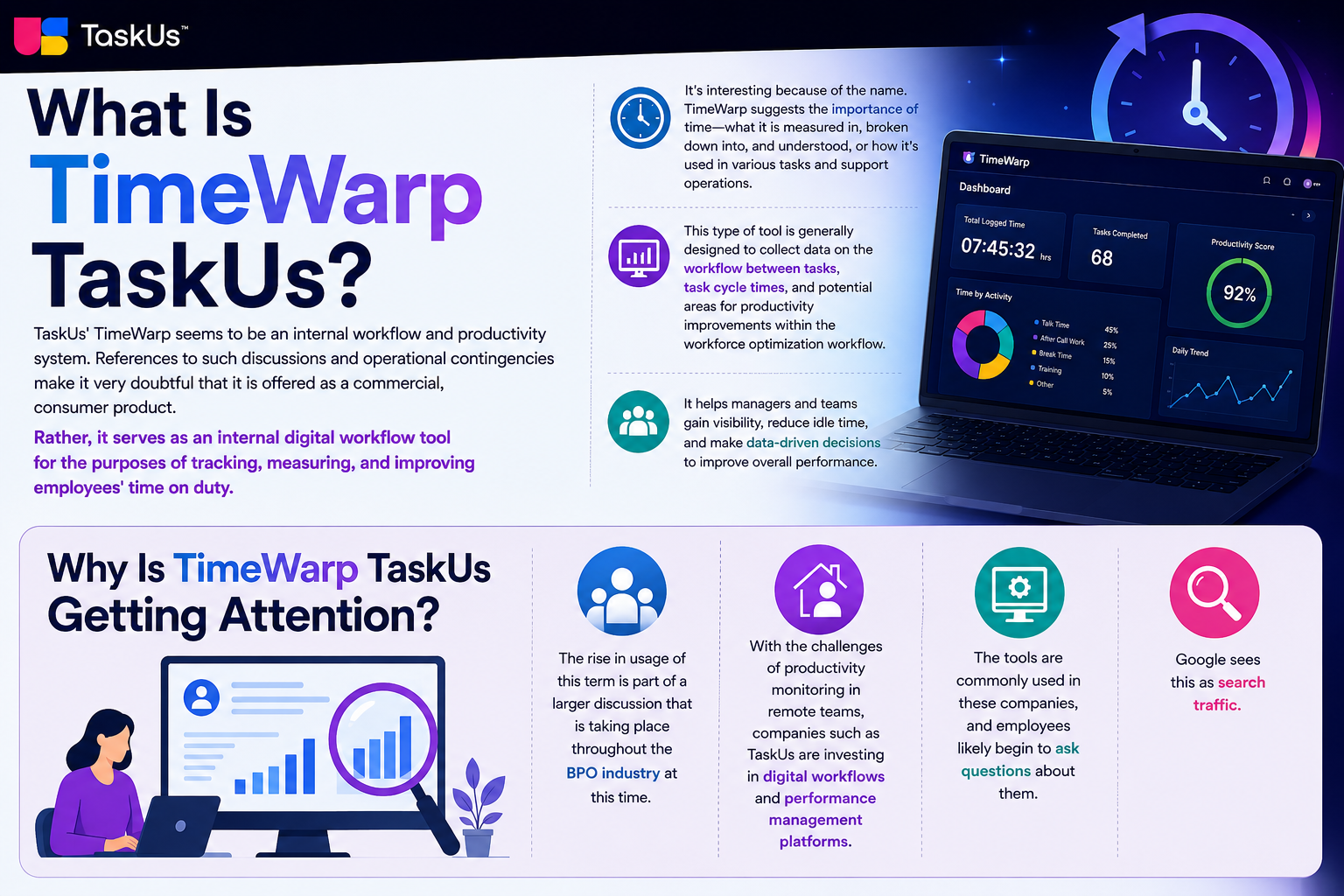
TaskUs’ TimeWarp seems to be an internal workflow and productivity system. References to such discussions and operational contingencies make it very doubtful that it is offered as a commercial, consumer product. Rather, it serves as an internal digital workflow tool for the purposes of tracking, measuring, and improving employees’ time on duty.
It’s interesting because of the name. TimeWarp suggests the importance of time—what it is measured in, broken down into, and understood, or how it’s used in various tasks and support operations.
This type of tool is generally designed to collect data on the workflow between tasks, task cycle times, and potential areas for productivity improvements within the workforce optimization workflow.
Why Is TimeWarp TaskUs Getting Attention?
The rise in usage of this term is part of a larger discussion that is taking place throughout the BPO industry at this time. With the challenges of productivity monitoring in remote teams, companies such as TaskUs are investing in digital workflows and performance management platforms.
The tools are commonly used in these companies, and employees likely begin to ask questions about them – and Google sees this as search traffic.
How Workflow Systems Are Used in TaskUs-Style Operations
The easiest way to comprehend the TimeWarp feature is to first understand the general workflow management methodologies inside large BPO and support operations. In these centers, agents are expected to handle large volumes of interactions in the form of chats, calls, and tickets. The time that the agent spends on each activity is then tracked very meticulously. Workforce optimization tools are able to measure average handle time, after-call work, idle periods, and task transitions.
In such a setting, task tracking serves purposes that go beyond identifying underperformance. For example, it is also a means of highlighting potential areas for workflow automation, pinpointing training needs, and identifying scheduling adjustments that could lead to increased productivity. TimeWarp, if it operates similarly to other workplace systems, probably provides input data for decisions of this nature.
TaskUs-level companies cannot depend on manual observation or spreadsheet reporting for their needs. They require real-time insight into the actions of hundreds or thousands of agents at the same time. The essential tool that serious BPO operations use is productivity software that can capture this data on a large scale.
Features Commonly Associated With TimeWarp TaskUs
Without an official product documentation source, I can only describe features that are consistent with what tools of this type typically include — and that appear consistent with how TaskUs employees describe their work environment.
| Feature | What It Likely Does |
| Task-Level Time Tracking | Logs how long each task takes, not just total hours worked. |
| Shift Activity Monitoring | Shows when agents are active, on break, or between tasks. |
| Productivity Dashboards | Displays performance metrics for both agents and supervisors. |
| Workflow Status Updates | Mark tasks as in progress, completed, or escalated. |
| Performance Reporting | Turns time and task data into reports for coaching and scheduling. |
Productivity Benefits and Workplace Concerns
TimeWarp and similar tools bring about a real tension, which is a great point to be examined earnestly. Besides the efficiency of operating, by tracking the tasks in real-time, managers get the chance to see the bottlenecks, adjust workloads, and help the agents find the right solutions. Only through a thoughtful use can this bring measurable productivity results.
On the other hand, for the employees, incessant supervision is the main reason for feeling that their privacy is violated. Besides, BPO workers are already under a lot of stress because of the metrics, handle time, quality scores, and schedule adherence. When a system is added that tracks every minute of their work, it is possible that the stress level will increase and the satisfaction with the job will decrease if the system is not cleverly implemented.
The impact of any workforce surveillance system will, in the end, be geared to management’s manner of data use. A measure that is only implemented with a punitive aim will only worsen morale and increase turnover rates. Conversely, when used as a basis for coaching and process improvement support, data use is more developmental and achieves better long-term results.
Also Read- Crypto30x.com Blockchain Review – My Honest Experience Exploring the Platform
Is TimeWarp TaskUs a Real Platform or an Internal Workflow Concept?
This is actually the question every individual is asking. At least, according to what’s publicly available, TimeWarp in the context of TaskUs is a genuine system, not just a marketing gimmick or a misspoken name. It is not a public-facing platform; hence, very little official information is available about it.
There are productivity applications that lots of big businesses tend to create or license within their internal media, and these programs are seldom announced on their public list. There are productivity apps that many huge companies develop or license internally that would not be publicized. They are essential systems that do work, but never make headlines, as they are used as part of the support operations. I would say that TimeWarp is in this category — something that’s functional, in use, but not something that TaskUs has marketed as a public product.
Final Verdict
TimeWarp TaskUs is quite fascinating, mainly because it’s right at the crossroads of workforce optimization, employee monitoring, and the operational needs of high-volume support work. The absence of publicly available documentation is a bummer for researchers, but it is understandable for a firm that considers its internal systems as a sort of proprietary infrastructure.
Based on what I can gather, it is a type of digital workflow tool that major BPO operations rely on for their work, and one cannot fully appreciate it without first getting a grasp on the larger picture of how TaskUs handles performance, productivity, and remote team operations.
FAQs
What is TimeWarp TaskUs?
TimeWarp TaskUs appears to be an internal workflow management and time-tracking system used by TaskUs to monitor employee productivity, track task completion, and optimize BPO operations across their teams.
Is TimeWarp TaskUs an Official TaskUs Tool?
Based on available information, it appears to be an internal operational system used within TaskUs rather than a publicly marketed software product. TaskUs has not released official public documentation about it.
Why Are People Searching for TimeWarp TaskUs?
Most searches come from TaskUs employees or job candidates trying to understand the tools used in their workplace. Growing interest in BPO workforce monitoring and productivity software is also driving broader curiosity about how companies like TaskUs manage operational efficiency at scale.