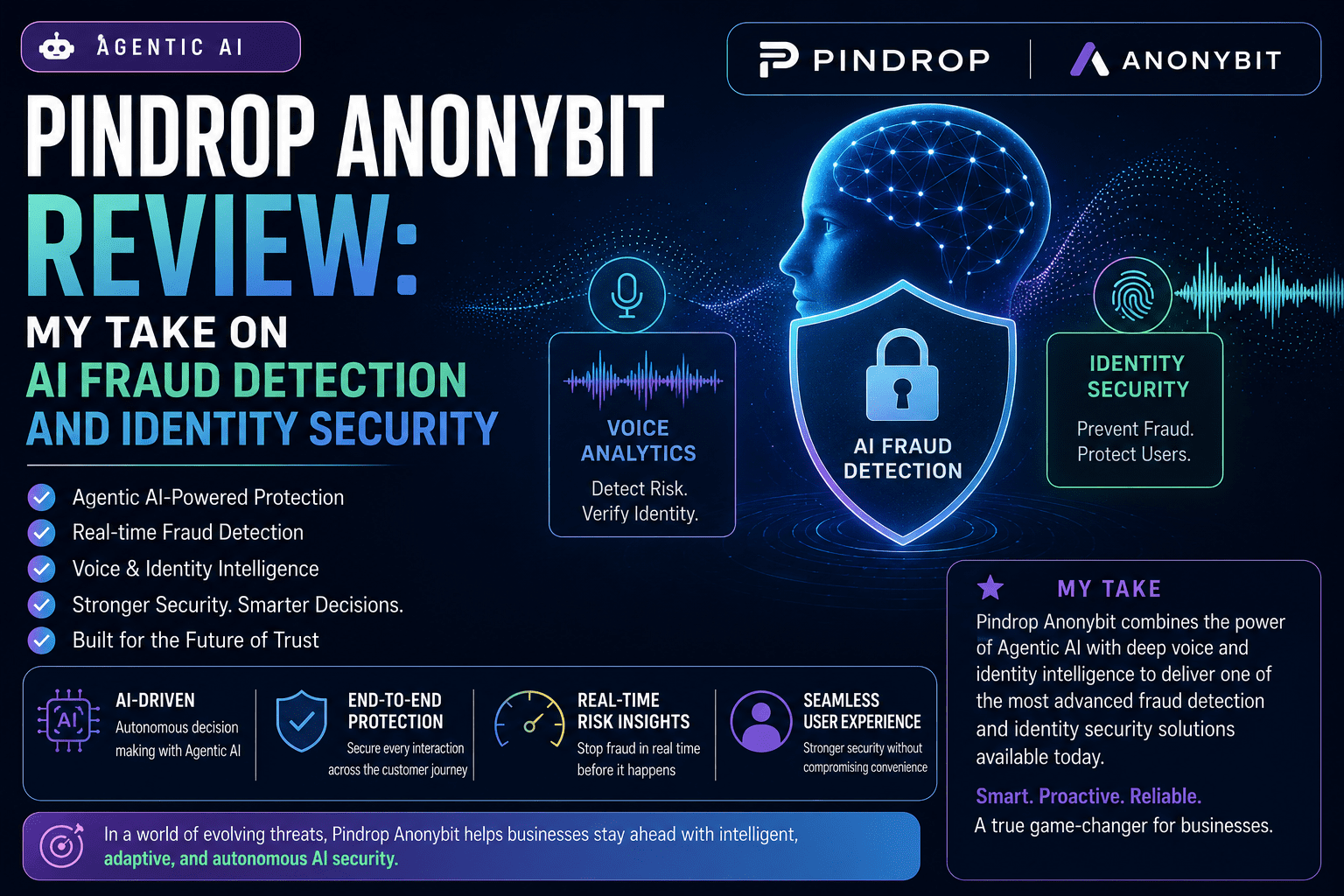
Agentic AI Pindrop Anonybit Review: My Take on AI Fraud Detection and Identity Security
- 1 Quick Verdict for Agentic AI Pindrop Anonybit
- 1.0.1 Best for:
- 1.0.2 Not suitable for:
- 1.1 Honest verdict:
- 1.2 Agentic AI in Security Context
- 1.3 Pindrop and Anonybit Overview
- 1.4 Real Use Case Scenarios
- 1.5 Comparison Between Pindrop and Anonybit
- 1.6 Trust and Evidence Signals
- 1.7 Limitations and Risks
- 1.8 Who Should Use It
- 1.9 Unique Insights
- 2 Final Verdict
- 2.1 FAQs
I started looking into Agentic AI Pindrop Anonybit after my digital system ID fraud got compromised repeatedly. I decided to focus on what enterprise security stands for and not only on call center security, voice cloning, and account takeover.
I aimed to find out how companies are verifying the identity of people when AI-generated voices are used. I focused on Agentic and its use of AI technology for fraud decision-making automation. Besides that, it was possible for me to chat with Pindrop about their Security for the Voice solutions and with Anonybit about how they are approaching decentralized Identity security.
Initially, I was skeptical about such a thing being possible. On paper, most security tools offer similar features. I did see those platforms for real-time detection and biometric signals, but. That made me want to look deeper into how exactly they manage to reduce fraud risk in live systems.
Quick Verdict for Agentic AI Pindrop Anonybit
Rating: 8.2/10
Best for:
- Large corporations that are managing fraud related to voice calls, checking the identity of users, and customer authentication systems.
Not suitable for:
- Small business owners or individuals who want simple, ready-to-use security solutions.
Honest verdict:
A powerful identity and fraud detection solution primarily designed for enterprises; however, to get the complete benefit, a large-scale proper integration is a must.
Agentic AI in Security Context
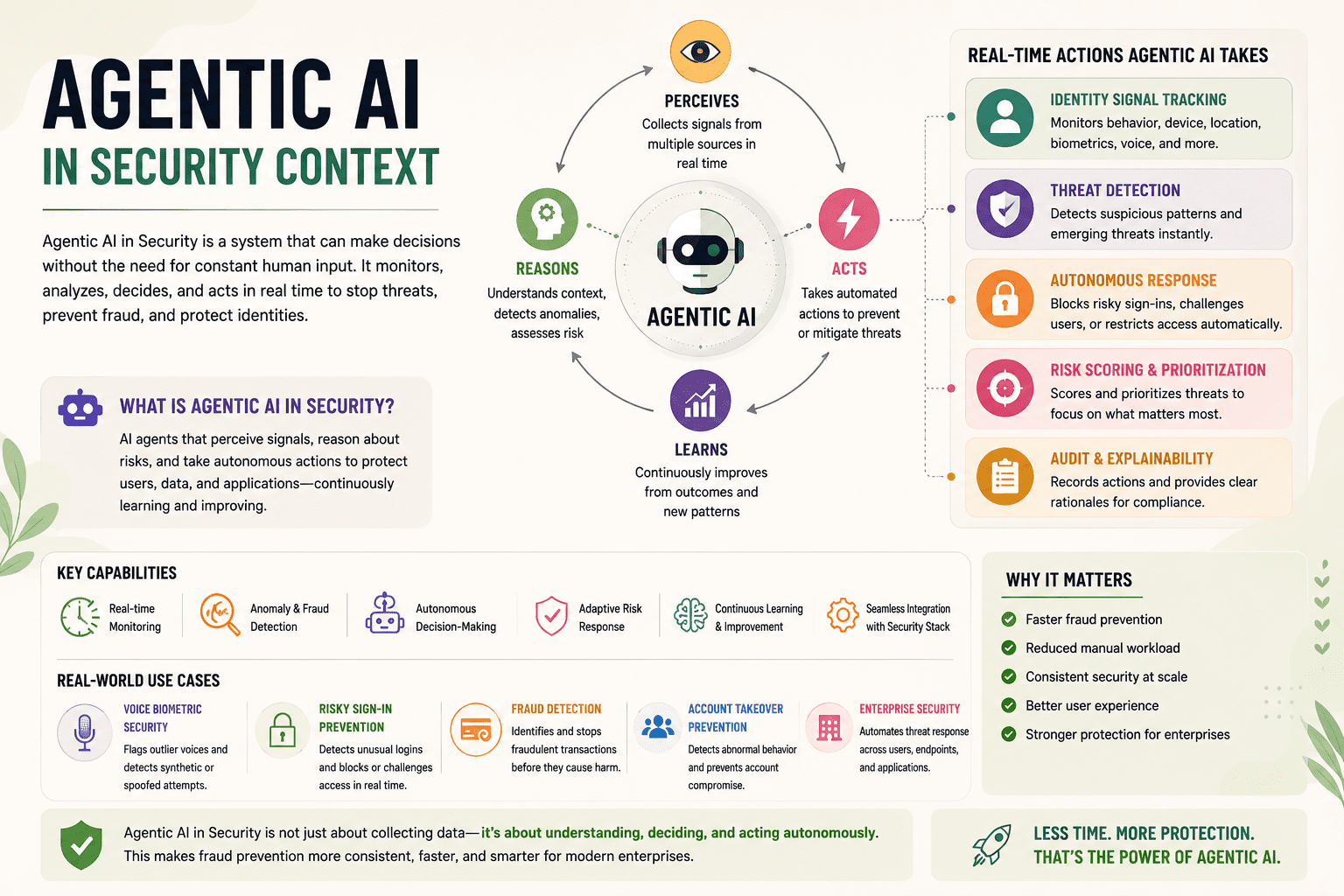
I have come to know Agentic AI in Security is a system that can make decisions without the need for constant human input. I was struck by the ability of these AI agents to track identity signals in real time and take action when they sense something suspicious. It is something that I began to see in fraud detection scenarios, where automated detection is more important than manual verification, because it takes less time.
I knew that in the identification verification space, Agentic AI can do tasks such as flagging outlier voices or preventing risky sign-ins. It isn’t only a data catcher; it takes action on it. This allows fraud prevention to be more consistent and quicker in enterprise security systems.
Pindrop and Anonybit Overview
To get a better understanding of how the two platforms work in the real world, I went there myself. Firstly, I took a look at Pindrop and found out that it mainly deals with voice intelligence and fraud prevention in call centers as well as customer authentication systems. It also seems that their focus is on the way voice is used to detect whether one is trying to impersonate someone or any other potential scams.
Pindrop uses voice recognition to detect fraud, while Anonybit employs decentralized biometrics to protect someone’s identity.
Real Use Case Scenarios
I pictured what these systems would look like in the real business. I looked at call centers in which attempts to commit fraud occur during the customer service phone call. In real time, Pindrop enables the detection of fake voices and suspicious activity.
I saw the banking systems implementing identity verification layers to preemptively verify identities before transactions. Anonybit enhances this by capturing biometric information when authenticating.
I also examined enterprise security automation, in which systems have to react immediately to threats. Both platforms are effective in cutting down on manual checks and boosting speed in the fraud prevention workflow.
Comparison Between Pindrop and Anonybit
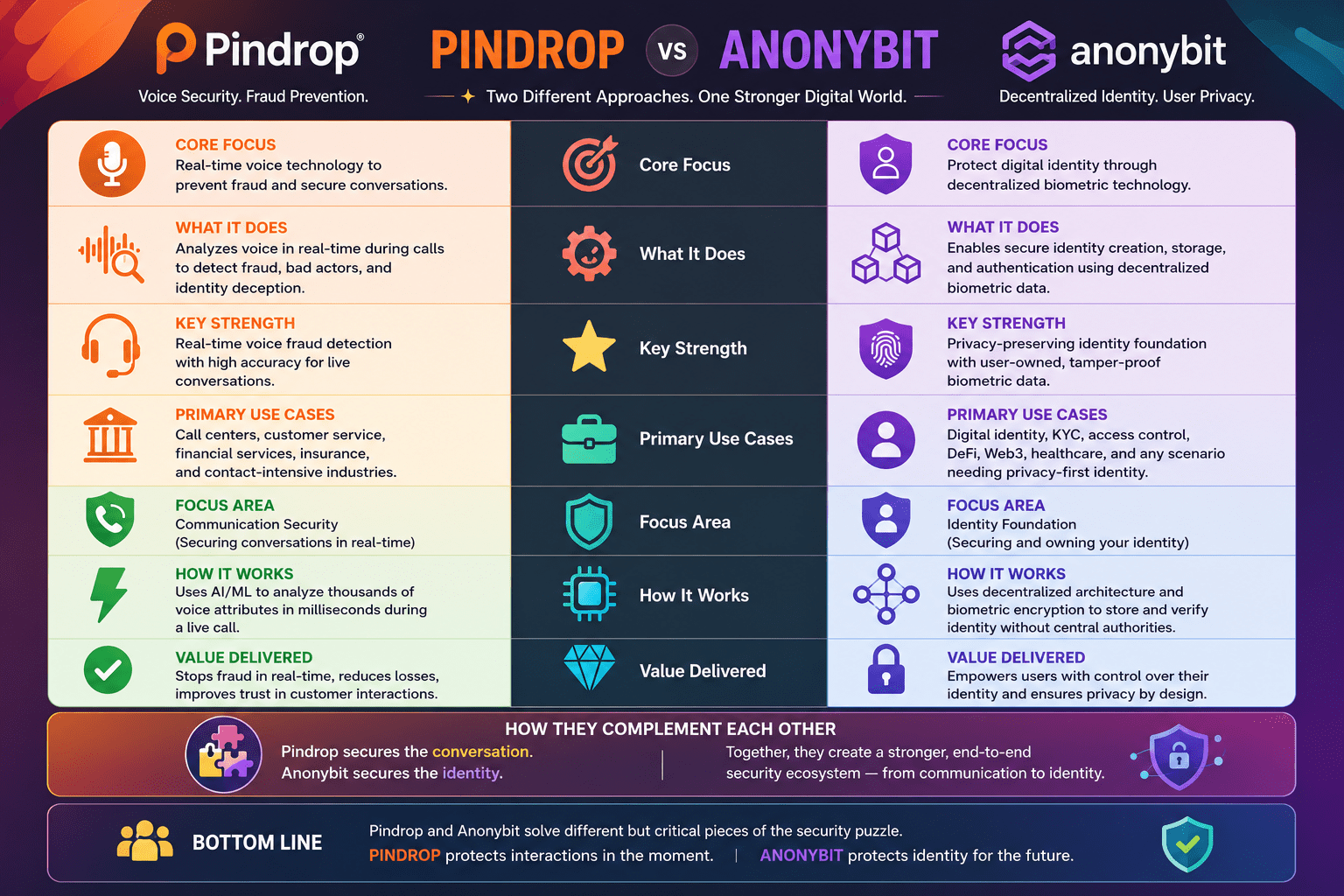
I researched to understand their work. Pindrop, mainly, is about using voice technology and preventing fraud. Anonybit wants to protect our identity mainly through decentralized biometric tech.
Real-time voice fraud detection is definitely Pindrop’s main strength, especially in the context of call centers. On the other hand, Anonybit is great at safe identity storage and privacy-based authentication.
Having cross-checked with use cases, I believe that Pindrop focuses more on communication security, while Anonybit is more about the foundation of identity. They both complement each other but are geared towards different elements of security.
Trust and Evidence Signals
I checked the usage of both platforms in the enterprise. I examined the adoption signals available for each of them in different sectors, like banking, insurance, customer support systems, etc. One of Pindrop’s use cases, which caught my attention, was a fraud detection where the component of real-time voice analysis is a crucial requirement.
Anonybit uses privacy-oriented identity systems for enterprise organizations that handle sensitive user information. I checked them out and found out that this is indeed the case. Both platforms seem to place a strong emphasis on security compliance and enterprise-grade deployments.
I also analyzed their market positioning and found out that they have been designed to serve as major security tools rather than consumer products.
Also Read- Ziply Fiber Review: My Real Experience With Speed and Reliability
Limitations and Risks
I was worried about how difficult it would be to implement these two systems. Observation: It is not simple to integrate it into the existing enterprise infrastructure; it requires technical resources.
I feel it is a bit complicated that these solutions require a lot of good data to be fed into them in order to produce the correct outcome. If there is not sufficient data, the detection capability can be impaired.
Besides that, I identified that there are cost issues, as enterprise AI security tools are not simple solutions. I was thinking that small companies might experience difficulties in the adoption. Another downside is that it depends on system tuning and continual updates to be able to combat new types of fraud.
Who Should Use It
I’ve seen that these systems are definitely geared towards enterprise areas. Banks, insurance companies, and large organizations with a high fraud risk are the best users.
Reviewed use cases in security teams & fraud prevention teams where real-time identity verification is essential. These teams can improve manual workload by leveraging automation.
I also thought perhaps this is over the top for smaller businesses. I don’t think that’s something that should be done unless it’s dealing with lots of financial or identity data.
These tools were designed for high-security situations, not for doing basic operations.
Unique Insights
I concluded that the greater change going on is not only fraud detection, but also autonomous security decision-making. Agentic AI transforms systems from reactive monitoring to proactive response.
I saw identity security is increasingly complex, with voice, biometrics, and behavioural signals all added in! This decreases the use of only one verification method.
I believe the security future is one of architecture based on identity, meaning systems are continually checking the identities, not just one time.
I see this change reflected in a couple of ways with both Pindrop and Anonybit, one being voice intelligence, the other being decentralized identity.
Final Verdict
I did a practical security review of both platforms. I noticed that they discuss major issues related to enterprises with regard to fraud detection and identity verification. Pindrop deals with detecting fraud through voice technology in real time. Anonybit focuses on protecting identity using decentralized biometric systems.
I believe both have strengths in their respective fields, but neither is an easy tool. I found them to be helpful for organisations that face high-risk identity threats. I saw that their true strength lies in scale, where automation and accuracy play a key role in security operations.
FAQs
What is Agentic AI in security?
It is AI that can make automated security decisions in real time without human input.
What does Pindrop do?
It detects fraud using voice intelligence and analyzes calls for suspicious activity.
What does Anonybit do?
It provides decentralized identity and biometric security for enterprise authentication.
Is this used in real enterprises?
Yes, these systems are used in banking, call centers, and enterprise security environments.