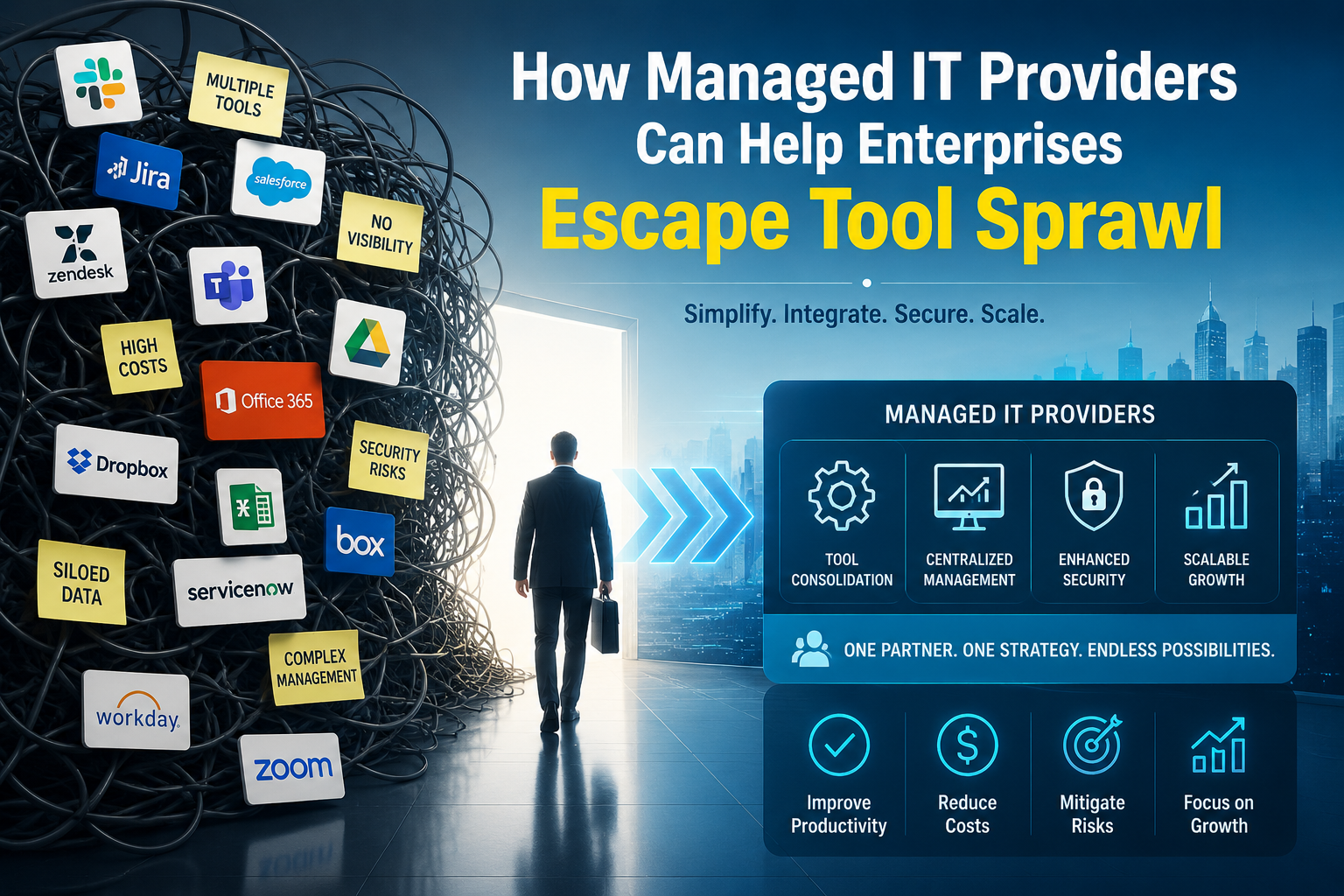
How Managed IT Providers Can Help Enterprises Escape Tool Sprawl
- 1 What Causes IT Tool Sprawl in Enterprise Environments?
- 2 The Hidden Costs of Too Many IT Tools
- 2.1 Alerts lose operational meaning
- 2.2 Asset records stop matching reality
- 2.3 Workflow ownership becomes unclear
- 2.4 Reporting becomes an argument about numbers
- 2.5 Exit costs keep weak products in place
- 3 Consolidation Should Start with Work, Not Product Names
- 4 A Managed IT Rationalization Model That Avoids Disruption
- 4.1 Rationalize the portfolio
- 4.2 Integrate around operational records
- 4.3 Assign ownership beyond administration
- 4.4 Consolidate reporting logic
- 5 How to Measure IT Tool Consolidation?
- 6 The Goal Is a Smaller Decision Surface
A tool earns its place when it removes work. Yet many enterprise IT estates now contain products that create more work around the work: another console to watch, another connector to maintain, another renewal to justify, and another data set that disagrees with the rest. Rippling’s 2025 IT operations research found that 90% of IT teams needed three or more tools simply to onboard one employee. BetterCloud also reported that 60% of IT teams were burdened by excessive manual work. The issue is no longer the number of products alone. It is the operational tax created between them.
That tax is the clearest sign of IT tool sprawl. It appears when monitoring, endpoint management, ticketing, security, asset records, and reporting systems grow through separate buying decisions. Each purchase may solve a valid problem. Together, they can produce duplicate alerts, incomplete records, conflicting priorities, and blurred accountability.
Managed IT providers can help because they see the operating system around the tools, supported by managed IT services that simplify monitoring, support, assets, reporting, and accountability. Their job should extend beyond administering products. They should determine which systems deserve to remain, which should connect, which should retire, and who owns the decisions generated by the remaining estate.
What Causes IT Tool Sprawl in Enterprise Environments?
Most technology estates do not become crowded through one poor procurement cycle. They accumulate in layers.
A service desk adds discovery because the asset database is unreliable. Security buys another endpoint product. Infrastructure adopts separate cloud monitoring. Business units purchase reporting tools because central reports arrive too late. Acquisitions bring additional ticketing, identity, and backup systems.
This is how IT operations fragmentation takes hold. Different functions fund different products, so no single leader sees the full cost or interaction burden.
Five areas usually show the first signs:
- Monitoring: Separate tools watch infrastructure, applications, logs, and user experience.
- Endpoint management: Inventory, patching, deployment, remote support, and security rely on different agents.
- Ticketing: Internal teams and vendors maintain separate queues and records.
- Security: Identity, endpoint, email, vulnerability, and event products generate overlapping findings.
- Reporting: Teams export data because source systems cannot present a trusted operational view.
A strong product list means little when the connections fail.
The Hidden Costs of Too Many IT Tools
The first visible cost is licensing. It is rarely the largest one.
The higher cost sits in administration, integration, alert review, access management, reporting, and handoffs. A cheap product can still be expensive when it adds another queue, agent, taxonomy, and support contract.
Alerts lose operational meaning
Two systems may detect the same server issue while a third reports the application impact. Without correlation rules, teams receive three signals and no shared context.
This makes IT tool sprawl an attention problem. Engineers spend time proving that alerts are related before they can address the underlying fault. Alert volume rises while decision quality falls.
Asset records stop matching reality
One console lists a laptop as active. Another shows it as unpatched. The service desk assigns it to a former employee, while finance still carries the license.
These mismatches weaken enterprise IT visibility. During an audit or incident, reconciliation begins when evidence is already needed.
Workflow ownership becomes unclear
Tools often automate a technical step without defining who owns the outcome. A scanner opens a ticket, infrastructure receives it, another team owns the application, and a vendor owns the server. Nobody owns the complete remediation path.
The failure sits between systems and teams. Adding another product usually adds another handoff.
Reporting becomes an argument about numbers
Leadership reports often combine exports from ticketing, monitoring, endpoint, and security systems. Different time periods, severity definitions, identifiers, and closure rules can make a precise dashboard fundamentally inconsistent.
This is one of the most damaging effects of IT tool sprawl. Senior leaders may approve budgets, risk exceptions, or staffing changes using metrics that cannot be traced to a common operational model.
Exit costs keep weak products in place
A redundant product can survive because dependencies are unclear. Integrations may be undocumented, reports may rely on their fields, and historical records may require retention. Renewal feels safer than investigation.
Consolidation Should Start with Work, Not Product Names
A rushed consolidation program often begins with a vendor reduction target. It can remove licenses while preserving broken workflows.
Effective managed IT tool consolidation starts with operational work. The provider maps how incidents, changes, vulnerabilities, patches, assets, and reports move from signal to closure. Products are then assessed against those flows.
| Review area | What to examine | Decision test |
| Operational purpose | The specific work the product performs | Does another approved system perform the same work well enough? |
| Data authority | Records created, updated, and consumed | Is this system the trusted source for a critical field? |
| Workflow position | Alerts, tickets, approvals, and actions exchanged | Would removal break a control or remove duplication? |
| Operating burden | Admin effort, agents, integrations, training, and support | Does the product remove more effort than it creates? |
This method protects useful specialist tools. It also exposes products that survive through familiarity rather than operational value.
A Managed IT Rationalization Model That Avoids Disruption
A managed IT provider should treat rationalization as a controlled service improvement program with four connected parts.
Rationalize the portfolio
Build a verified register of tools, owners, contracts, agents, integrations, data types, and renewal dates. Procurement records miss free tools, bundled modules, inherited systems, and business-led purchases.
Each product can then be classified:
- Retain: It has a defined purpose, active use, and accountable ownership.
- Replace: Its function is required, though another approved platform can perform it with less operating burden.
- Integrate: It remains useful but needs reliable data exchange with core systems.
- Retire: Its function is duplicated, unused, unsupported, or no longer tied to a business control.
- Contain: It must remain temporarily because of contractual, technical, or regulatory constraints.
This classification turns IT tool sprawl into a sequence of decisions rather than a broad cleanup campaign.
Integrate around operational records
Integration should follow the records that matter most. Asset identity, service ownership, user identity, incident status, vulnerability state, and change history need consistent identifiers.
The objective is to create dependable paths between systems that detect, decide, act, and prove.
An endpoint finding, for example, should carry the device identifier, assigned user, business service, severity, owner, and closure evidence into the service workflow.
Assign ownership beyond administration
Every retained product needs three owners:
- A business owner who approves the purpose and spending.
- A service owner who is accountable for the process supported by the product.
- A technical owner who maintains configuration, access, integrations, and product health.
One person may hold multiple roles, though each role must remain explicit. Technical administration alone does not establish accountability for outcomes.
This ownership model also limits future IT tool sprawl. New purchases must state the supported service, the controlled record, the replaced capability, and the person reviewing the continued value.
Consolidate reporting logic
Reporting consolidation does not require one giant dashboard. It requires one metric definition for each management question.
Each management metric should have a documented source, formula, scope, refresh cycle, and owner.
This creates enterprise IT visibility that leaders can trust. It also allows specialists to keep detailed consoles while management receives consistent service-level reporting.
How to Measure IT Tool Consolidation?
The success of managed IT tool consolidation should not be reduced to a count of retired products. Fewer products can still leave poor workflows in place.
Measure operational movement instead:
| Measure | What improvement indicates |
| Duplicate alert rate | Better event correlation and fewer repeated investigations |
| Ticket reassignment rate | Clearer routing and service ownership |
| Asset reconciliation effort | More consistent identifiers and records |
| Agent count per endpoint | Lower endpoint overhead and fewer control conflicts |
| Manual report preparation time | Better data flow and common metric definitions |
| Renewal exceptions | Stronger product ownership and review discipline |
| Time from detection to assigned action | Faster movement from signal to accountable response |
These measures show whether operations improved and where IT operations fragmentation remains.
The Goal Is a Smaller Decision Surface
Enterprises do not need the fewest possible tools. They need the fewest interfaces, handoffs, and conflicting records required to run IT safely.
A specialist security or monitoring product may deserve its place because it improves detection or control. Trouble starts when its findings enter a disconnected process, its data cannot be reconciled, or ownership ends at the console.
Managed IT providers can reduce IT tool sprawl by treating the estate as an operating model. They can connect procurement to service workflows, assign accountable owners, and retire products without removing needed controls.
The final test is simple: when a material issue appears, can the enterprise identify the affected service, confirm the responsible owner, see the current risk, assign the next action, and report the outcome from a trusted record?
If the answer requires five consoles and a spreadsheet, the tools are still running the operation.