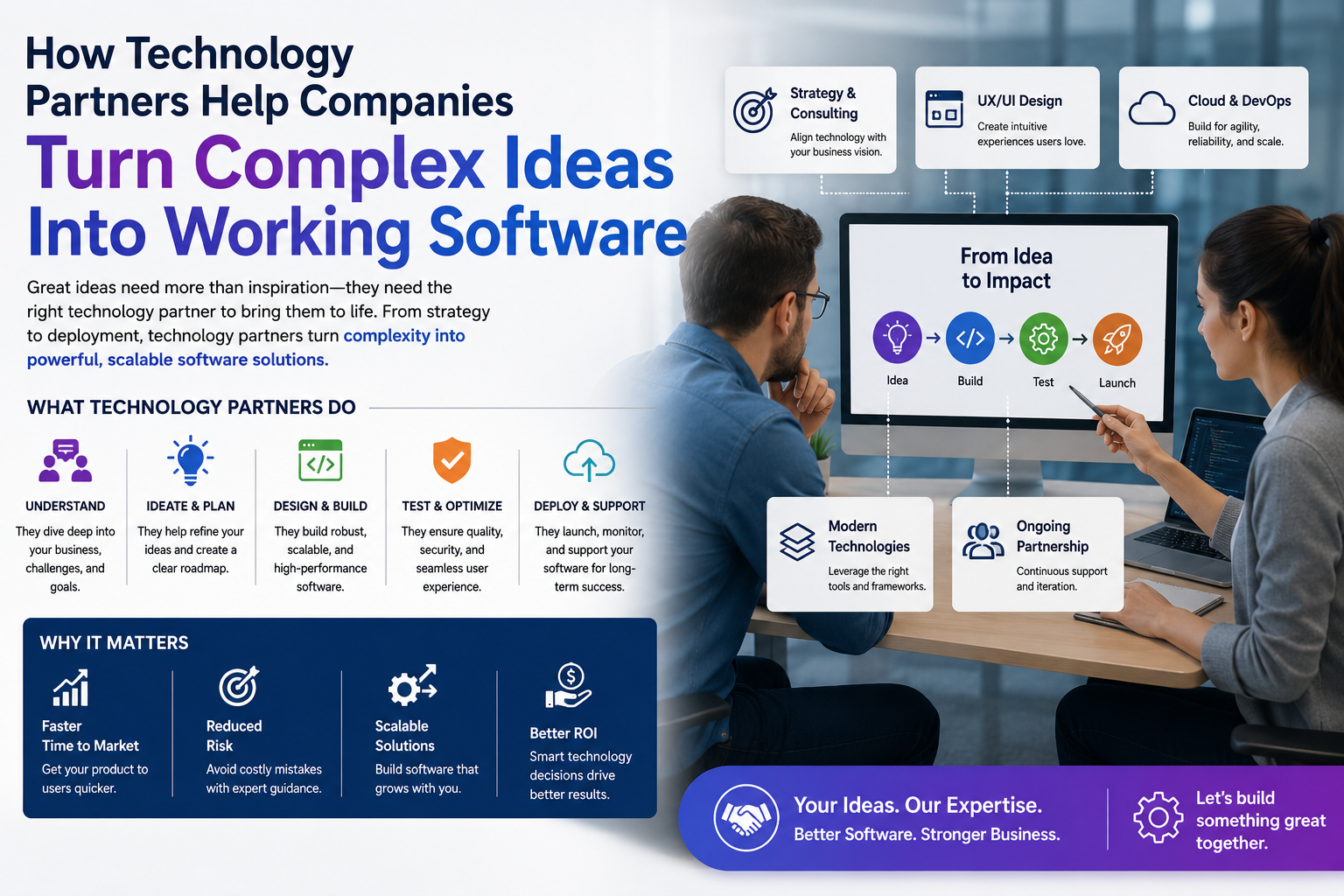
How Technology Partners Help Companies Turn Complex Ideas Into Working Software
- 1 The Strategic Limits of Transactional Engineering
- 1.1 Cultivating Product Architecture for Long-Term Scale
- 1.2 Navigating the Selection Process for Enterprise-Grade Collaboration
- 1.2.1 Rigorous Evaluation of Tech Stack Alignment
- 1.2.2 Establishing Structured Communication Protocols
- 1.2.3 Ensuring Absolute Cost and Process Transparency
- 1.2.4 Setting Up Long-Term Post-Launch Maintenance
- 1.3 Maximizing Operational Efficiency with Microservices
- 1.4 Sustaining Competitive Momentum in Distributed Markets
- 1.5 Aligning Quality Culture with Commercial Realities
Bringing a sophisticated software platform to market is a complex journey fraught with structural risks. For modern business founders and enterprise technology leaders, the primary challenge is rarely a shortage of innovative ideas. The real friction lies in execution, specifically the process of translating high-level product visions into stable, secure, and scalable production environments.
Many organizations approach this challenge with a purely transactional mindset, treating software delivery as a basic utility that can be outsourced to the lowest-bidding code contractor. This approach often results in a profound misalignment between technical architecture and true corporate objectives. A standard code vendor or generic software development company focuses exclusively on completing assigned tickets, regardless of whether those features add actual business value. To successfully navigate the modern marketplace, companies require a true technology partner capable of providing technical validation, resource prioritization, and architectural foresight from day one.
The Strategic Limits of Transactional Engineering
A strategic software partner acts as an extension of your internal leadership team, analyzing your technical roadmap through a commercial lens. They help identify hidden database dependencies, evaluate API integration risks, and simulate potential user-scale bottlenecks long before the first lines of backend code are committed to repositories. This proactive discovery work ensures that development investments are channeled into high-impact capabilities rather than complex features that look excellent on presentation wireframes but strain infrastructure performance.
Cultivating Product Architecture for Long-Term Scale
A major point of failure in modern enterprise tech initiatives is the deep disconnect between high-level corporate strategy and foundational database design. Executive teams often plan product roadmaps for years without realizing that their existing legacy software layers cannot support those future workloads.
Engaging a specialized software development team at a premier software development company provides the deep architectural foresight needed to bridge this operational divide. As the SoftDoes engineering team notes: “Reliability and scalability are not features you add later. They must be engineered into the foundation of any system that will serve tens or hundreds of locations simultaneously.” This sophisticated design approach ensures that your underlying infrastructure can adapt smoothly to future business models, new market entries, and sudden spikes in user transaction velocity without requiring a complete system rewrite every few years.
Navigating the Selection Process for Enterprise-Grade Collaboration
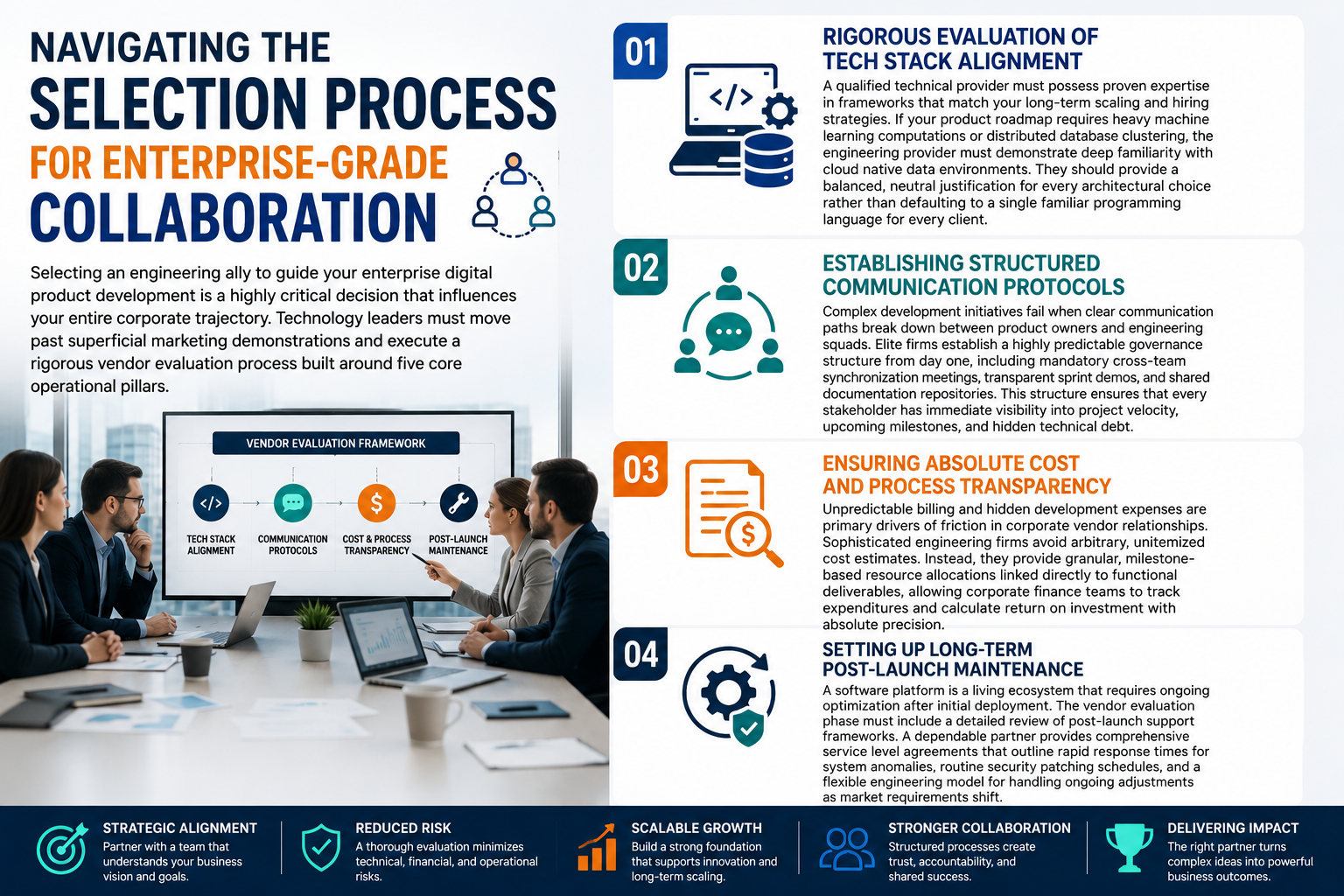
Selecting an engineering ally to guide your enterprise digital product development is a highly critical decision that influences your entire corporate trajectory. Technology leaders must move past superficial marketing demonstrations and execute a rigorous vendor evaluation process built around five core operational pillars.
Rigorous Evaluation of Tech Stack Alignment
A qualified technical provider must possess proven expertise in frameworks that match your long-term scaling and hiring strategies. If your product roadmap requires heavy machine learning computations or distributed database clustering, the engineering provider must demonstrate deep familiarity with cloud native data environments. They should provide a balanced, neutral justification for every architectural choice rather than defaulting to a single familiar programming language for every client.
Establishing Structured Communication Protocols
Complex development initiatives fail when clear communication paths break down between product owners and engineering squads. Elite firms establish a highly predictable governance structure from day one, including mandatory cross-team synchronization meetings, transparent sprint demos, and shared documentation repositories. This structure ensures that every stakeholder has immediate visibility into project velocity, upcoming milestones, and hidden technical debt.
Ensuring Absolute Cost and Process Transparency
Unpredictable billing and hidden development expenses are primary drivers of friction in corporate vendor relationships. Sophisticated engineering firms avoid arbitrary, unitemized cost estimates. Instead, they provide granular, milestone-based resource allocations linked directly to functional deliverables, allowing corporate finance teams to track expenditures and calculate return on investment with absolute precision.
Setting Up Long-Term Post-Launch Maintenance
A software platform is a living ecosystem that requires ongoing optimization after initial deployment. The vendor evaluation phase must include a detailed review of post-launch support frameworks. A dependable partner provides comprehensive service level agreements that outline rapid response times for system anomalies, routine security patching schedules, and a flexible engineering model for handling ongoing adjustments as market requirements shift.
Maximizing Operational Efficiency with Microservices
Maintaining long-term commercial relevance requires a constant willingness to modernize legacy applications and embrace decoupled infrastructure patterns. According to deep industry breakdowns featured on platforms like ZDNET, enterprise systems minimize operational failure rates by validating their core technical blueprints early in the design phase.
Transitioning from monolithic applications toward containerized microservices allows modern engineering teams to deploy software updates smoothly without causing service disruptions. This agility enables organizations to roll out newly prioritized features in days rather than quarters.
- Decoupled Architecture Benefits: Modifying individual modules independently reduces the risk of cascading platform errors.
- Resource Optimization: Infrastructure capacity scales automatically based on real-time load demands, saving substantial cloud compute costs.
- Seamless API Ecosystems: Decoupled frameworks simplify integrations with modern customer relationship platforms and external finance networks.
Sustaining Competitive Momentum in Distributed Markets
The business landscape continues to shift toward highly distributed operations, requiring software ecosystems that support multi-site data consistency and low-latency performance across various regions. A generic, off-the-shelf business software package cannot adapt to the intricate operational rules of a growing, multi-location organization.
As detailed technical analyses published by VentureBeat illustrate, the enterprises dominating the modern landscape are those that treat software delivery as a core strategic asset rather than a background overhead cost. Designing systems built around how your personnel actually execute their daily tasks eliminates the internal workflow friction caused by rigid, unyielding platforms.
Ultimately, an innovative digital concept is only as strong as the technology partner tasked with building its underlying architecture. By collaborating with an experienced engineering firm that understands the delicate balance between technical debt and market velocity, business leaders can transform complex ideas into robust, sustainable software platforms that accelerate enterprise growth for decades to come.
Also Read- Is the Lenovo Tab M9 Worth It? Honest Review After Extensive Testing
Aligning Quality Culture with Commercial Realities
A brilliant platform concept that experiences regular downtime or compromises user data security is a severe corporate liability. This reality highlights why elite tech firms embed thorough quality control and continuous integration frameworks directly into every single sprint cycle rather than treating validation as a final checklist item before launch.
Experienced technology leaders recognize that sophisticated enterprise ecosystems feature countless multi-user dependencies that basic automated test scripts cannot fully validate. A dedicated quality engineering specialist acts as a vital guardian of the digital experience, building complex real-world testing scenarios that push the software platform to its absolute performance limits. They uncover edge cases, access management flaws, and integration friction points before they impact live production environments, safeguarding customer satisfaction from day one.