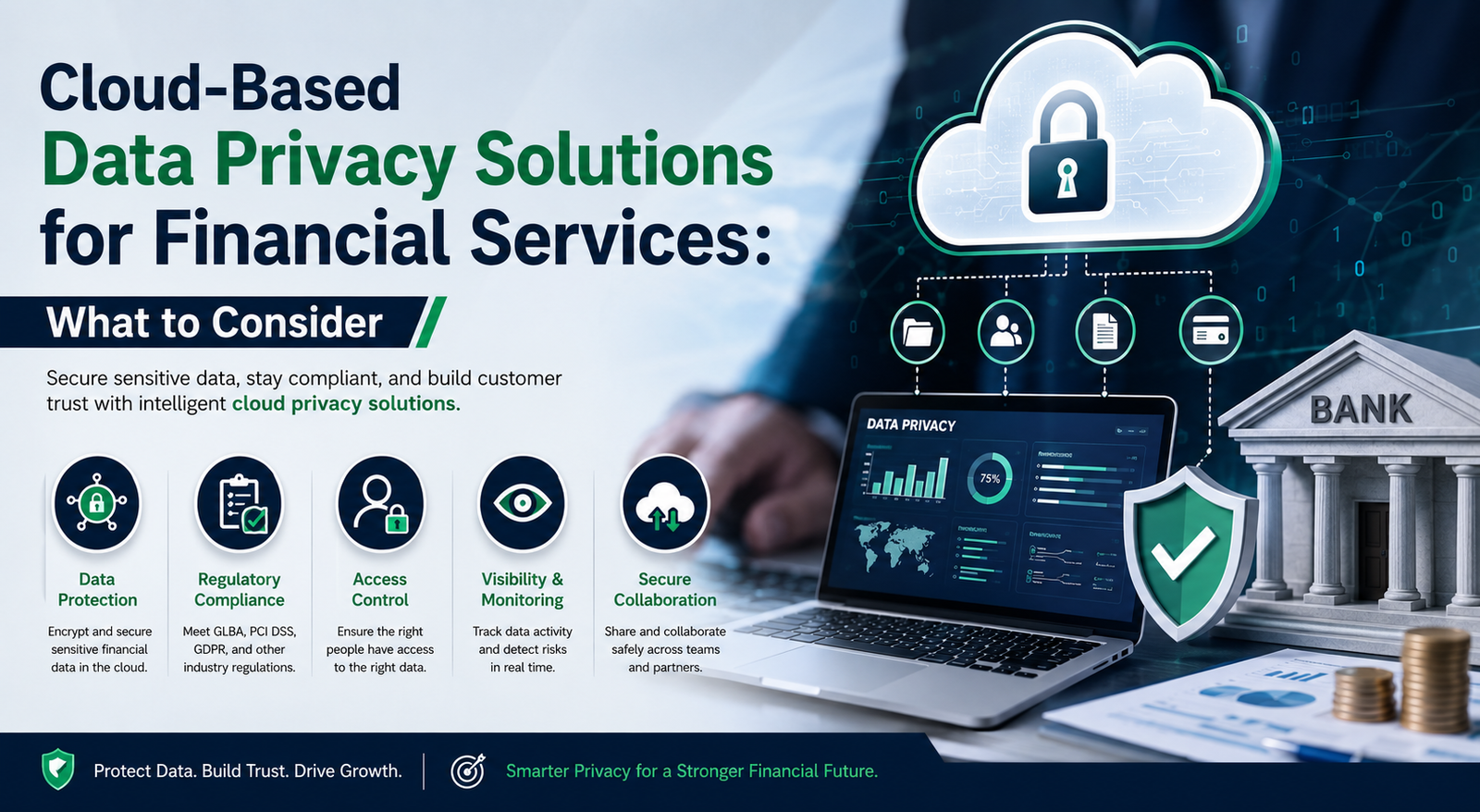
Cloud-Based Data Privacy Solutions for Financial Services: What to Consider
- 1 Why Cloud-Based Data Privacy Matters
- 1.1 Regulatory Compliance Is More Complex Than Ever
- 1.2 Balancing Speed and Governance
- 1.3 Automated PII Discovery
- 1.4 Contextual Access Permissions
- 1.5 Unified Audit Trails
- 2 Essential Features to Look for
- 2.1 End-to-End Encryption
- 2.2 Zero Trust Security
- 2.3 Data Classification
- 2.3.1 For example:
- 2.4 Threat Detection
- 2.5 Multi-Factor Authentication
- 2.6 The Benefits of Intelligent Cloud Privacy
- 2.6.1 Improved Productivity
- 2.6.2 Better Collaboration
- 2.6.3 Reduced Compliance Costs
- 2.6.4 Lower Security Risks
- 2.6.5 Greater Customer Trust
- 2.7 Best Practices for Financial Organizations
- 2.8 Looking Beyond Traditional Security
- 3 Conclusion
The financial services industry has experienced a major digital transformation over the past decade. Banks, insurance companies, investment firms, mortgage lenders, and fintech organizations increasingly rely on cloud platforms to improve collaboration, reduce infrastructure costs, and deliver faster customer service. While cloud adoption offers tremendous advantages, it also introduces new challenges related to data privacy, cybersecurity, and regulatory compliance.
Financial institutions handle highly sensitive information, including customer identities, account numbers, transaction histories, tax records, and investment portfolios. Protecting this information is no longer as simple as locking it behind the walls of an on-premises data center. Modern employees work remotely, collaborate through cloud applications, communicate over messaging platforms, and share files with clients and partners around the world. As a result, organizations must rethink how they secure data without slowing business operations.
Historically, protecting sensitive client data meant building high digital walls around a static, on-premises data center. If a file never left the building, it was deemed safe. To understand this shift, we have to look at the fragmented reality of how modern financial institutions operate. Data is no longer tucked away in neat, centralized databases. It lives in scattered email chains, Slack channels, collaborative cloud documents, and third-party loan processing apps.
Frankly, trying to secure this decentralized ecosystem with old-school, perimeter-based blockades is like putting a padlock on a screen door.
When institutions try to force outdated security protocols onto modern cloud workflows, they create a highly dangerous byproduct: employee friction. If a wealth manager needs to jump through six different authentication loops and wait forty-eight hours for IT clearance just to share a portfolio update with a high-net-worth client, they will find a workaround. They will export the data to a personal desktop, text it over an unencrypted app, or drop it into a consumer-grade cloud share. This is where things get complicated. By prioritizing heavy-handed, restrictive policies that stymie daily operations, security teams inadvertently drive sensitive records straight into the shadows.
Why Cloud-Based Data Privacy Matters
The shift to cloud computing has changed the way financial organizations manage information. Instead of storing files in a single physical location, data now moves across multiple cloud environments, employee devices, and third-party applications. While this flexibility supports productivity, it also increases the attack surface for cybercriminals.
Financial institutions are frequent targets of ransomware attacks, phishing campaigns, insider threats, and data breaches because they store valuable financial and personal information. A single breach can result in regulatory fines, reputational damage, financial losses, and reduced customer trust.
Cloud-based privacy solutions help organizations secure sensitive information while allowing employees to collaborate efficiently. Rather than blocking productivity, modern platforms integrate security directly into daily workflows.
Regulatory Compliance Is More Complex Than Ever
The financial sector remains caught in a persistent tension between short-term operational speed and long-term data governance. Many organizations lean heavily toward reactionary, short-term fixes—buying disconnected niche tools to address specific regulations like GLBA, NYDFS, or GDPR as they pop up, which only adds to the complexity and overhead.
This operational gridlock is exactly where Egnyte grounds its entire philosophy. Instead of forcing employees to alter how they work, the platform embeds intelligent monitoring directly into the fabric of the existing corporate workflow, making it easier than ever to maintain strict data privacy financial services standards without pulling the emergency brake on innovation.
Rather than relying on several disconnected security products, organizations benefit from a unified platform that automatically monitors sensitive data and helps satisfy evolving compliance requirements.
Balancing Speed and Governance
To actually make this happen, organizations must stop relying on manual checklists and adopt security solutions that protect information based on what the data contains rather than where it is stored.
Automated PII Discovery
Modern cloud privacy platforms automatically detect personally identifiable information (PII) such as Social Security numbers, bank account details, routing numbers, tax identification numbers, and credit scores the moment files are uploaded.
Once identified, the system can automatically classify the information, restrict access, and apply encryption policies before sensitive data is accidentally shared.
This proactive approach significantly reduces the chances of human error.
Contextual Access Permissions
Not everyone within an organization needs access to every document.
Cloud privacy platforms use contextual permissions to ensure employees, auditors, brokers, wealth advisors, and external partners only receive access to information relevant to their specific responsibilities.
Even better, permissions can automatically expire after a project ends, reducing unnecessary long-term exposure.
Unified Audit Trails
Financial organizations undergo regular compliance audits. Having detailed records of file activity simplifies this process.
Unified audit trails provide complete visibility into:
- Who opened a document
- Who downloaded a file
- Who edited sensitive information
- When changes occurred
- Which device accessed the data
When regulators request documentation, organizations can generate comprehensive reports within minutes instead of spending days collecting logs from multiple systems.
Essential Features to Look for
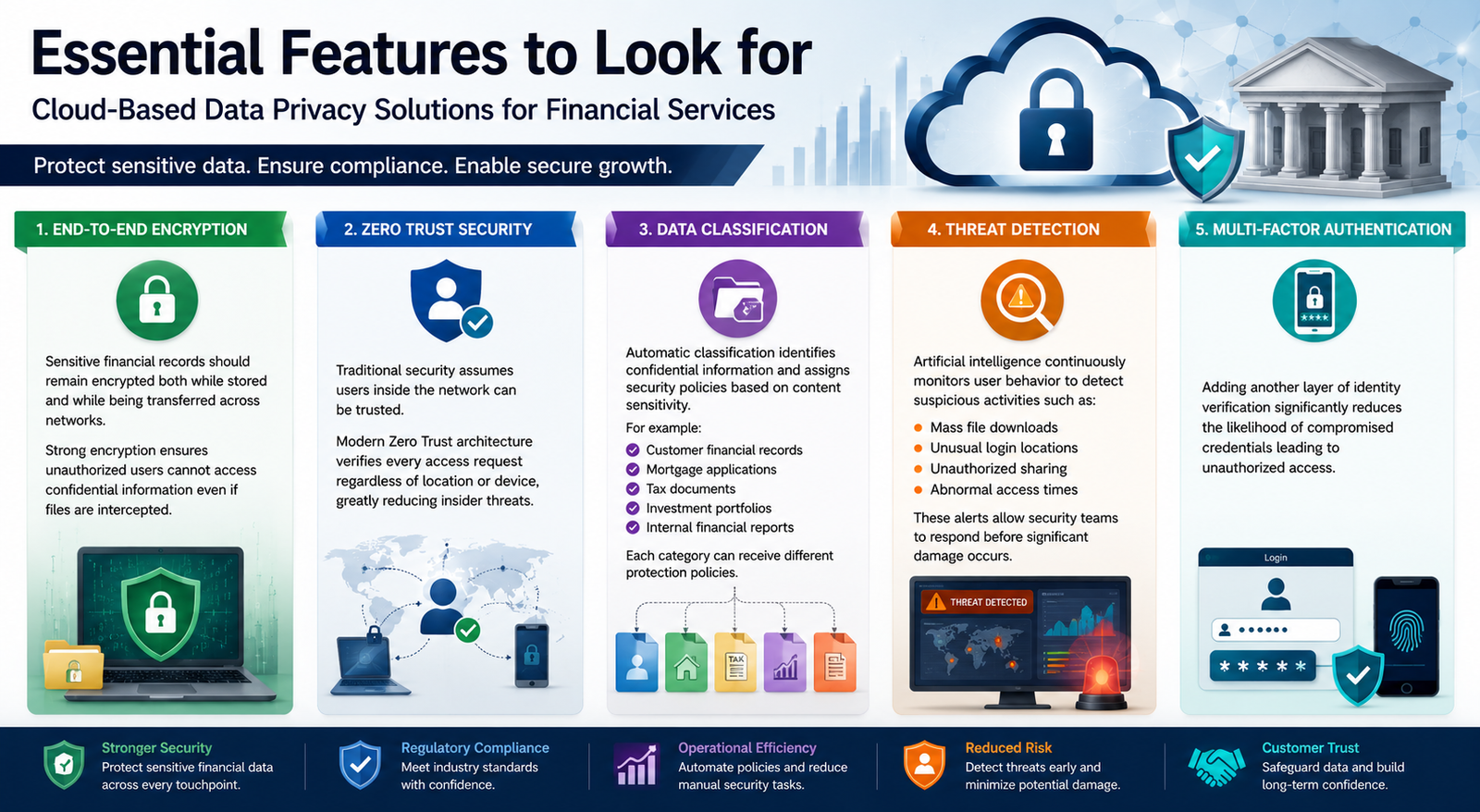
When evaluating cloud-based privacy solutions, financial institutions should prioritize platforms offering the following capabilities.
End-to-End Encryption
Sensitive financial records should remain encrypted both while stored and while being transferred across networks.
Strong encryption ensures unauthorized users cannot access confidential information even if files are intercepted.
Zero Trust Security
Traditional security assumes users inside the network can be trusted.
Modern Zero Trust architecture verifies every access request regardless of location or device, greatly reducing insider threats.
Data Classification
Automatic classification identifies confidential information and assigns security policies based on content sensitivity.
For example:
- Customer financial records
- Mortgage applications
- Tax documents
- Investment portfolios
- Internal financial reports
Each category can receive different protection policies.
Threat Detection
Artificial intelligence continuously monitors user behavior to detect suspicious activities such as:
- Mass file downloads
- Unusual login locations
- Unauthorized sharing
- Abnormal access times
These alerts allow security teams to respond before significant damage occurs.
Multi-Factor Authentication
Adding another layer of identity verification significantly reduces the likelihood of compromised credentials leading to unauthorized access.
The Benefits of Intelligent Cloud Privacy
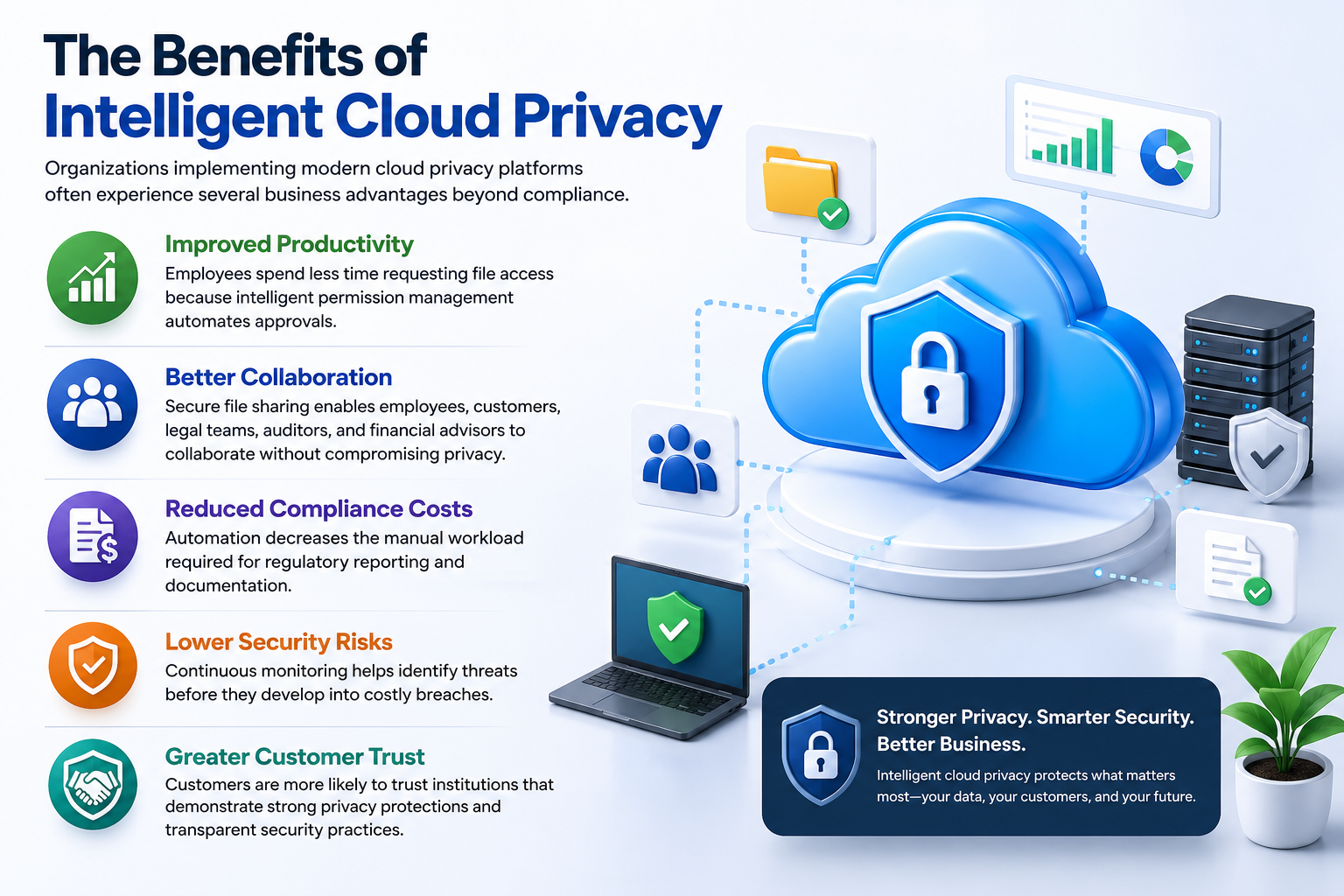
Organizations implementing modern cloud privacy platforms often experience several business advantages beyond compliance.
Improved Productivity
Employees spend less time requesting file access because intelligent permission management automates approvals.
Better Collaboration
Secure file sharing enables employees, customers, legal teams, auditors, and financial advisors to collaborate without compromising privacy.
Reduced Compliance Costs
Automation decreases the manual workload required for regulatory reporting and documentation.
Lower Security Risks
Continuous monitoring helps identify threats before they develop into costly breaches.
Greater Customer Trust
Customers are more likely to trust institutions that demonstrate strong privacy protections and transparent security practices.
Best Practices for Financial Organizations
To maximize the value of cloud privacy investments, organizations should also adopt several best practices.
- Train employees regularly on cybersecurity awareness.
- Limit user access according to job responsibilities.
- Monitor file-sharing activity continuously.
- Encrypt sensitive customer information.
- Review third-party vendor security practices.
- Conduct regular compliance assessments.
- Automate security policy enforcement whenever possible.
- Maintain detailed audit logs for regulatory reporting.
These practices strengthen overall security while supporting efficient day-to-day operations.
Also Read- AI vs. Cloud Vision: Architecting Low-Latency Visual Inspection Under Hardware Constraints
Looking Beyond Traditional Security
The thing is, choosing a cloud infrastructure isn’t about finding the absolute tightest digital vault. It’s about building a visibility layer that natively understands the lifecycle of a financial record.
Moving past localized patches means modern finance departments must adopt tools that integrate metadata classification directly into everyday work routines. By breaking free of the constraints of the old security-focused mindset, organizations can make themselves more resilient to regulatory fluctuations. With a more intelligent, contextual cloud environment, companies can cease to view file privacy as an impediment to corporate progress and instead turn conventional risk-assessment practices into an expected operational standard.
Organizations that embrace this modern approach gain not only stronger security but also greater agility, allowing them to innovate confidently while meeting evolving customer expectations.
Conclusion
Cloud technology has become essential for modern financial services, but its benefits come with increased responsibility. As data spreads across cloud platforms, collaboration tools, and third-party applications, traditional perimeter-based security models are no longer sufficient.
Financial institutions should prioritize cloud-based privacy solutions that combine automated data discovery, contextual access controls, unified auditing, encryption, and intelligent monitoring. These capabilities protect sensitive customer information while allowing employees to work efficiently without unnecessary obstacles.
Ultimately, successful cloud data privacy is not about restricting innovation—it’s about enabling secure collaboration, maintaining regulatory compliance, and building lasting customer trust in an increasingly digital financial landscape.