Cloud Application Security Best Practices: How to Protect Cloud Workloads and Data
- 1 What is Cloud Application Security?
- 2 Core Elements of Cloud Application Security
- 3 Cloud Application Security Best Practices
- 3.1 1. Focus on Security of Identities
- 3.2 2. Regular Vulnerability Scanning
- 3.3 3. Cloud Configurations
- 3.4 4. Never Stop Monitoring Cloud Activity
- 3.5 5. Always Ensure Compliance
- 4 Why Cloud Security Posture Management (CSPM) is Vital
- 5 Fidelis Halo® Cloud Security Application
- 6 Conclusion
The absence of physical infrastructure for businesses has meant an increase in operational scale, efficiency of inter-business collaboration, and faster deployment of business applications. However, issues associated with exposed APIs, broad permissions, and configuration errors pose new challenges for businesses. Risk is exacerbated by the complexity of cloud systems, resulting in the need for secure access, configuration, and persistent monitoring. This article provides you with the industry standards for Cloud application security.
What is Cloud Application Security?
Cloud application security is a set of policies and tools that implement security for cloud-hosted data and application workloads. Cloud application security is capable of securing environments hosted on public, private, and hybrid cloud systems. With a shared responsibility model, cloud application security can provide the following security for corporations:
- Protection of data and the prevention of unauthorized access
- Early detection of threats and the lessening of the effect of security breaches
- Security compliance with applicable regulations
Core Elements of Cloud Application Security
The following are necessary elements of comprehensive cloud security:
Identity and Access Management (IAM)
IAM (Identity and Access Management) allows the restriction of access to cloud services and the moderation of what can be done therein. Limiting permissions reduces the likelihood of either illegal access or accidental disclosure of information.
Some practices that constitute good IAM are:
- Role-based access control (RBAC)
- Application of the least privilege policy
- Multi-factor authentication (MFA)
- Periodic audits for the purpose of removing permissions that are no longer needed
Data Encryption
To be moved or stored, sensitive data must be protected with encryption.
- Data in cloud storage that is at rest
- Data that is in transit between applications and users
- Sensitive workloads
Organizations need to consider encrypting as much of their data as is possible.
Attacks do not render data that is encrypted useless, as attackers cannot read or use the data without the encryption keys.
Threat Monitoring and Detection
Cloud data is in constant flux with the addition of new workloads, users, and services. This necessitates the need for constant visibility.
Security teams need to monitor:
- Unusual user activity
- Suspicious network traffic
- Configuration changes
- Unapproved access attempts
- Indicators of compromise
Automated threat detection, when used along with constant monitoring, allows security teams to identify and mitigate threats.
Cloud Application Security Best Practices
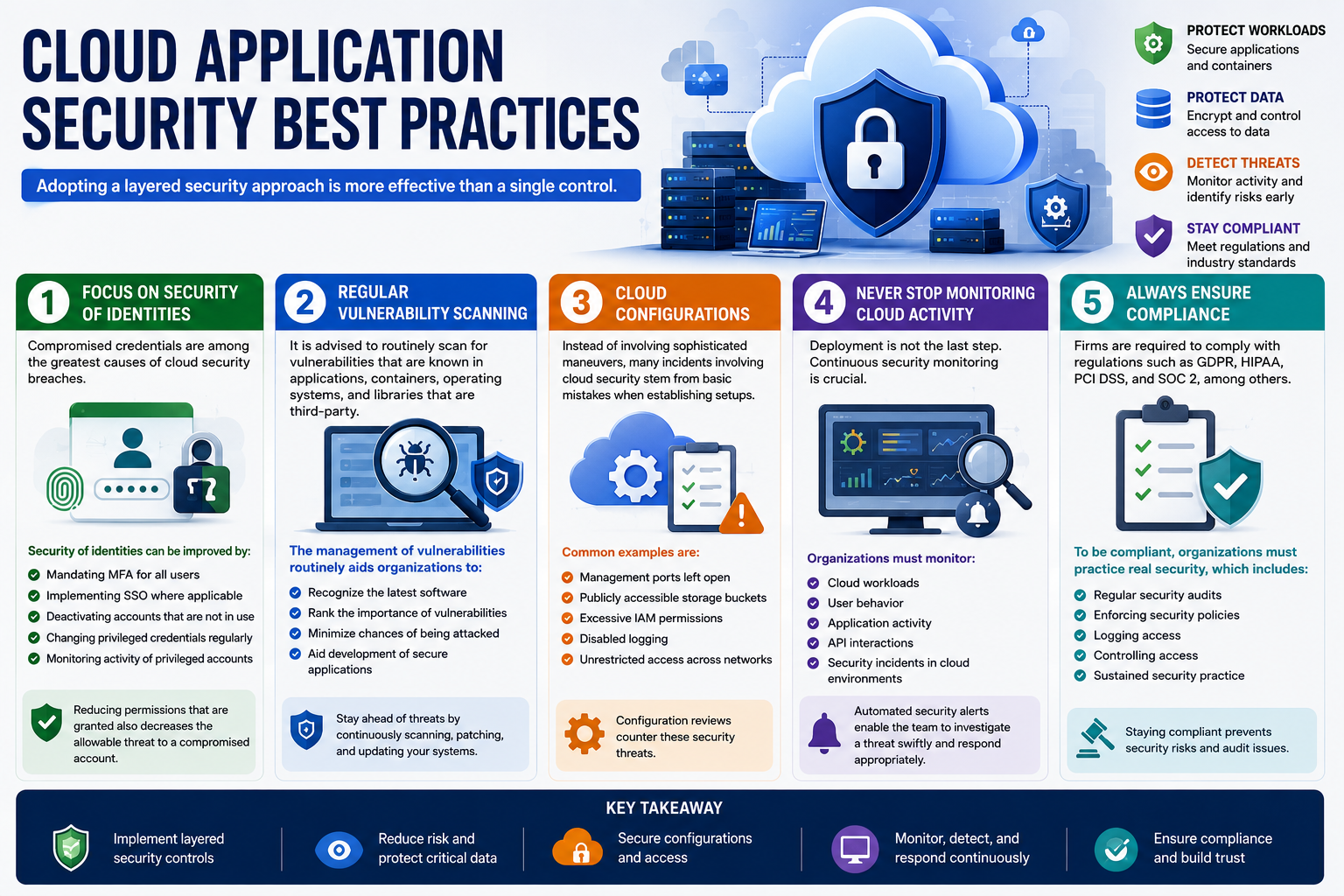
Adopting a layered security approach is more effective than a single control.
1. Focus on Security of Identities
Compromised credentials are among the greatest causes of cloud security breaches.
Security of identities can be improved by:
- Mandating MFA for all users
- Implementing SSO where applicable
- Deactivating accounts that are not in use
- Changing privileged credentials regularly
- Monitoring activity of privileged accounts
Reducing permissions that are granted also decreases the allowable threat to a compromised account.
2. Regular Vulnerability Scanning
It is advised to routinely scan for vulnerabilities that are known in applications, containers, operating systems, and libraries that are third-party.
The management of vulnerabilities routinely aids organizations to:
- Recognize the latest software
- Rank the importance of vulnerabilities
- Minimize chances of being attacked
- Aid development of secure applications
3. Cloud Configurations
Instead of involving sophisticated maneuvers, many incidents involving cloud security stem from basic mistakes when establishing setups.
Common examples are:
- Management ports left open
- Publicly accessible storage buckets
- Excessive IAM permissions
- Disabled logging
- Unrestricted access across networks
Configuration reviews counter these security threats.
4. Never Stop Monitoring Cloud Activity
Deployment is not the last step. Continuous security monitoring is crucial.
Organizations must monitor:
- Cloud workloads
- User behavior
- Application activity
- API interactions
- Security incidents in cloud environments
Automated security alerts enable the team to investigate a threat swiftly and respond appropriately.
5. Always Ensure Compliance
Firms are required to comply with regulations such as GDPR, HIPAA, PCI DSS, and SOC 2, among others. To be compliant, organizations must practice real security, which includes:
- Regular security audits
- Enforcing security policies
- Logging access
- Controlling access
- Sustained security practice
Staying compliant prevents security risks and audit issues.
Why Cloud Security Posture Management (CSPM) is Vital
As cloud security systems expand, the challenge of supervising security manually increases. Organizations may monitor system security continuously, enforce security policies across platforms, and identify security threats with Cloud Security Posture Management (CSPM).
A comprehensive CSPM system should be capable of:
- Identifying security misconfigurations
- Automated compliance evaluations
- Remediation of security threats
- Enforcing security and access policies
A CSPM system enhances the security of an organization, promotes efficiency, and lowers security risks.
Also Read- 7 Best Residential IP VPN Services for Home Users: Secure Static IP Picks
Fidelis Halo® Cloud Security Application
A cloud security application must contain the ability to monitor continuously, assess risk automatically, and offer complete visibility across all cloud offerings.
With a single cloud security platform, Fidelis Halo® helps businesses safeguard their multi-cloud and hybrid environments.
Some of its key features include:
- The ability to see cloud tools, workloads, servers, and containers.
- Ongoing evaluation of cloud security.
- Compliance checks and reporting done automatically.
- Finding cloud misconfigurations and security threats.
- Working with hybrid and multi-cloud environments.
- Automating the fix to save hands-on time.
The security teams, with the continued checks and monitoring, are able to strengthen their security and find threats faster with the centralized view.
Conclusion
Cloud security is difficult and becoming more difficult. Even though businesses rely on the cloud to store data and run operations, the rapid increase of IT resources available on the Internet presents all kinds of risks to information security. These include data theft, improper access, data breaches, as well as fines and penalties from government agencies due to not abiding by the terms of service in contracts pertaining to data storage. Organizations rely on the Internet to run operations and store data. In response, organizations use stronger methods of control to improve the security of sensitive data and to mitigate threats from improper access and victimization of security breaches.
Cloud security posture management (CSPM) provides the ability to identify and assess risk and threats. CSPM helps develop methods to correct and prevent exposure from the cloud. Misconfigurations, violations, and threats to security may go unchecked and unmonitored. CSPM continuously reviews the secure state of the cloud and helps organizations take a more proactive, preventative, and protective approach to the security of their cloud.
Continuous evaluation and monitoring provide strong and secure operations. Businesses can meet their security goal of reliability and safeguard their most valued assets: their customers.