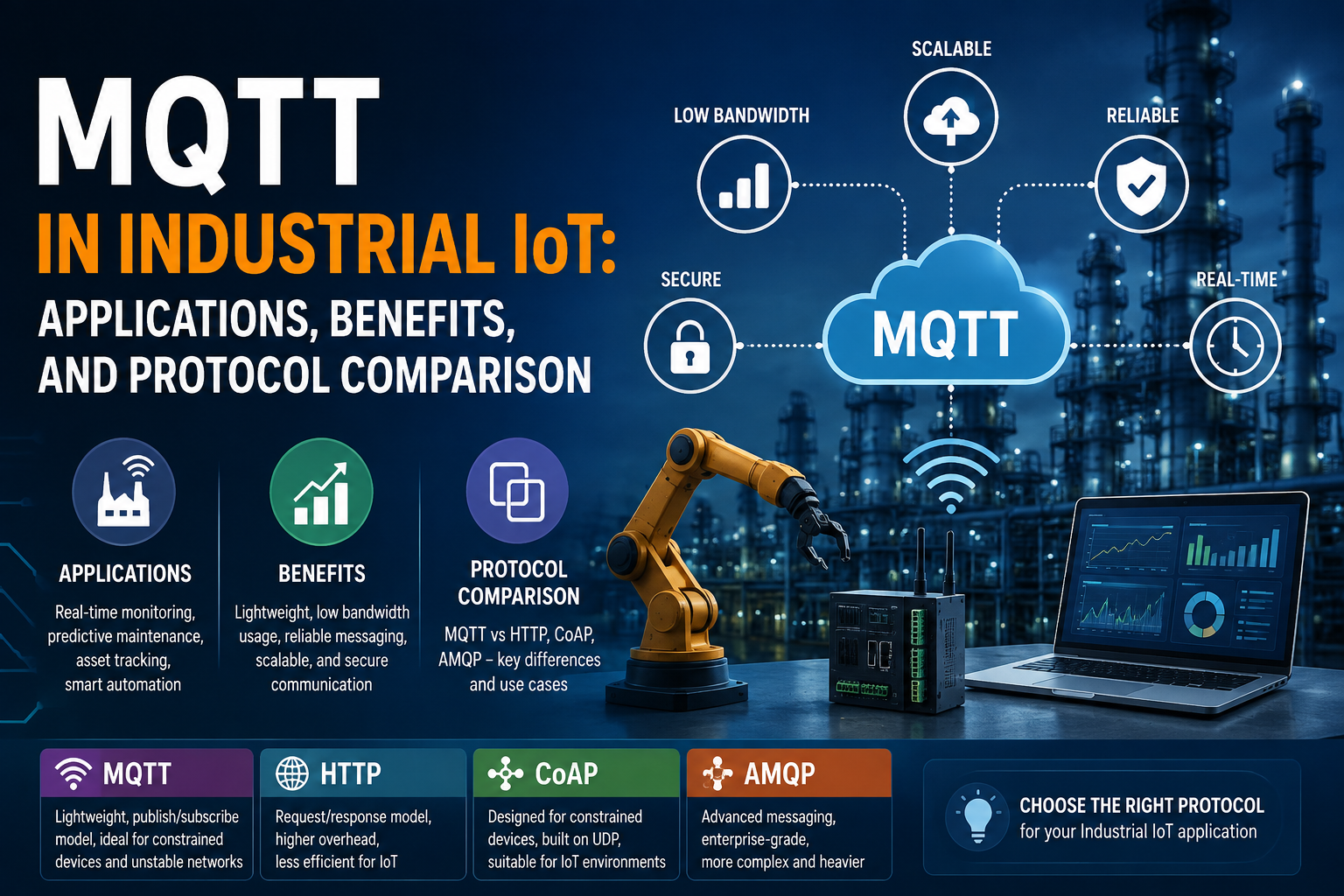
MQTT in Industrial IoT: Applications, Benefits, and Protocol Comparison
MQTT is a messaging protocol widely used in industrial IoT for its lightweight design, efficiency, and ability to support reliable machine-to-machine communication. As factories modernize, the choice of communication protocol, such as MQTT, impacts productivity, integration, and overall automation strategies. Understanding MQTT’s strengths and how it differs from alternatives is key for engineers and decision-makers in today’s factories.
Industrial environments are adopting MQTT to streamline data transfer between devices, sensors, and platforms. The way MQTT facilitates low-latency, secure, and scalable communication has made it particularly attractive for factory automation. Comparing MQTT vs opc ua highlights how protocol selection shapes data flow, interoperability, and the ability to adapt to future technology shifts. For some teams, MQTT vs OPC UA frames early architectural decisions when planning new lines or retrofits. Examining these aspects helps manufacturers make informed investments and future-proof their operations.
Core applications of MQTT in factory operations
MQTT enables devices such as sensors, programmable logic controllers, and gateways to exchange information quickly across factory environments. Its publish-subscribe model allows machines and supervisory systems to connect efficiently, reducing delays and simplifying network management. Factories use MQTT to relay process status, alerts, and telemetry across production lines, supporting real-time monitoring and responsive control.
The protocol is well suited for large-scale deployments and environments where device resources or network bandwidth are limited. By optimizing message exchange, MQTT ensures that even equipment with minimal computing power can reliably participate in industrial IoT networks. This adaptability extends to integration with cloud analytics and edge processing, promoting seamless data flow for advanced automation.
Benefits and strengths of MQTT in industrial settings
Compared to traditional client-server protocols, MQTT’s lightweight footprint minimizes bandwidth usage and lowers processing demands. This trait allows it to operate efficiently in factories that require scalable integration across many machines and sensors. MQTT’s flexibility supports high-frequency data transmission, making it ideal for applications where real-time feedback and rapid event detection are critical.
Reliability features such as Quality of Service (QoS) levels, automatic reconnection, and message buffering increase confidence in uninterrupted data delivery. Security options, including encrypted connections and authenticated access, further protect sensitive industrial operations. The combination of these benefits allows factories to maintain high availability and robust communications, even under challenging conditions.
Comparing MQTT to other industrial IoT protocols
When evaluating different approaches such as MQTT vs OPC UA, it is essential to consider protocol architecture, data modeling capabilities, and flexibility in deployment. While MQTT excels in lightweight, high-velocity telemetry and remote monitoring, alternative protocols like OPC UA offer structured information models and deeper semantic interoperability, especially for complex automation hierarchies.
Different factories prioritize features such as integration with legacy systems, compatibility with existing infrastructure, or cloud readiness. The ability of MQTT to connect disparate technologies and operate across unreliable networks makes it a preferred choice for many industrial settings. In practical selection workshops, MQTT vs OPC UA is often used as a shorthand for discussing telemetry-first versus model-driven integration. Choosing the right protocol depends on specific operational requirements, future expansion plans, and the manufacturing sector’s unique communication challenges.
Deployment realities and the future of MQTT in factories
MQTT’s popularity continues to grow as modern factories integrate legacy equipment and adopt more digital systems. Transitioning to MQTT often involves the use of gateways or translators, minimizing disruptions and protecting investment in existing assets. This protocol’s adaptability aligns well with the need for quick upgrades and ongoing technology evolution in industrial environments.
Engineers and factory leaders must also address governance, standardization, and security to ensure long-term protocol sustainability. As MQTT becomes the backbone for connecting devices across sites and cloud platforms, it supports the shift towards smarter, more connected production environments. The ongoing development of MQTT-based solutions signals its central role in driving industrial IoT innovation and operational excellence.