Kellogg Innovation Network: What It Is, How It Works, and Why Global Leaders Pay Attention
Most leadership forums follow the same tired pattern. A hotel ballroom. Keynote speakers reading from slides. Business cards exchanged over bad coffee. The Kellogg Innovation Network is nothing like that.
It was established in 2003 at one of the world’s most distinguished business schools on a completely new foundation: that the largest challenges confronting humanity will not be solved by any single industry, company, or government. It is an engineering feat: true, long-lasting cross-sector collaboration.
This article explains what KIN is, how it works on the ground, the impact it has had, and why it is still relevant in an age of disruption.
What Is the Kellogg Innovation Network?
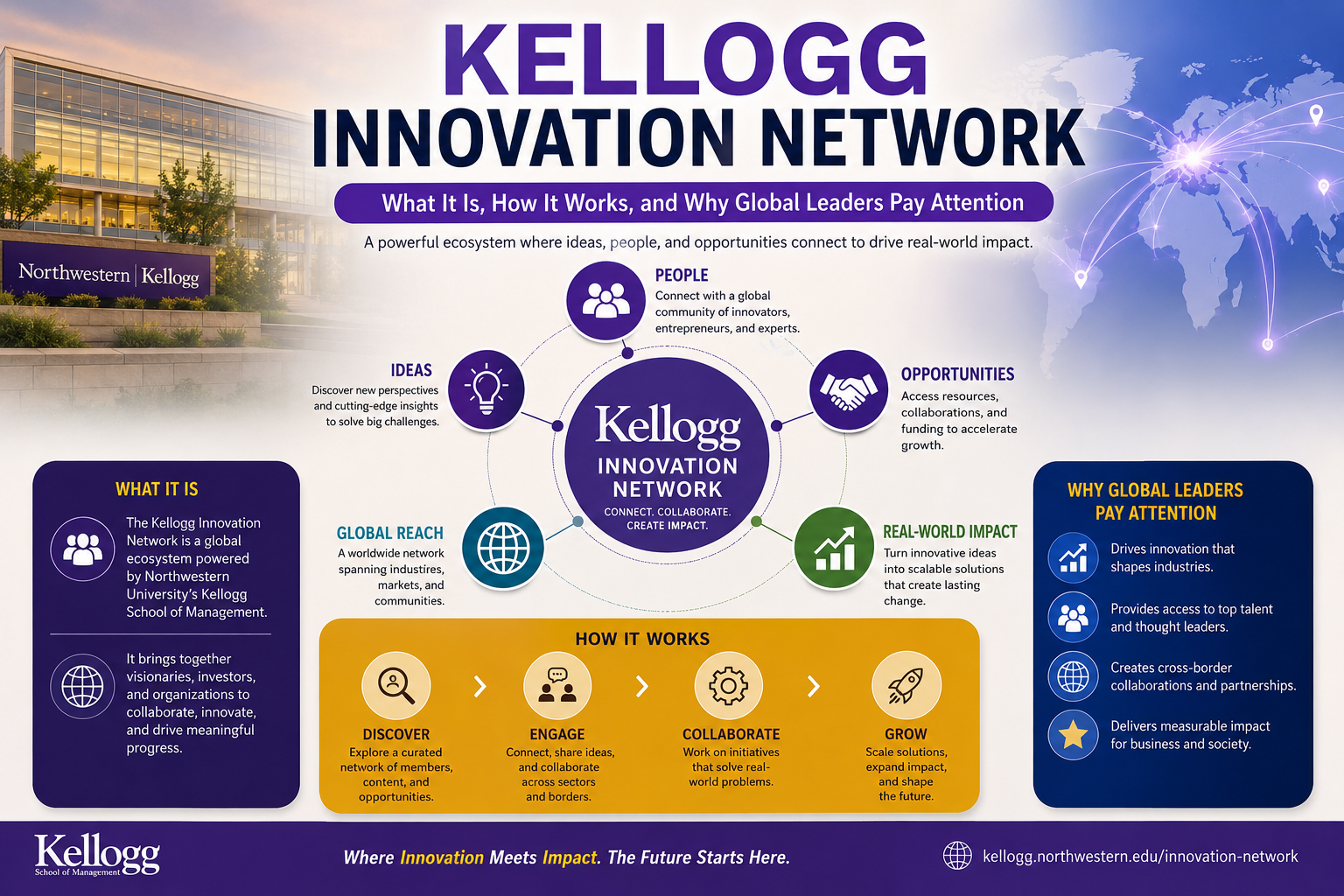
The Kellogg School of Management at Northwestern University’s Kellogg Innovation Network (KIN) is a global platform for leadership and innovation. It was founded by Professor Robert C. Wolcott and his colleagues in the faculty, with a clear and ambitious mission to develop a “network of networks” in which senior executives, faculty, policy makers, entrepreneurs, and even artists could work together and develop solutions to the world’s greatest challenges through innovation.
It is not a consultancy service. Not a think tank per se. Nor a rote-learned circuit of the conference. KIN is more of an ecosystem, not only a place where ideas are talked about, but also where ideas are supposed to yield tangible results.
How KIN Actually Works
This is where most articles fall short. They provide a broad description of KIN in inspirational terms and don’t go into the mechanics of KIN. The network works in the following way.
The KIN Global Summit is the flagship event. It is invitation-only and takes place once a year. No open registration. No dues to pay for admission. Delegates are carefully selected based on their experience (KIN’s calling them “KINians”) and their dedication to “success to significance” (KIN’s mission). Hailing from more than 30 countries, they represent a diversity of sectors ranging from energy and mining to healthcare, technology, social enterprise, and more. Issues addressed at previous summits have included food security, climate resilience, and AI ethics, among others.
The difference with the summit is that it is all about format. It is not passive. Delegates develop frameworks, discuss compromises, and agree on action after the event. This continuity is intentional.
Catalyst Forums are extensions of the summits. These are industry-specific collaborative projects over a few months (usually 6 to 18 months) in which members of a particular industry collaborate to redesign a whole framework. The Mining Company of the Future, for instance, which gathered global mining leaders to consider how mining can be committed to helping host communities, rather than simply extracting resources, was one example of this.
Global Innovation Expeditions bring KINians to go places: Silicon Valley, Tel Aviv, Berlin, and immerse themselves in active innovation environments for in-the-field learning. Members directly interact with start-ups, VC networks, and policy labs. It is not tourism that is the aim. It’s to restore structures that interpret within their own organisations.
A series of executive modules and workshops helps complete the programming, offering structured opportunities to practice how to use the innovation frameworks to address a specific organisational challenge.
Who Gets In — and Why That Matters
KIN membership is both selective and earned. Members typically include CEOs, chief innovation officers, R&D heads, senior policymakers, academics, and nonprofit leaders. But the selectivity is not just about status. It ensures that conversations inside KIN stay honest, substantive, and far more useful than what happens in open public forums. Members contribute intellectually and get involved in active projects. Over the years, many have stepped into senior fellow roles, helping shape the direction of the organization. This creates ongoing engagement — not the one-time interaction you get at most professional events.
Real-World Impact: Beyond the Talking Shop
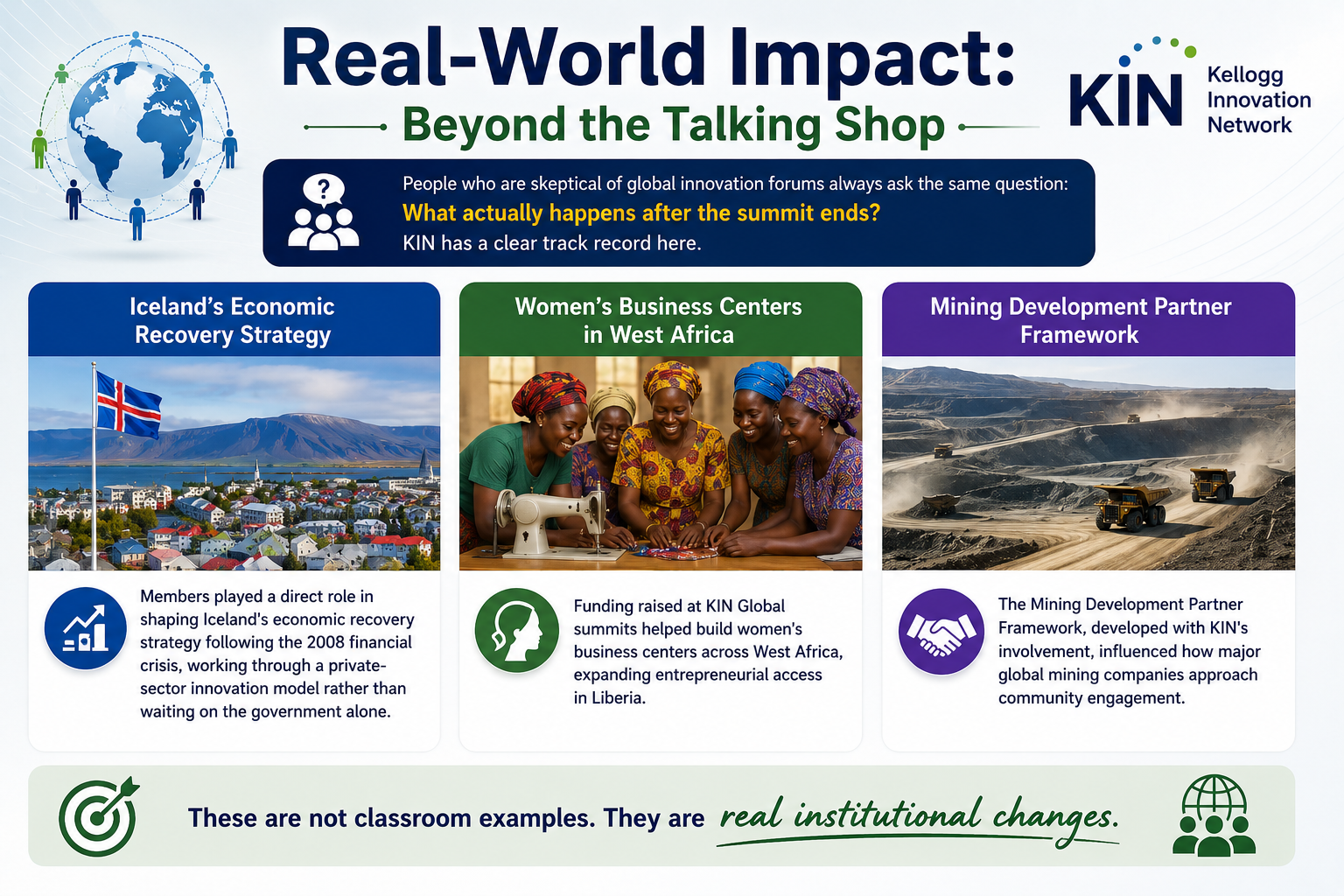
People who are skeptical of global innovation forums always ask the same question: What actually happens after the summit ends? KIN has a clear track record here. Members played a direct role in shaping Iceland’s economic recovery strategy following the 2008 financial crisis, working through a private-sector innovation model rather than waiting on the government alone. Funding raised at KIN Global summits helped build women’s business centers across West Africa, expanding entrepreneurial access in Liberia. The Mining Development Partner Framework, developed with KIN’s involvement, influenced how major global mining companies approach community engagement.
These are not classroom examples. They are real institutional changes.
KIN’s Evolution Into TWIN Global
The one thing most articles fail to mention or get right, KIN has officially grown and changed. With the network’s reach expanding across the globe, it moved to a larger, self-standing entity, The World Innovation Network (TWIN Global). Wolcott is its Chair.
TWIN Global takes the collaborative model off the Northwestern campus to establish localised innovation networks in regions, sharing the same philosophy: that sustainable innovation is born of diversity of perspective, not homogeneity of industry.
Academic rigor and integration of research remain, and KIN continues to be part of the Kellogg School community. However, the model is the one that has gone global at TWIN. If you’re looking into KIN for institutional or strategic reasons, it’s important to grasp the difference.
Also Read- Asus TUF Gaming F15 Review: The Budget Gaming Laptop That Refuses to Quit
Why It Remains Relevant in 2026
The need for KIN-style collaboration is growing and growing. AI is changing whole industries faster than most executive education courses can keep up. The climate commitments are causing governments and corporations to collaborate across sectors, where they’ve never cooperated before. Silo thinking has been revealed to be very fragile in the face of pressure in the supply chain.
KIN was developed for this type of environment. Not to give ready-made solutions. To develop the connections, structures, and vocabulary to make difficult problems solvable. In such a world, where there are a lot of conferences that produce slide decks, that’s quite a special thing.
Final Verdict
The Kellogg Innovation Network is one of the very few leadership platforms around the world to prove itself by delivering results, not by selling a brand. KIN looks at no sector being able to address complex global challenges without the help of another, and they do this through their summits, multi-month catalyst projects, and global expeditions. It has developed into TWIN Global, which is scalable.
KIN is not just something that’s worth knowing about for senior leaders who are committed to innovation strategy, cross-sector collaboration, and long-term thinking. It’s something that needs to be learned on a very fundamental level.
FAQs
What is the Kellogg Innovation Network?
KIN is a global leadership platform founded in 2003 at Northwestern University’s Kellogg School of Management. It connects senior executives, policymakers, academics, and innovators to collaborate on complex global challenges through structured summits, forums, and joint projects.
Who founded the Kellogg Innovation Network?
Professor Robert C. Wolcott co-founded KIN in 2003. He is a Clinical Professor of Innovation and Entrepreneurship at Kellogg, a published author, Forbes contributor, and the current chair of TWIN Global — KIN’s independent successor organisation.
How is KIN different from a regular business conference?
KIN is invitation-only, multi-format, and outcome-focused. Beyond its annual summit, it runs 6–18 month Catalyst Forums and Global Innovation Expeditions. Members are expected to produce frameworks and commitments, not just attend panels.
What is TWIN Global and how does it relate to KIN?
TWIN Global (The World Innovation Network) is the independent international organisation that grew out of KIN. It expands the collaborative model globally while KIN continues operating under Kellogg’s academic framework at Northwestern University.