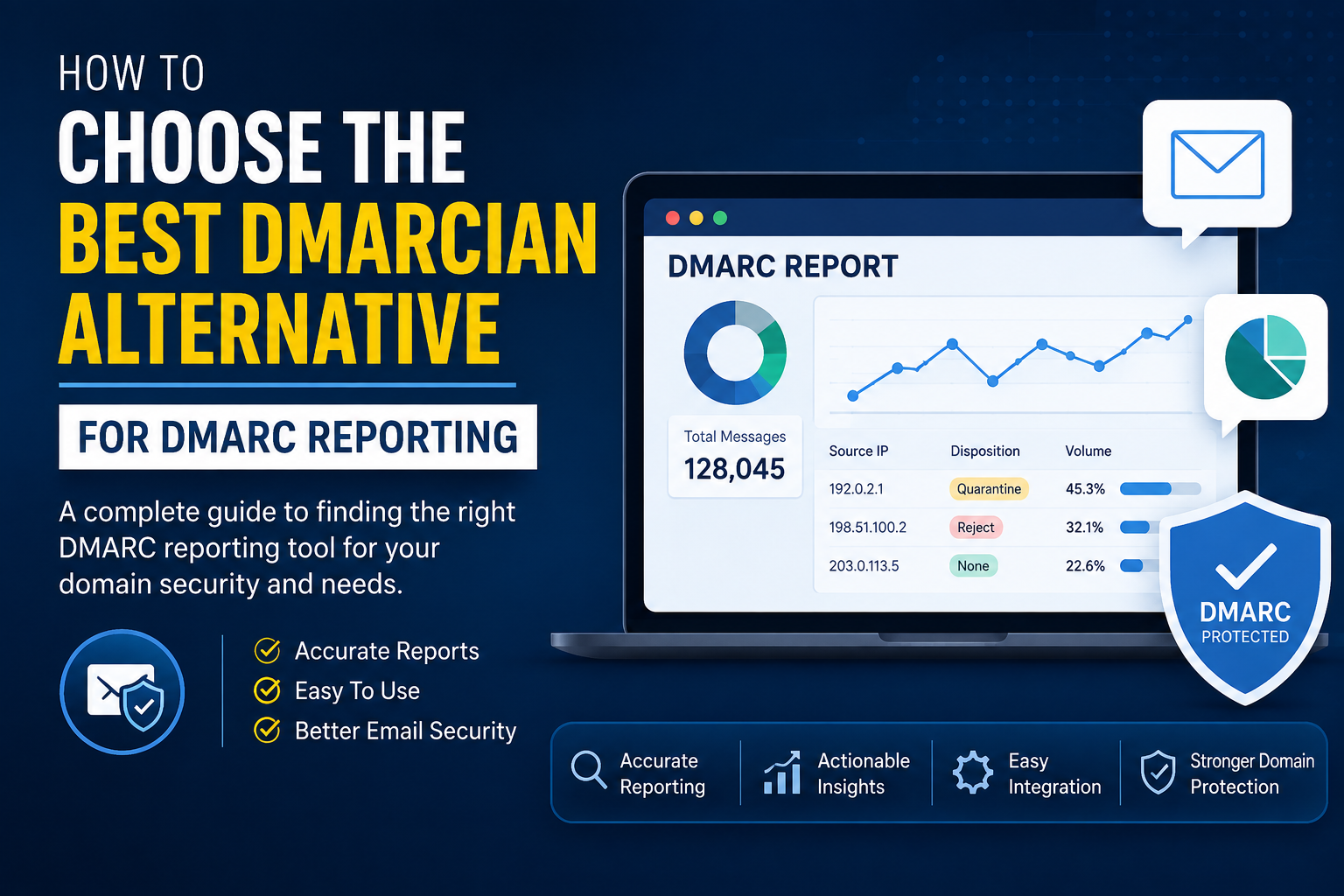
How To Choose The Best Dmarcian Alternative For DMARC Reporting
- 1 Why Select a dmarcian Alternative for DMARC Reporting
- 2 Core Features to look for: Aggregated Reports, Forensics, SPF/DKIM Alignment, and Policy Management
- 2.1 DMARC aggregated reports and forensics
- 2.2 SPF Management and DKIM Alignment
- 2.3 Policy, Enforcement and Domain Management
- 3 Usability and Automation: Dashboards, Alerts, Integrations and Guided Enforcement
- 3.1 Intuitive Dashboards and User-friendly Interfaces
- 3.2 Automated Alerts and Workflow Automation
- 3.3 Integration and Interoperability
- 3.4 Guided Enforcement and Policy Progression
- 4 Comparing Pricing, Scalability, Support, and Compliance Needs
- 4.1 Transparent and Flexible Pricing Models
- 4.2 Scalability for Enterprise and MSP
- 4.3 Support, Compliance, and Data Handling
- 5 How to Assess and Test the Best dmarcian Alternative Prior to Switching
Businesses that are looking for better email security and more visibility into email sending sources, along with an effective solution for email spoofing and phishing protection, need to find the best DMARC reporting solutions. Although dmarcian is a favorite among many companies, there are options with more flexibility and automation, at a lower price, for example, with greater policy management and integration. This guide highlights the options available for selecting the best dmarcian alternative based on the required DMARC reporting and email authentication needs.
Why Select a dmarcian Alternative for DMARC Reporting
More than ever, organizations are focused on the security of their email systems to help tackle phishing, spoofing, and brand abuse. DMARC (Domain-based Message Authentication, Reporting & Conformance) plays a significant role in this email authentication framework. However, not all DMARC solutions are the same. While dmarcian remains a widely used solution, the preference for dmarcian alternatives continues to grow among enterprise, MSP, and SMB customers, especially as they seek greater flexibility, automation, enforcement, more affordable pricing, and advanced threat detection.
There are many reasons to assess DMARC reporting competition to dmarcian:
- Feature requirements: Your organization may require enterprise-level security, lightweight monitoring, MSP automation, or other aspects of DMARC reporting that dmarcian doesn’t currently provide.
- Scalability: Organizational growth increases the importance of multi-domain management and operational ownership. DMARC reporting alternatives PowerDMARC and Valimail Monitor are said to excel dmarcian in terms of scalability regarding an organization’s daily load and streamlined onboarding processes.
- Compliance and brand protection: When protecting a brand name, an organization may be required to use PGP-encrypted reporting, enhanced spoofing prevention, and BIMI readiness. These offerings may be better handled by a more customized DMARC solution.
- Support and integration: Fortra, Agari Brand Protection, and Red Sift OnDMARC are a few among dmarcian’s more integrated MSP competitors, with structured support and easier implementation for multidomain setups.
Switching to a different DMARC provider could provide noticeable improvements for both outbound email authentication and DMARC reporting.
Core Features to look for: Aggregated Reports, Forensics, SPF/DKIM Alignment, and Policy Management
Careful assessment of DMARC reporting and policy management functionality is equally important when considering a switch to a new DMARC provider.
DMARC aggregated reports and forensics
Any trustworthy DMARC provider should offer the following:
- Aggregate reporting combines DMARC XML outputs and transforms them into easy to read formats that include policy compliance and guidance that can aid in accessibility.
- Forensic reporting helps identify threats and aids in the mitigation of phishing and abuse of a given domain.
When looking at DMARC alternatives such as PowerDMARC, Proofpoint Email Fraud Defense, and Postmark DMARC, all provide advanced aggregate reports and forensics to help enhance email authentication and completeness of reporting.
SPF Management and DKIM Alignment
All advanced DMARC providers should include the following:
- Seamless protocol configuration.
- SPF macros. Extends SPF record health and active discovery of senders during continuous changes to the infrastructure.
- DKIM alignment tools: provide increased visibility to track progress on the alignment of policy and help ease trouble shooting.
Red Sift OnDMARC and Valimail Monitor are two solutions noted for their ease of use when configuring and automating SPF, DKIM and DMARC.
Policy, Enforcement and Domain Management
Of the available solutions for DMARC, the most important factor of differentiation is support for:
- Policy management: simple UI, step-by-step policy progression, and goal-state enforcement.
- Multi-domain management: integrations to manage multiple subdomains and autonomous sending sources, often with subdomain detection.
- Enforcement guidance: step-by-step enforcement workflows with alerts to help users enforce DMARC, with deliverability maintained.
Usability and Automation: Dashboards, Alerts, Integrations and Guided Enforcement
The utility of a DMARC reporting platform hinges on its automation and usability, particularly for customers or clients with complex, multi-tenant environments.
Intuitive Dashboards and User-friendly Interfaces
Look for a DMARC solution with a customizable dashboard, such as PowerDMARC and Skysnag. These help security teams and MSPs:
- Spot deliverability issues via reporting history
- Track policy adoption and progress toward DMARC enforcement
- Identify sending sources to aid in a response to an incident
Automated Alerts and Workflow Automation
Critical automation features are real-time, policy enforcement change automated alerts and threat escalation. DMARC solutions, like Agari and Red Sift, provide automated alerts and workflow automation to reduce the time required to respond to an incident.
Integration and Interoperability
To properly administer DMARC, several integration ecosystems must be in place with email service providers, ticketing systems, SIEM, MTA-STS, and TLS authentication. Leading competitors to dmarcian offer APIs and pre-built integrations to automate visibility and reporting, thus improving the entire onboarding and maintenance process.
Guided Enforcement and Policy Progression
The best DMARC implementations should include modules to assist the user in policy rollout. These should include enforcing guidance, active DMARC enforcement, step-by-step guides, and easy to understand information to aid the user in enforcement, depending on policy in their current state and desired enforcement.
Comparing Pricing, Scalability, Support, and Compliance Needs
When considering the competitors of dmarcian to fulfill your DMARC reporting and enforcement needs, consider the following:
Transparent and Flexible Pricing Models
Whereas many competing DMARC products offer quote-based pricing, subscription models, or per-domain pricing, assess pricing models focusing on:
- Predictability: Is it easy to estimate costs with a given DMARC solution as more domains or users are incorporated?
- Affordability at scale: Does the vendor charge more as you add more customers? Conversely, does the vendor offer a multi-domain plan with unlimited users?
Scalability for Enterprise and MSP
For maximum scaling:
- Ensure the DMARC alternative supports both single and multi-tenant environments.
- For MSPs or fast-growth enterprises, features such as lightweight monitoring and managed services are necessary.
- Integration of MSP or MSSP workflows along with an enterprise-grade security interface is optimal.
Support, Compliance, and Data Handling
Your selected DMARC solution should provide:
- Responsive technical support and managed services.
- Detailed guidelines for compliance with laws such as the GDPR and SOC2 (as well as the option for PGP-encrypted reporting).
- Support for brand protection as well as BIMI readiness in order to combat spoofing and increase visibility of legitimate brands within recipient email inboxes.
How to Assess and Test the Best dmarcian Alternative Prior to Switching
The last step when comparing alternatives to dmarcian is to conduct empirical testing in order to validate the ease of switching to a new service and to ensure improvements in DMARC reporting and email security.
Pilot Testing and Structured Rollout
The first step in the new implementation is to perform a pilot on a subset domains. Assess new dashboards, reporting interfaces, and alerts by monitoring DMARC reporting results. Evaluate the features for automating sender discovery and discovery during the implementation of DMARC.
Measure Deliverability and Threat Detection
Measurable improvements in the detection of email threats and abusive use of Internet domains are to be evaluated along with improvements in the deliverability of email. If a DMARC reporting platform provides an AI-based threat detection system, this should also be evaluated.
Assess Support and Onboarding Experience
The DMARC reporting feature should include easy to understand reports and offer assistance during the policy configuration. The response time
Review Compliance, Security, and Data Handling
Validate PGP-encrypted reporting, access controls and reporting history. Check that compliance is met for all areas of sensitive sector or customer information data, prior to execution of final migration.
By reviewing the above listed features thoroughly and subjecting them to comprehensive testing, companies can migrate with confidence from dmarcian to a more capable DMARC service provider for reporting, automation, email authentication and multi-domain service management with scalable technology.