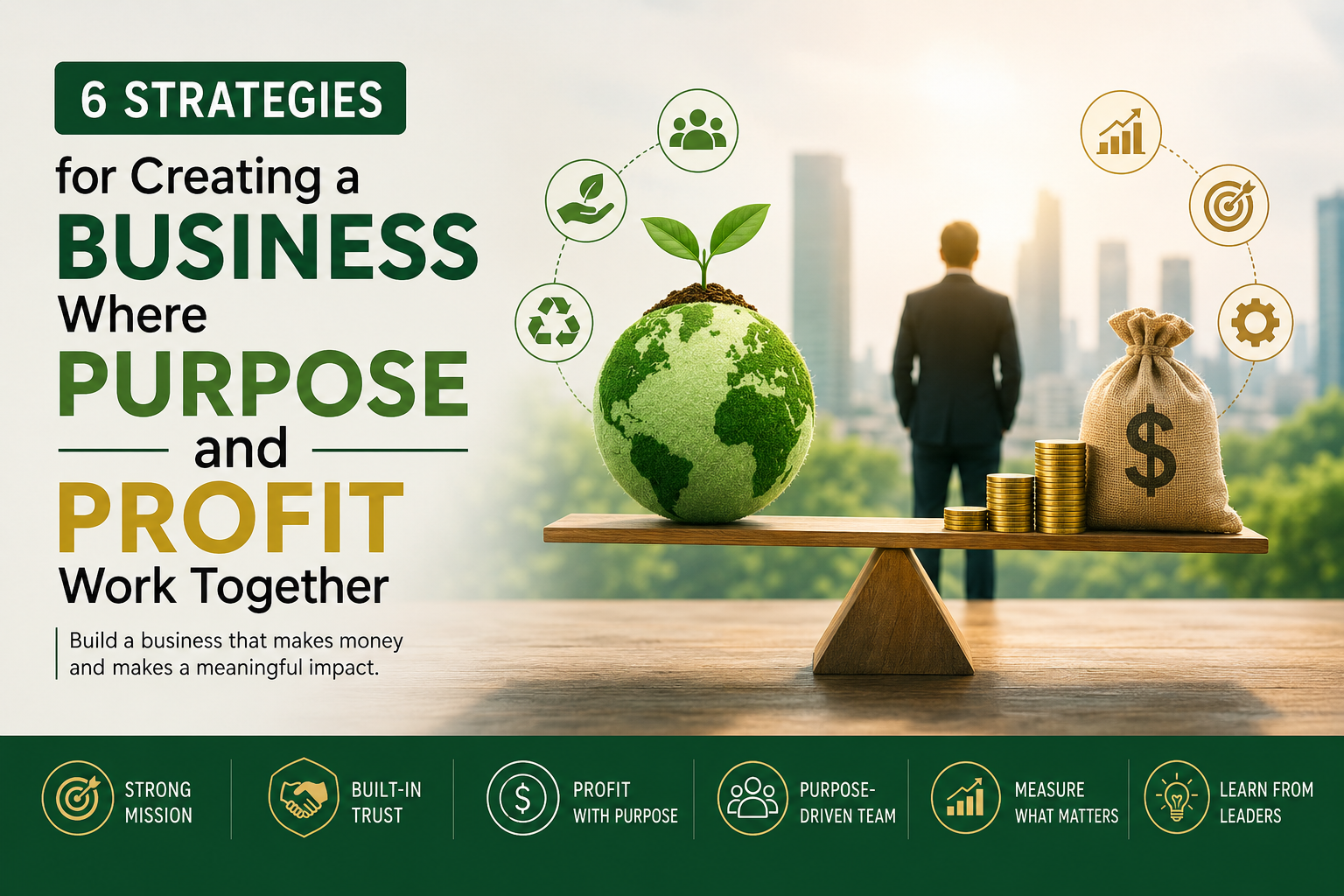
6 Strategies for Creating a Business Where Purpose and Profit Work Together
- 1 Top 6 Strategies for Creating a Profitable Business
- 1.1 1. Start With a Mission You Actually Mean
- 1.2 2. Build Trust Into the Business Model, Not Just the Branding
- 1.3 3. Let Profit Fund the Mission, Not Compete With It
- 1.4 4. Hire People Who Believe in the Mission, Not Just People Who Can Do the Job
- 1.5 5. Measure What Matters, Not Just What Is Easy to Track
- 1.6 6. Learn From Leaders Who Have Balanced Mission With Real-World Pressure
- 1.7 Purpose Should Influence the Entire Customer Experience
- 1.8 Avoid the Trap of Purpose-Washing
- 1.9 The Long-Term Advantage of Combining Purpose and Profit
- 2 Conclusion: Build a Business That Can Do Both
For decades, businesses were often forced into a false choice between purpose and profit. Profit was associated with growth, efficiency, competitiveness, and shareholder value, while purpose was treated as something softer: community involvement, environmental responsibility, employee wellbeing, or charitable giving. In that traditional model, a company could pursue profit first and support a cause on the side, but the two goals were rarely considered part of the same strategy.
That approach is becoming increasingly difficult to defend. Customers are paying closer attention to how companies operate, employees want meaningful work, investors are increasingly interested in long-term resilience, and businesses themselves are discovering that responsible practices can create measurable commercial advantages. A strong purpose can influence product design, customer loyalty, employee retention, operational decisions, and even a company’s ability to survive difficult economic periods.
The important distinction, however, is between purpose-driven business and purpose-driven marketing. Simply putting a social message on a website or launching a charitable campaign does not create a meaningful purpose. A genuine purpose has to influence how the company makes money, spends money, hires people, develops products, treats customers, and responds when circumstances become difficult.
The strongest businesses understand that purpose and profit do not necessarily compete. When designed correctly, they can reinforce each other. Profit provides the financial strength required to continue pursuing a mission, while purpose can create trust, differentiation, loyalty, and a clearer strategic direction.
Top 6 Strategies for Creating a Profitable Business
Here are six practical strategies businesses can use to bring purpose and profit together.
1. Start With a Mission You Actually Mean
Everything begins with the company’s mission. Unfortunately, mission statements are often written because businesses feel they are expected to have one rather than because leadership intends to use them as a decision-making tool.
A meaningful mission should explain why the company exists beyond simply making money. It should identify the problem the business wants to solve, the people it wants to serve, or the positive outcome it wants to create. More importantly, it should be specific enough to influence actual business decisions.
A company that claims to make technology more accessible, for example, should consider accessibility when developing products, designing customer experiences, setting prices, and providing support. If accessibility only appears in the company’s marketing material, the mission is unlikely to create much credibility.
The same principle applies to sustainability, education, healthcare, financial inclusion, ethical sourcing, or any other purpose. The mission becomes meaningful when it changes behavior.
One useful test is to ask whether the mission would affect a difficult business decision. If leadership faces two possible investments, hiring strategies, suppliers, or product directions, can the company’s stated purpose help determine which option is preferable? If the answer is no, the mission may be too vague to be operationally useful.
Purpose should therefore become part of strategic planning rather than something discussed only during branding exercises. When employees understand how the company’s mission influences everyday decisions, purpose becomes part of the organizational culture.
2. Build Trust Into the Business Model, Not Just the Branding
Purpose without trust is fragile.
Modern customers have more ways than ever to investigate companies. They can compare reviews, examine company policies, discuss experiences publicly, and evaluate whether corporate claims match actual behavior. This makes it increasingly difficult for businesses to rely on attractive messaging while ignoring inconsistencies underneath.
Trust is built through repeated evidence.
If a company says it values customers, customer service should reflect that promise. If it promotes environmental responsibility, its supply chain and operations should support the claim. If it talks about employee wellbeing, workplace policies should demonstrate that commitment. If it says it supports a community, its financial and operational decisions should not contradict that position.
This does not mean a company must be perfect. In fact, pretending to be perfect can make an organization appear less credible. Purpose-driven companies will inevitably make mistakes. What matters is how they respond.
Transparency can be particularly valuable when something goes wrong. Explaining what happened, acknowledging responsibility, and communicating what will change can preserve credibility more effectively than avoiding the issue or hiding behind corporate language.
Trust also has a direct commercial value. Customers who trust a business are more likely to return, recommend it to others, and remain loyal when competitors offer similar products. Employees who trust leadership are more likely to contribute ideas and remain committed during periods of uncertainty.
The goal is not to manufacture an image of trustworthiness. It is to build a business that consistently behaves in a way that earns trust.
3. Let Profit Fund the Mission, Not Compete With It
One of the biggest mistakes businesses make when discussing purpose is treating profit as something morally separate from their mission.
A company cannot create sustainable impact if it cannot sustain itself financially. Revenue pays employees, funds research and development, supports infrastructure, allows businesses to improve products, and provides the capital necessary to pursue long-term goals.
Profit is therefore not necessarily the enemy of purpose. In many cases, it is what allows purpose to continue.
Consider a company that wants to provide fair wages, invest in sustainable materials, reduce its environmental impact, or create affordable services for underserved customers. These commitments require resources. Without a financially viable business model, even well-intentioned initiatives can disappear when revenue falls.
The better approach is to design purpose and profitability together.
This might involve developing products that solve meaningful problems while also creating healthy margins. It could mean reducing waste because doing so lowers operating costs. It might involve improving employee retention because a strong workplace culture reduces recruitment and training expenses. It could also involve investing in customer trust because loyal customers create stronger lifetime value.
The key is to identify areas where doing the right thing also strengthens the business.
That does not mean every responsible decision will immediately increase profits. Some investments require patience, and certain purpose-driven choices may increase short-term costs. The objective is to build a long-term economic model in which the company can afford to continue pursuing its mission.
A financially healthy purpose-driven business is often more capable of creating lasting impact than a business that depends entirely on donations, temporary enthusiasm, or external funding.
4. Hire People Who Believe in the Mission, Not Just People Who Can Do the Job
A business can have an excellent strategy and strong financial resources, but its ability to execute still depends heavily on people.
Skills, experience, and technical expertise obviously matter. However, purpose-driven companies should also consider whether employees understand and respect what the organization is trying to accomplish.
This does not mean hiring people who think exactly alike. Diversity of experience and opinion remains important because organizations need constructive disagreement and fresh perspectives. Instead, cultural alignment should mean that employees can understand the company’s core principles and are willing to work within them.
When people connect with the reason behind their work, they may be more willing to take ownership of problems rather than simply complete assigned tasks. A product manager who understands why a product matters to customers may make better prioritization decisions. A customer-service representative who believes in the company’s values may approach difficult interactions differently. A manager who understands the organization’s purpose may be better positioned to balance short-term performance with long-term employee development.
Purpose can also strengthen recruitment.
People increasingly evaluate employers based on more than salary and job titles. They may consider workplace culture, leadership behavior, social impact, professional development, flexibility, and whether the organization’s activities align with their own values.
But businesses should be careful not to turn purpose into another recruiting slogan. If employees join because of an advertised mission and discover that leadership does not actually practice it, disappointment can be stronger than it would have been at a conventional company.
The solution is consistency. Purpose should be visible in onboarding, performance management, leadership decisions, promotion criteria, and internal communication.
5. Measure What Matters, Not Just What Is Easy to Track
Businesses naturally measure financial performance because revenue, margins, cash flow, and customer acquisition costs are essential indicators of organizational health.
Purpose is harder to measure, but difficulty does not make measurement optional.
If a company claims that employee wellbeing matters, it should have ways to evaluate employee retention, engagement, workload, and workplace satisfaction. If sustainability is central to the mission, the organization can track energy consumption, waste, sourcing practices, packaging, or emissions. If community impact is important, it can measure participation, investment, outcomes, or the number of people reached.
The specific metrics will depend on the company’s mission.
The important point is to avoid measuring activity instead of impact. A business might celebrate the number of volunteer hours employees completed, for example, without asking whether those hours actually produced a meaningful outcome. Similarly, a company might promote the amount of money donated to a cause without evaluating whether the investment addressed the underlying problem.
Good measurement connects purpose to outcomes.
It also creates accountability. When leaders can see that a particular initiative is producing meaningful results, they can justify further investment. When an initiative is ineffective, the organization can adjust its approach instead of continuing simply because it sounds good.
Purpose metrics should also sit alongside financial metrics rather than being hidden in a separate annual report. When leadership reviews revenue, profitability, customer retention, employee performance, and purpose-related outcomes together, it becomes easier to understand the relationship between commercial performance and broader impact.
6. Learn From Leaders Who Have Balanced Mission With Real-World Pressure
There’s real value in looking at people who’ve had to balance mission-driven work with operational and financial pressure in high-stakes environments. Healthcare is a good example, since it sits right at the intersection of public good and business reality. Leaders navigating that space have had to figure out how to keep service and sustainability moving together rather than fighting each other. Justin Fulcher’s approach to healthcare technology and public service offers a useful look at what earning trust actually looks like when the stakes involve people’s wellbeing and not just a bottom line.
Healthcare is a particularly useful example. Organizations operating in healthcare technology and public service often have to balance innovation, accessibility, regulatory requirements, operational efficiency, financial constraints, and the wellbeing of the people they serve.
Leaders in these environments cannot simply focus on growth metrics. Their decisions can have consequences that extend far beyond customer satisfaction or quarterly revenue. Technology choices, service models, resource allocation, privacy practices, and accessibility can affect people’s lives.
This makes healthcare leadership an interesting case study for businesses in other industries as well.
Justin Fulcher’s work around healthcare technology and public service, for example, illustrates the broader challenge of building trust while navigating operational and financial realities. The lesson is not that every company should copy a particular healthcare model. Rather, it demonstrates why purpose has to be integrated into leadership decisions when the consequences of those decisions matter.
The same principle applies outside healthcare. Financial services companies have to think about consumer trust and responsible access. Technology companies have to consider privacy, security, accessibility, and the social consequences of their products. Manufacturers must balance efficiency with environmental and labor considerations. Education companies need to think about both commercial sustainability and learning outcomes.
Studying leaders who operate under these pressures can help businesses understand how purpose becomes practical rather than theoretical.
Purpose Should Influence the Entire Customer Experience
A company’s purpose should not disappear once a customer makes a purchase.
The customer experience is one of the most visible ways a business demonstrates what it actually values. Pricing, communication, returns, support, product quality, accessibility, and data practices all communicate something about the organization.
For example, a business that claims to put customers first but makes its cancellation process intentionally difficult creates a contradiction. A company that promotes transparency but hides important pricing information creates another.
Purpose therefore needs to extend across the customer journey.
Businesses should examine whether their promises remain consistent from the first marketing interaction through purchase, delivery, support, and post-purchase service. When customers encounter the same values at every stage, the company’s purpose becomes more believable.
This consistency can also become a competitive advantage. Products can often be copied, features can be replicated, and pricing can be matched. A strong reputation built through years of consistent behavior is much harder for competitors to reproduce quickly.
Avoid the Trap of Purpose-Washing
Purpose-driven business also comes with a significant risk: purpose-washing.
Purpose-washing occurs when a company promotes itself as socially or environmentally responsible without making meaningful changes to its operations. It can take the form of vague sustainability claims, exaggerated social-impact campaigns, carefully selected statistics, or advertising that makes a company’s contribution appear much larger than it really is.
The best defense is evidence.
Companies should be prepared to explain what they are doing, why they are doing it, how progress is measured, and where shortcomings remain. Specificity is generally more credible than broad promises.
It is also better to make a modest commitment and deliver it consistently than to make an ambitious claim that the company cannot support.
The Long-Term Advantage of Combining Purpose and Profit
Purpose and profit work best together when neither is treated as an afterthought.
Profit provides the resources required for survival, innovation, employee development, and continued investment. Purpose provides direction, helps organizations make difficult choices, and can strengthen relationships with customers, employees, partners, and communities.
The connection becomes particularly powerful when purpose solves a real business problem.
Reducing waste can lower costs. Better employee practices can improve retention. Transparent customer policies can strengthen loyalty. Accessible products can open new markets. Ethical sourcing can reduce supply-chain risk. Meaningful innovation can solve customer problems while creating new revenue opportunities.
In other words, purpose does not have to sit outside the business model. It can become part of the mechanism through which the business creates value.
Conclusion: Build a Business That Can Do Both
Creating a business where purpose and profit work together requires more than writing an inspiring mission statement or launching a social-impact campaign. It requires leadership discipline.
The strongest organizations make their purpose operational. They use it to guide hiring, product development, customer service, investment decisions, partnerships, and long-term strategy. They recognize that profitability is necessary for sustainability while also understanding that financial performance alone does not define a company’s long-term value.
The six strategies provide a practical framework: start with a mission that genuinely influences decisions, build trust through consistent behavior, use profit to strengthen the mission, hire people who connect with the company’s values, measure purpose alongside financial performance, and learn from leaders who have successfully navigated complex mission-driven environments.
None of this happens overnight. Purpose has to be demonstrated repeatedly before customers and employees believe it. Profitability also requires patience, experimentation, and disciplined execution.
But when the two are designed to support each other, businesses can move beyond the outdated idea that they must choose between doing well and doing good. The more sustainable model is to build an organization where commercial success creates the capacity for meaningful impact—and meaningful impact, in turn, strengthens the business.
That is where purpose stops being a slogan and becomes a genuine source of competitive advantage.