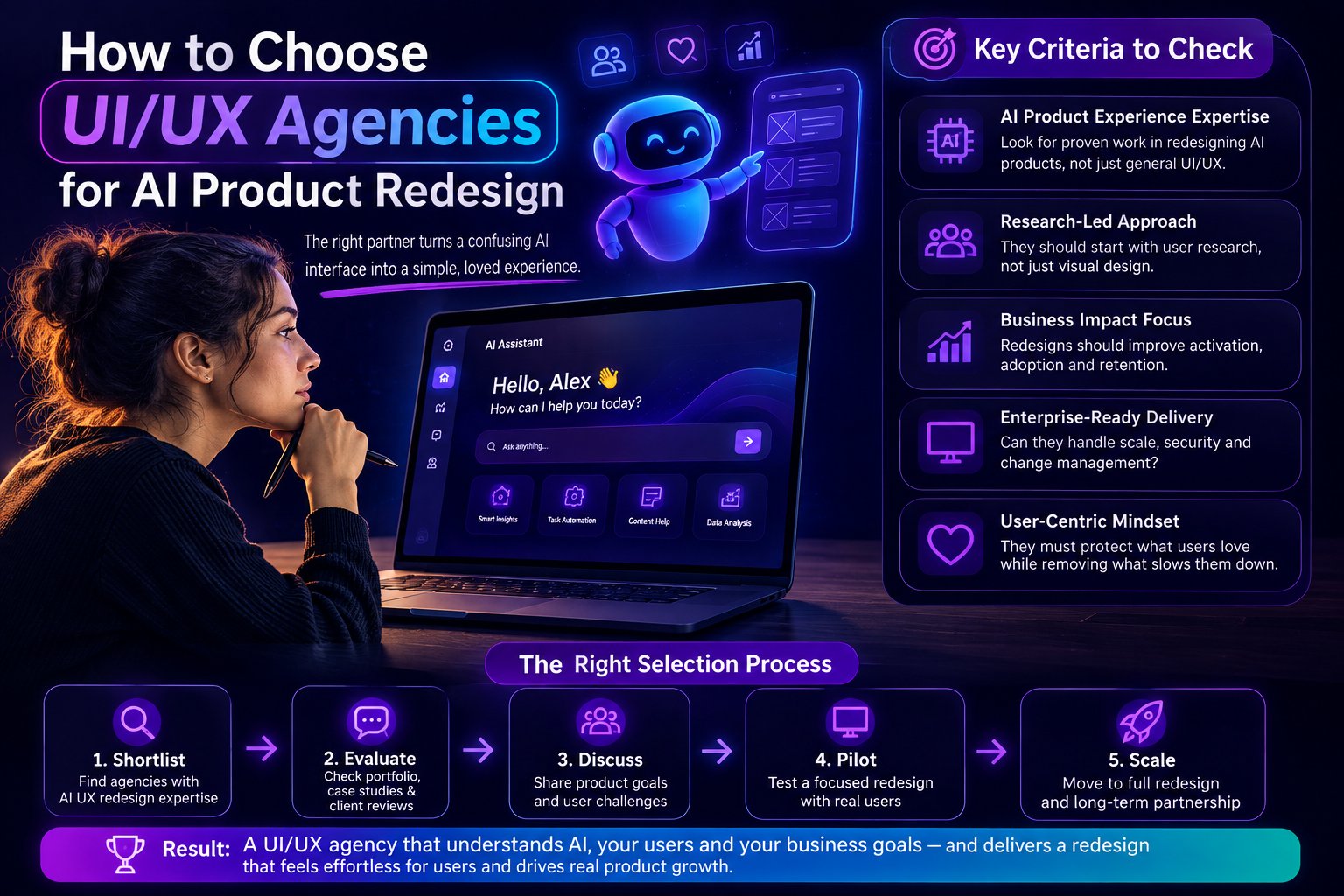
Best UI/UX Agencies for AI Product Redesign in 2026
- 1 Best UI/UX Agencies for AI Product Redesign in 2026
- 1.1 1. Linkup ST
- 1.2 2. Adaptive Path
- 1.3 3. Work & Co
- 1.4 4. Ustwo
- 1.5 5. Huge
- 1.6 6. Cieden
- 1.7 7. Ramotion
- 1.8 8. Clay
- 1.9 9. Blink UX
- 1.10 10. Unfold
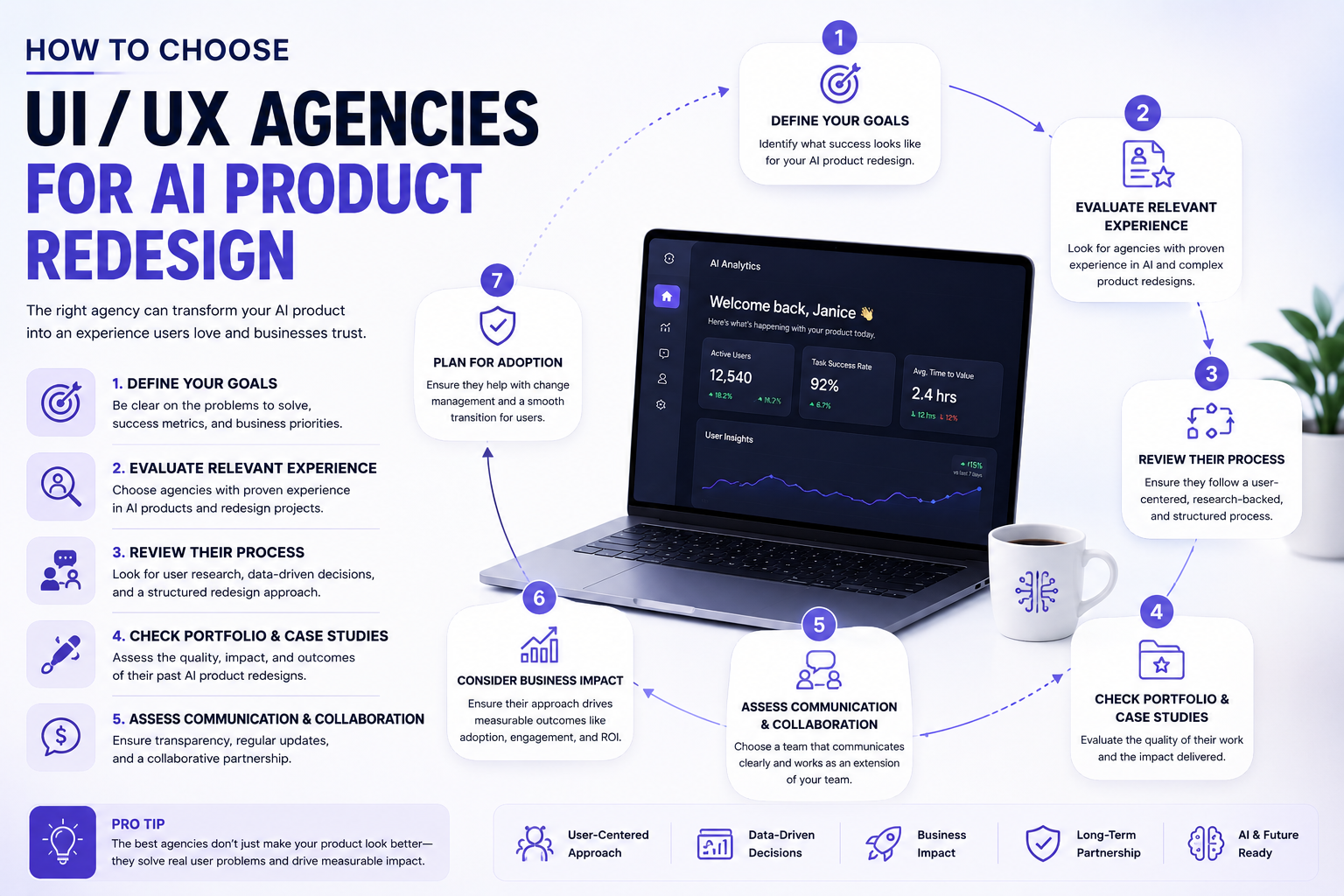
- 2 How to Choose UI/UX Agencies for AI Product Redesign
- 2.1 Start with diagnosis before direction
- 2.2 Define what success looks like in measurable terms
- 2.3 Evaluate their approach to existing user behavior
- 2.4 Consider organizational change management for enterprise redesigns
- 2.5 Look at their implementation continuity specifically for redesign
- 2.6 Evaluate how they handle redesign scope creep
AI product redesign is harder than new AI product design. Not because the design problems are more complex — they often aren’t — but because you’re working with constraints that new product design doesn’t have.
Existing users have formed habits around the current interface. Some of those habits are the problem you’re trying to solve. Others are the thing you can’t break without losing the users who’ve built their workflows around them. Figuring out which is which requires research that goes deeper than standard usability testing, and design judgment that distinguishes between friction that should be eliminated and familiarity that should be preserved.
Enterprise AI products have an additional layer. The redesign needs organizational approval, change management planning, and a rollout strategy that keeps operations running during the transition. Users who were trained on the old interface need a path to the new one that doesn’t require relearning everything at once.
The UI UX agencies on this list have worked through AI product redesign specifically — not just new AI product design applied to an existing product, but the genuine redesign challenge of improving an AI product that real users depend on.
Best UI/UX Agencies for AI Product Redesign in 2026
1. Linkup ST
Website link – upst.com/design
Location – New York, NY / Europe
Focus – UI/UX Redesign for AI Products, Conversion & UX Optimization
Best for – AI businesses needing redesign that improves measurable outcomes without alienating existing users
Linkup ST approaches AI product redesign through the Emotional-Functional Framework — which provides the two things that redesign specifically requires: a clear definition of what success looks like before any design decisions get made, and a structured way to evaluate whether proposed changes improve the experience or just make it different.
The functional track defines the OKRs and metrics the redesign needs to move — activation rate, feature adoption, time-to-value, enterprise conversion — and traces every design change back to those metrics. This provides the prioritization discipline that separates redesigns that move business outcomes from ones that produce a better-looking version of the same performance. The emotional track evaluates how proposed changes affect existing users across visceral, behavioral, and reflective levels — which is the tool for distinguishing between changes that feel like improvements and changes that feel like disruption regardless of their objective quality.
As an AI product design partner for redesign specifically, Linkup ST validates key user flows through prototype testing before handoff — which for redesign means testing with existing users who have the current interface’s mental models, not just new users encountering the product fresh. That distinction changes what the testing reveals and what the design needs to address.
11+ years. 40+ global recognitions including Red Dot, Webby, and Apple. Work reaching 70M+ users worldwide.
Key differentiator: OKR-driven redesign methodology that prioritizes changes by business impact and validates with existing users — the discipline that separates redesigns that move metrics from ones that change aesthetics
2. Adaptive Path

Website: adaptivepath.com
Location: San Francisco, CA
Focus: UX strategy, service design, journey mapping
Best for: AI businesses needing research and strategy to define what the redesign should accomplish before execution begins
Adaptive Path’s strength in redesign is upstream — understanding why the current design isn’t working before proposing what to change. Their research and strategy capability produces redesign briefs grounded in actual user behavior rather than stakeholder assumptions about what users need. For AI product redesigns where the symptoms are visible but the causes aren’t, their diagnostic work prevents redesigns that solve the wrong problem with high craft.
Key differentiator: Diagnostic research before redesign execution — understanding why the current AI product design fails before committing to how to fix it
3. Work & Co
Website: work.co
Location: Brooklyn, NY
Focus: Digital product design and development
Best for: AI businesses needing redesign and implementation continuity
Work & Co has done some of the most notable digital product redesigns in the market — Delta Air Lines’ digital experience, Apple TV’s interface, major e-commerce platform redesigns. Their commitment to staying involved through implementation means AI product redesigns actually ship the way they were designed rather than losing the design intent that made the redesign worth doing in the engineering handoff.
Key differentiator: AI product redesign through implementation — redesign quality that survives the engineering process intact
4. Ustwo
Website: ustwo.com
Location: London / New York
Focus: Product design, venture building
Best for: AI businesses needing strategic clarity about what the redesign should accomplish before committing to execution
Ustwo approaches redesign from a strategy-first position — they want to understand why the current AI product design isn’t working before proposing what to change. Their deliberately upstream-heavy process produces redesigns that address root causes rather than surface symptoms. For AI product redesigns where the temptation is to start with what the new version should look like rather than why the current version is failing, their strategic discipline redirects that energy productively.
Key differentiator: Strategy-first AI product redesign — root cause analysis before design direction rather than aesthetic improvement before problem definition
5. Huge
Website: hugeinc.com
Location: New York, NY
Focus: Digital experience design for enterprise
Best for: Large enterprises redesigning AI products across organizational scale
Huge has the scale for enterprise AI product redesigns that span multiple products, business units, and user groups simultaneously. For large organizations undertaking AI product redesign that affects thousands of daily users across departments — where change management is as much a design challenge as the interface itself — their organizational capacity and enterprise experience handle the scope that boutique agencies can’t accommodate.
Key differentiator: Enterprise-scale AI product redesign across complex multi-product organizational environments
6. Cieden
Website: cieden.com
Location: Europe / North America (remote)
Focus: B2B SaaS, AI UX, Enterprise Product Design
Best for: B2B AI businesses redesigning products to improve AI feature adoption
Among AI design companies with specific B2B AI redesign experience, Cieden’s depth in the adoption problem is directly relevant. B2B AI product redesigns most often need to improve AI feature adoption among existing users who’ve been using the product without engaging with AI capabilities — which requires understanding why they’ve been avoiding the AI features and designing a path that makes adoption feel like a natural progression rather than a forced change.
Key differentiator: B2B AI feature adoption redesign — improving AI capability engagement among existing users who’ve been avoiding it
7. Ramotion
Website: ramotion.com
Location: San Francisco, CA
Focus: Brand and product redesign for tech companies
Best for: AI businesses redesigning products alongside a brand evolution
Ramotion has built a strong reputation for tech company redesigns where brand identity and product design need to be realigned simultaneously — Netflix, GitHub, Stripe. For AI businesses where the product redesign is happening alongside a brand evolution or repositioning, their combined brand-and-product redesign capability ensures the new product experience and the new brand feel like they came from the same strategic direction rather than two parallel projects that happened at the same time.
Key differentiator: Brand and AI product redesign aligned — relevant for AI businesses repositioning alongside their product redesign
8. Clay
Website: clay.global
Location: San Francisco, CA
Focus: UI/UX and visual redesign for technology companies
Best for: AI businesses where the redesign priority is premium visual credibility
Clay produces some of the highest quality visual redesign work in the technology sector — major tech companies that needed their products to feel more premium, more trustworthy, more credible to enterprise buyers. For AI businesses where the current product design is functionally sound but visually undermining credibility with enterprise buyers, Clay’s redesign work addresses the visual and brand layer specifically without necessarily rebuilding the underlying interaction architecture.
Key differentiator: Premium visual AI product redesign — for businesses where visual credibility is the primary redesign objective
9. Blink UX
Website: blinkux.com
Location: Seattle, WA (multiple offices)
Focus: UX research and design for enterprise software
Best for: AI businesses that need research to understand why the current design isn’t working before redesigning
Blink’s research-first approach to redesign is particularly valuable for AI products where the failure modes aren’t obvious from analytics alone. Their contextual inquiry and usability research with existing users surfaces the specific ways current AI product design is failing — which AI features users don’t engage with and why, where trust breaks down in actual use, what mental models users have developed around the AI that the current interface doesn’t accommodate. That understanding changes what the redesign needs to accomplish.
Key differentiator: Existing user research before redesign — understanding actual failure modes rather than assumed ones
10. Unfold
Website: unfold.co
Location: New York, NY
Focus: Product strategy and UX for B2B SaaS
Best for: B2B AI businesses redesigning products to support enterprise sales alongside user experience
Among design agencies new york with B2B SaaS redesign depth, Unfold’s product strategy capability is directly relevant for AI product redesigns where the goal is improving enterprise sales conversion alongside user experience. Their upstream strategic engagement helps B2B AI businesses define what the redesign needs to accomplish for enterprise buyers — not just what users need, but what the interface needs to communicate to procurement teams, executive sponsors, and the sales process that happens before users ever touch the product.
Key differentiator: B2B AI product redesign with enterprise buyer experience in scope — redesign that works for the sales process as well as the user experience
How to Choose UI/UX Agencies for AI Product Redesign
Start with diagnosis before direction
The most common AI product redesign mistake is starting with how the new version should look before understanding why the current version isn’t working. The agencies that produce the best redesign outcomes start with research — understanding actual user behavior, identifying specific failure modes, distinguishing between problems that are causing poor outcomes and characteristics that users have adapted to and rely on. That diagnostic work determines what the redesign should accomplish, which is different from what it should look like.
Define what success looks like in measurable terms
A redesign that produces a better-looking version of the same outcomes is expensive and disappointing. Before briefing any agency, define the specific metrics the redesign needs to move — activation rate, AI feature adoption, enterprise conversion, support ticket volume, time-to-value. Agencies that tie redesign decisions to specific metrics produce work that’s accountable to outcomes. Those that don’t produce work that’s accountable to aesthetics.
Evaluate their approach to existing user behavior
The hardest part of AI product redesign is changing what needs to change without breaking what’s working. Ask specifically how agencies approach this — how they identify which existing user behaviors to preserve and which to disrupt, how they test redesign proposals with existing users who have the current interface’s mental models, how they design transition paths that move existing users to new interaction patterns without alienating them. This is the core competency of redesign specifically.
Consider organizational change management for enterprise redesigns
Enterprise AI product redesigns affect users who were trained on the old interface, workflows that were built around existing design patterns, and organizational processes that depend on current interface conventions. Agencies that understand this design for the transition as much as the destination — rollout strategies, progressive disclosure of new patterns, training implications of design changes. For enterprise AI redesigns, the change management dimension is as important as the design quality.
Look at their implementation continuity specifically for redesign
Redesign fidelity in implementation matters more than new product fidelity in some ways — existing users notice when the redesigned product doesn’t match what they saw in demos, and that discrepancy undermines trust in the redesign itself. Agencies that stay involved through implementation of redesigns ensure the design intent survives the engineering process, which is particularly important when the redesign involves nuanced changes to interaction patterns that are easy to simplify away in development.
Evaluate how they handle redesign scope creep
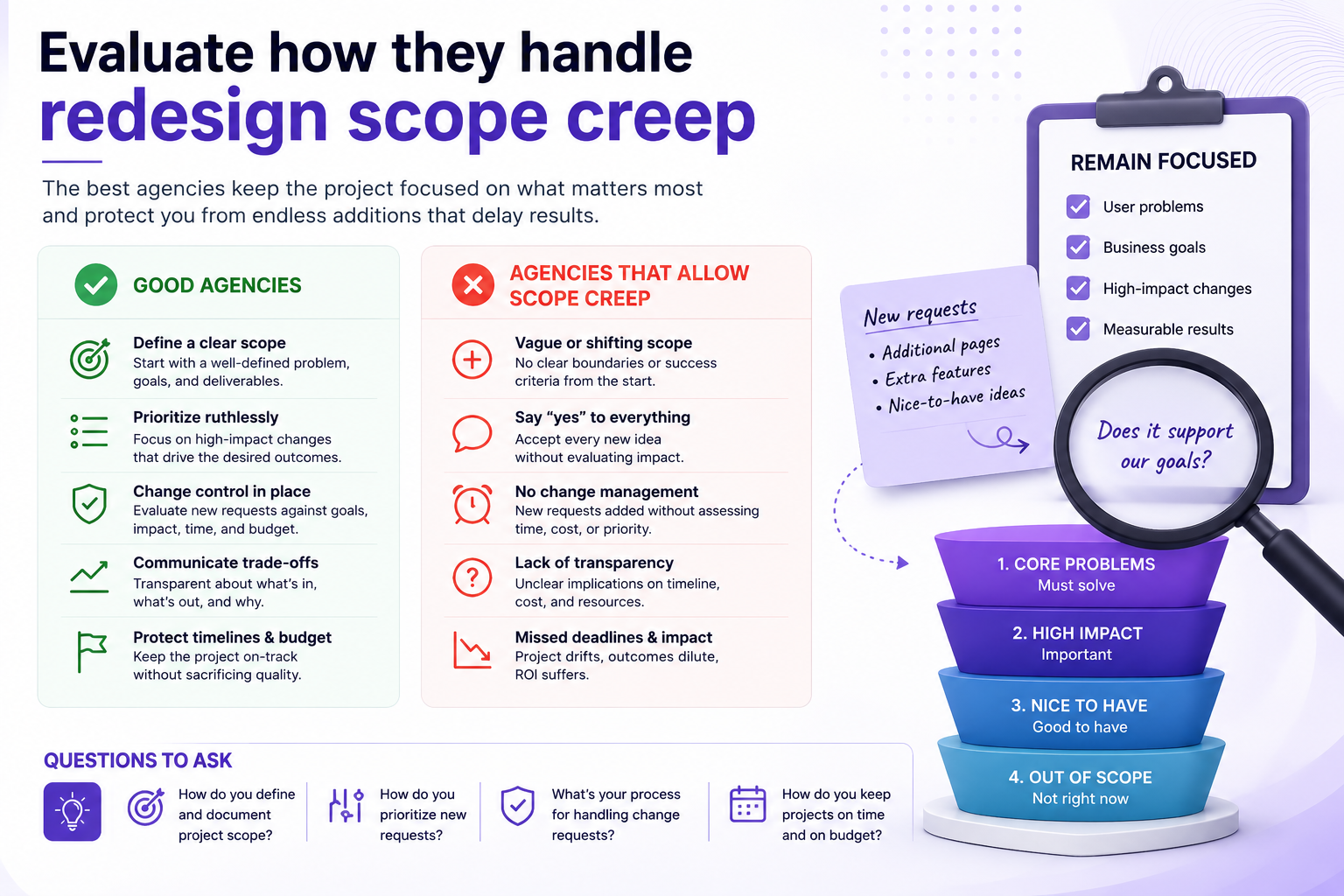
AI product redesigns have a specific scope creep problem — once the design team starts looking at what’s not working, the list of things to change grows faster than the timeline and budget allow. Agencies with genuine redesign experience have processes for prioritizing what to change first, what to queue for future releases, and what to leave alone because the cost of changing it exceeds the benefit. That prioritization discipline separates redesigns that ship and move metrics from ones that expand indefinitely and deliver late.