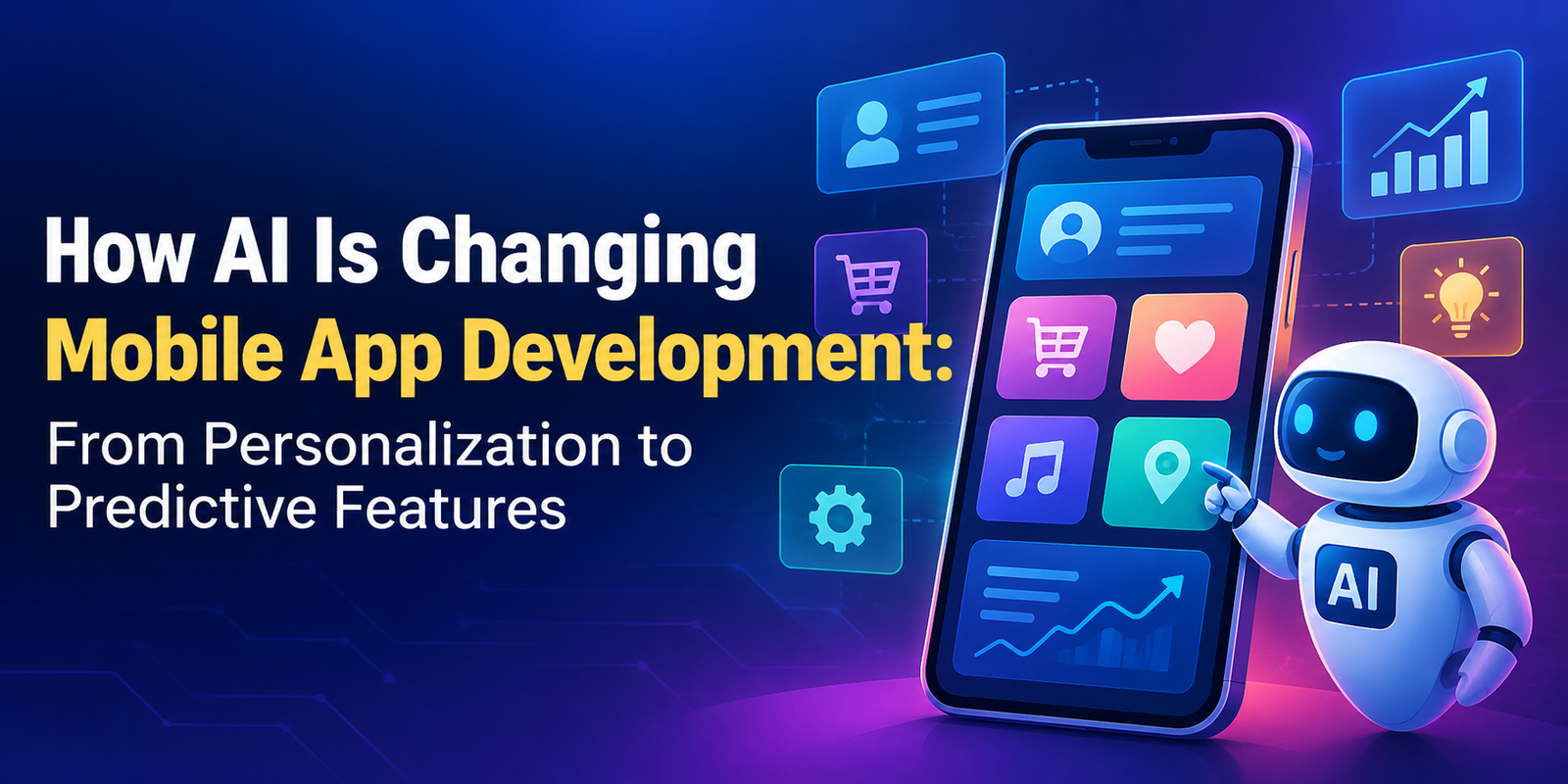
How AI Is Changing Mobile App Development: From Personalization to Predictive Features
- 1 1. AI-Powered Personalization in Mobile Apps
- 2 2. Predictive Features and Analytics in Mobile Applications
- 2.1 Predictive Search and Recommendations
- 2.2 Predictive Health and Fitness Insights
- 2.3 Predictive Maintenance
- 3 3. AI Chatbots, Voice Assistants, and Automation
- 4 4. Computer Vision and Voice Recognition
- 5 5. How AI Improves Mobile App Development and Security
- 6 6. Benefits and Challenges of AI in Mobile App Development
- 7 7. Best Practices for Building AI-Powered Mobile Apps
- 8 Conclusion
Artificial intelligence is transforming mobile app development by making applications more personalized, predictive, and responsive to user needs. Instead of relying only on predefined rules, AI-powered mobile apps can analyze user behavior, recognize patterns, automate tasks, and provide relevant recommendations.
From personalized shopping experiences to predictive health insights, AI helps businesses build mobile applications that offer greater value. It also supports developers through automated testing, intelligent debugging, and performance analysis.
However, successful AI integration requires more than adding a chatbot or connecting an AI model. Businesses must choose relevant use cases, protect user data, and ensure that AI features deliver measurable benefits.
1. AI-Powered Personalization in Mobile Apps
Personalization is one of the most common applications of AI in mobile app development. Machine learning algorithms analyze browsing history, preferences, purchase activity, and engagement patterns to tailor app experiences.
For example, Netflix recommends content based on viewing interests, while Spotify offers personalized playlists to help users discover music.
E-commerce applications use similar techniques to recommend products, customize search results, and deliver relevant notifications. Fitness apps can suggest workouts based on activity levels and individual goals.
AI can also help applications adapt their interfaces by prioritizing frequently used features or suggesting shortcuts. However, personalization should remain predictable and respect user privacy. The goal is to make an app more useful, not intrusive.
2. Predictive Features and Analytics in Mobile Applications
Predictive analytics uses historical data and machine learning models to estimate future events, behaviors, or needs. It helps mobile applications move beyond reacting to user actions toward anticipating what users may need next.
Predictive Search and Recommendations
AI-powered search can understand user intent and suggest relevant results even when search terms do not exactly match product descriptions. Smart suggestions can also reduce typing and simplify navigation.
Predictive Health and Fitness Insights
Fitness applications can analyze workout history and activity patterns to recommend exercise routines or estimate recovery needs. Healthcare applications can flag unusual readings for professional review, provided the features are appropriately validated.
Predictive Maintenance
Industrial mobile applications can analyze equipment sensor data and historical failures to identify potential maintenance requirements. This helps businesses investigate problems before they cause significant operational disruptions.
Predictive features are most valuable when their results are accurate, understandable, and actionable.
3. AI Chatbots, Voice Assistants, and Automation
AI chatbots and virtual assistants are changing how users interact with mobile applications. Natural language processing allows users to ask questions, find information, and complete certain tasks through conversational interfaces.
For example, a travel app could help users find hotels based on location and budget. A banking assistant could explain transactions or guide customers through account settings.
AI agents can extend these capabilities by coordinating multiple steps in a workflow. However, sensitive actions such as payments and account changes should require appropriate authorization and confirmation.
Businesses exploring conversational interfaces, predictive systems, or intelligent automation can use AI Development Services to evaluate suitable models and integration approaches.
4. Computer Vision and Voice Recognition
Computer vision enables mobile apps to analyze images and video, while speech recognition allows users to interact through spoken commands.
Retail applications can use image recognition to help customers find similar products. Document processing apps can extract information from invoices and receipts. Voice-enabled applications can support hands-free search, dictation, and navigation.
These technologies can improve convenience and accessibility. However, developers must account for factors such as poor image quality, background noise, different accents, and device limitations.
5. How AI Improves Mobile App Development and Security
AI is influencing both mobile app functionality and the development process.
Development teams can use AI-assisted coding tools to generate code suggestions, create test cases, explain errors, and support debugging. AI-powered testing can help identify interface inconsistencies, analyze application failures, and prioritize test scenarios.
Machine learning can also support fraud detection by identifying unusual transaction patterns or suspicious account activity. However, AI predictions should complement established security measures such as encryption, authentication, access controls, and secure API design.
When building these capabilities, businesses should work with an experienced Mobile App Development Company that can integrate AI while maintaining application performance, reliability, and security.
6. Benefits and Challenges of AI in Mobile App Development
AI can improve mobile app development and user experiences in several ways:
- Personalization: Delivers relevant content, recommendations, and notifications.
- Automation: Reduces repetitive tasks and improves operational efficiency.
- Predictive insights: Helps users and businesses make informed decisions.
- User engagement: Makes interactions more relevant and convenient.
- Development efficiency: Supports coding, testing, and debugging activities.
Despite these benefits, AI introduces challenges that businesses must address.
Data privacy is a major concern because AI systems may process sensitive user information. Model inaccuracies can produce misleading recommendations or unreliable predictions. Infrastructure, API usage, and ongoing maintenance can also increase development costs.
Performance requires careful consideration, particularly when AI features consume significant battery power or depend on network connectivity.
Businesses should evaluate models using representative data, monitor performance after launch, and provide human oversight for high-impact decisions.
7. Best Practices for Building AI-Powered Mobile Apps
Successful AI integration starts with a clearly defined user problem rather than a desire to add new technology.
First, identify a use case that offers measurable value, such as improving search relevance or reducing customer support response times. Next, choose an appropriate approach, whether that involves an existing AI API, a machine learning model, or on-device AI.
Developers should also establish privacy safeguards, test AI outputs, and measure performance against defined objectives. Depending on the application, useful metrics may include prediction accuracy, response time, user satisfaction, and operational cost.
Regular monitoring is essential because user behavior and data patterns can change over time.
Conclusion
AI is changing mobile app development through personalized experiences, predictive analytics, conversational interfaces, intelligent automation, and improved testing. These capabilities help businesses build applications that better understand user needs and support faster, more informed decisions.
However, successful implementation depends on more than technology. Businesses must prioritize relevant use cases, reliable data, privacy, security, and measurable outcomes.
The future of AI-powered mobile applications will focus on creating more adaptive and proactive experiences without compromising user trust. Companies that combine intelligent features with strong engineering and thoughtful design will be better positioned to build useful, reliable mobile products.