How Cloud Trade Copying Helps Multi Account Traders Stay Consistent
- 1 What Is Cloud Trade Copying?
- 2 Why Multi Account Traders Need a Consistent Execution Process
- 3 How Cloud Infrastructure Improves Operational Reliability
- 4 Why Real-Time Synchronization and Latency Matter
- 5 Position Sizing Across Accounts With Different Balances
- 6 Essential Risk Controls for Multi Account Trading
- 7 Managing Prop Firm Accounts More Effectively
- 8 Choosing a Cloud Trade Copier
- 9 A Practical Setup Workflow for Cloud Trade Copying
- 10 Common Mistakes That Can Undermine Copying Performance
- 11 Conclusion
- 12 Risk Disclaimer
Managing multiple trading accounts can become complicated when every position requires separate execution, monitoring, and risk adjustments. Traders who operate across different brokers, proprietary trading firms, or personal accounts often face the same challenge: how to maintain consistent execution without spending the entire trading session repeating the same actions.
Manual execution may work when handling two accounts, but the workload increases as more accounts are added. A delayed order, incorrect position size, or missed stop-loss adjustment can create differences between accounts that were supposed to follow the same strategy.
Cloud trade copying offers a practical way to reduce these operational challenges. By automatically replicating trading activity from a master account to connected follower accounts, it helps traders coordinate their execution, manage multiple accounts from a centralized workflow, and reduce repetitive manual tasks.
However, successful trade copying involves more than connecting accounts and switching on synchronization. Execution quality, account-specific risk limits, broker compatibility, and monitoring procedures all influence how effectively a copying system performs.
What Is Cloud Trade Copying?
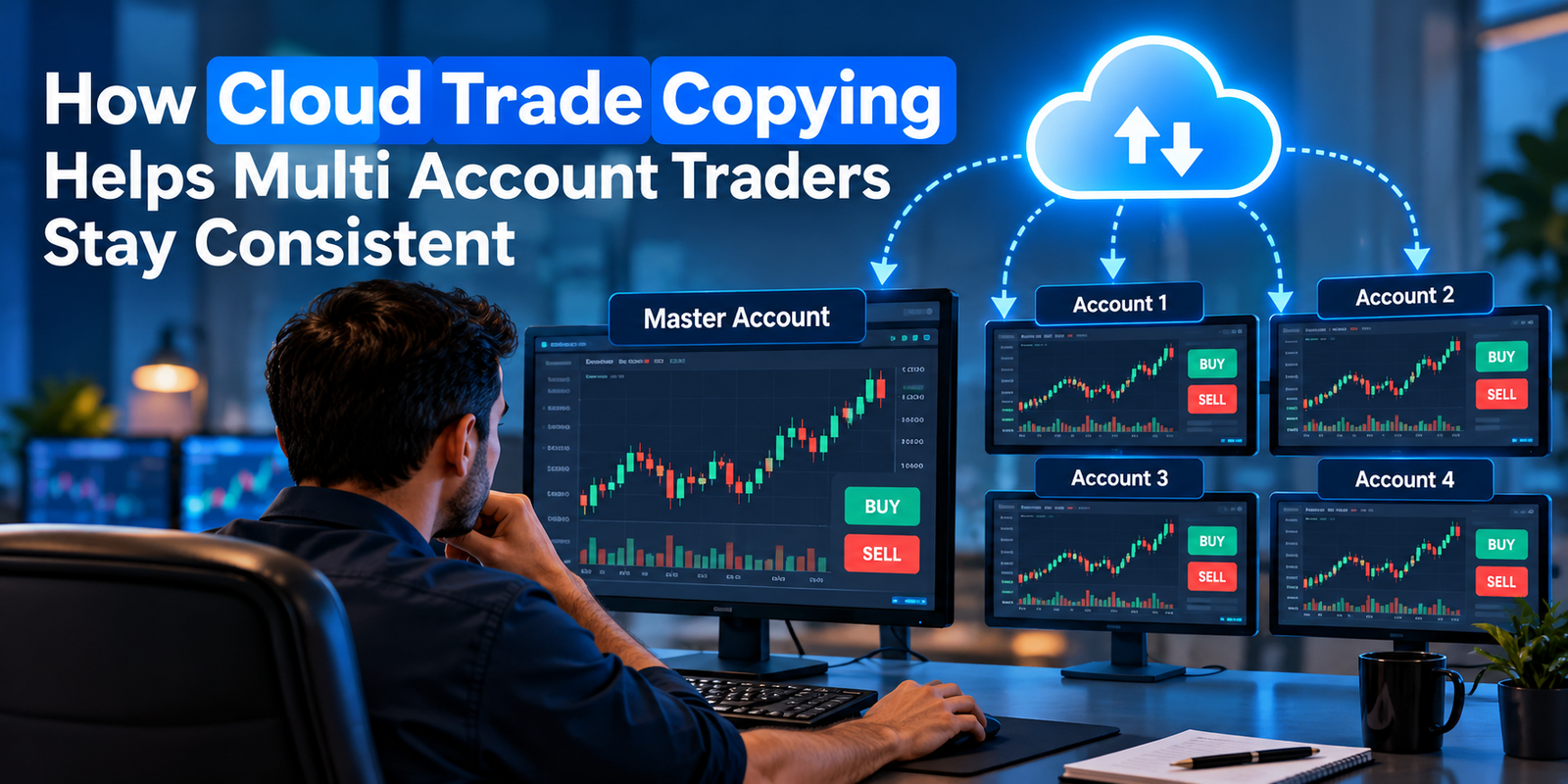
Cloud trade copying is a system that replicates trading actions from one account to other connected accounts through remotely hosted infrastructure. The primary account, commonly called the master account, generates trading instructions. The connected follower accounts then attempt to reproduce those instructions according to their configured settings.
Depending on the platform, copied actions may include opening positions, modifying stop-loss and take-profit levels, partially closing trades, and exiting positions completely. Some systems also support pending orders, although the available functionality depends on the copier and the connected trading platforms.
The cloud-based component is particularly important. Instead of depending entirely on a trader’s personal computer, the copying service operates on remote infrastructure designed to remain available while the trader’s device is offline.
For example, imagine a trader managing four accounts that follow the same strategy. When the trader opens a position on the master account, the copier sends the corresponding instruction to the four follower accounts. Each account executes the order according to its own configuration, including any position-sizing rules or instrument mappings.
This approach reduces the need to repeat the same order manually across several platforms. It also creates a more organized execution process, especially when the trader needs to manage accounts during fast-moving market conditions.
Why Multi Account Traders Need a Consistent Execution Process
Trading multiple accounts introduces operational complexity that does not necessarily exist when managing a single account. Each additional login creates another opportunity for an execution error.
A trader might enter a position on one platform but forget to open it on another. A stop-loss adjustment may be applied to three accounts but overlooked on the fourth. Alternatively, an order intended for a smaller account might be entered with a position size suitable for a larger balance.
These mistakes can produce inconsistent exposure even when the underlying trading strategy remains unchanged.
Cloud trade copying helps address this problem by centralizing trade initiation. Instead of manually reproducing every action, the trader uses one account as the primary source of instructions.
Consistency also matters when reviewing performance. If several accounts follow the same strategy but receive substantially different entries and exits because of manual execution errors, comparing their results becomes more difficult. Automated copying can reduce these avoidable differences and make performance analysis more meaningful.
Nevertheless, consistency does not mean identical results. Differences in spreads, liquidity, execution policies, and account restrictions can still affect individual outcomes.
How Cloud Infrastructure Improves Operational Reliability
Traditional trade copying arrangements sometimes depend on a local computer running trading software continuously. If the computer shuts down, the application crashes, or the internet connection fails, copying may stop until the problem is resolved.
A cloud-based copier moves the copying process to remote infrastructure, reducing dependence on the trader’s personal device and home internet connection.
This arrangement can be especially useful for traders who travel frequently, work on other projects, or manage accounts across different trading sessions. Once the accounts are connected and the required settings are configured, the service can continue processing supported copying instructions without requiring the trader to keep a personal computer running.
However, cloud hosting should not be confused with a guarantee of uninterrupted service. A cloud platform may experience maintenance, technical failures, connectivity problems, or disruptions involving a broker or trading platform.
Before choosing a provider, traders should understand its service availability, monitoring capabilities, recovery procedures, and approach to handling interrupted connections. It is also worth checking whether follower accounts can reconnect automatically and how the system identifies trades that were missed during an outage.
A reliable setup should make interruptions visible rather than silently allowing account positions to become inconsistent.
Why Real-Time Synchronization and Latency Matter
Latency refers to the time required for information to travel through a system and produce a response. In cloud trade copying, this includes the time between a trading action on the master account and the corresponding instruction reaching a follower account.
Low latency can help follower accounts respond more quickly, but speed alone does not guarantee accurate execution.
Consider a strategy that enters a position when a particular market price is reached. If the master account executes at one price and the follower accounts receive their instructions several moments later, market movement may cause the followers to enter at different prices.
This difference is known as execution slippage. It can become particularly important during economic announcements, sudden price movements, periods of reduced liquidity, or other volatile market conditions.
Traders should therefore evaluate copying performance under realistic trading conditions rather than relying exclusively on advertised synchronization speeds.
Important questions include whether copying remains active when the local computer disconnects, how the system handles rejected orders, whether it detects partial fills, and what happens when a follower account cannot execute an instruction.
It is equally important to understand how stop-loss and take-profit modifications are synchronized. Opening a position successfully is only one part of the process; subsequent changes must also reach the relevant follower accounts.
Position Sizing Across Accounts With Different Balances
One of the most important features of a multi account trade copier is flexible position sizing.
Accounts rarely have identical balances, leverage arrangements, or risk restrictions. Copying the same fixed lot size to every account may therefore create significantly different levels of risk.
For example, a position size that is reasonable for a $50,000 account may be excessive for a $10,000 account. Using the same lot size across both accounts would not preserve the same proportional exposure.
A copier may offer several sizing methods to address this problem.
Proportional sizing adjusts the follower’s position size according to a selected multiplier or account-size relationship. This can help maintain more comparable exposure across accounts, although balance-based scaling alone does not guarantee equal risk.
Fixed lot sizing assigns a predetermined position size to each follower. This may be useful when a strategy requires specific position sizes, but it needs careful consideration when account balances differ.
Risk-based sizing determines position size using factors such as account equity, stop-loss distance, instrument specifications, and the maximum acceptable monetary loss. Where supported, this approach can offer a more meaningful way to align risk across accounts.
For example, a trader who intends to risk 0.5% of an account on a trade should consider the distance to the stop-loss and the instrument’s value per price movement when calculating the appropriate position size.
The key is to distinguish between copying the same trade and copying the same level of risk. These are not necessarily equivalent.
Essential Risk Controls for Multi Account Trading
Automating trade execution does not eliminate the need for risk management. In fact, an incorrectly configured copier can distribute an error across every connected account in seconds.
A suitable system should provide controls that help limit exposure and prevent unintended position sizes.
Maximum lot limits can restrict the size of individual orders. Maximum open-position settings can prevent a strategy from accumulating more simultaneous trades than intended. Account-level allocation rules can help ensure that each follower receives only the trades and position sizes appropriate for its circumstances.
Where supported, daily loss limits and equity-based restrictions can provide additional safeguards. Traders should verify exactly how these controls operate, including whether they merely stop new orders or can also close existing positions.
Symbol mapping is another important consideration. Different brokers may use different names for the same underlying instrument. A currency pair, index, or commodity may have a suffix or other naming variation on one platform. Incorrect mapping can prevent an order from being copied or, in the worst case, direct it to an unintended instrument.
Traders should also establish a clear response to synchronization failures. If one follower misses a stop-loss modification or fails to close a position, the system should provide enough information to identify the discrepancy and take corrective action.
Risk controls should be tested before live deployment, especially when they involve automatic position closures or account-wide restrictions.
Managing Prop Firm Accounts More Effectively
Proprietary trading firm accounts can introduce additional requirements that make centralized execution attractive. Depending on the firm and account type, traders may need to observe daily loss thresholds, maximum drawdown limits, restrictions on certain trading practices, or rules governing automated execution and account relationships.
A cloud trade copier can reduce repetitive order entry when a trader is permitted to use copying tools across the relevant accounts. However, using a copier does not automatically make a trading arrangement compliant.
Each firm may have different policies regarding external copying, third-party signals, account coordination, automated strategies, and trades shared between accounts. Some firms may impose restrictions that make a particular configuration unsuitable.
Before connecting any prop firm account, review the current rules of the specific provider. Confirm whether the intended copying arrangement is allowed, whether accounts must belong to the same trader, and whether any restrictions apply to external signals or automated execution.
Account limits also deserve special attention. A trade that is acceptable for one account may violate the drawdown limit of another account with a different balance or existing loss position.
For this reason, a copier should not be treated as a substitute for account-specific risk management. Traders should configure individual limits and monitor each account’s remaining risk capacity.
Choosing a Cloud Trade Copier
Selecting a cloud trade copier requires evaluating more than its advertised features. The appropriate solution should fit the trader’s platforms, account structure, execution requirements, and risk-management approach.
Compatibility is a sensible starting point. Confirm that the service supports the trading platforms and brokers involved in the intended workflow. Check whether it can connect the required number of accounts and whether all essential actions can be copied.
Execution behavior should be examined next. Find out how the system handles order rejection, partial fills, market closures, connection interruptions, and modifications to existing trades. These details often matter more in practice than a headline latency figure.
Security is equally important because the service may interact with several trading accounts. Review its authentication process, account connection method, permission requirements, and data protection practices. Avoid providing unnecessary account permissions, and never share withdrawal credentials when they are not required for the service.
Cost and scalability should also be considered. A service that works well for two accounts may have different pricing or operational limitations when expanded to ten or more accounts. Evaluate the total cost alongside account limits, platform support, monitoring tools, and available technical assistance.
If you want to explore a cloud-based option for coordinating trades across multiple accounts and brokers, TradeSyncer is worth reviewing. Examine its current platform compatibility, synchronization capabilities, supported account connections, and risk-management features to determine whether it meets your requirements.
No provider should be selected solely on marketing claims. Verify important capabilities through product documentation and controlled testing before connecting accounts that carry meaningful financial risk.
A Practical Setup Workflow for Cloud Trade Copying
A structured setup process helps reduce configuration errors and makes it easier to identify problems before they affect live trading.
Start by selecting a master account with a clearly defined strategy and established risk rules. Decide whether trades will be entered manually or generated by an automated trading system. The master account should represent the strategy that follower accounts are intended to reproduce.
Next, connect the follower accounts and confirm that each account is authorized to trade the instruments involved. Review differences in contract specifications, minimum trade sizes, volume increments, and trading hours. These differences can prevent an otherwise valid master order from being reproduced exactly.
Configure position sizing separately for each follower. Establish appropriate maximum exposure, open-position limits, and any account-specific restrictions supported by the platform. Map instruments carefully when broker symbols differ.
The next step is to test the full trade lifecycle. Use a demo environment or another suitable low-risk testing arrangement to check whether opening orders, stop-loss changes, take-profit modifications, partial closes, and full exits behave as expected.
During testing, compare the master and follower accounts rather than assuming that successful order transmission guarantees successful execution. Record differences in entry prices, volumes, and execution times.
Finally, establish a monitoring routine. Review account status, failed orders, exposure, and synchronization warnings. Keep a documented procedure for pausing copying, handling discrepancies, and recovering from interruptions.
A small, controlled test is more useful than immediately connecting every account and assuming the configuration is correct.
Common Mistakes That Can Undermine Copying Performance
One frequent mistake is assuming that identical order instructions will produce identical results. In reality, differences in spreads, commissions, execution speeds, and available liquidity can cause follower accounts to perform differently.
Another mistake is using a single position-sizing multiplier without accounting for instrument volatility, stop-loss distance, and contract specifications. A multiplier may scale trade volume, but it does not necessarily equalize the amount of money at risk.
Ignoring failed or partially executed orders can also create serious problems. If the master account closes a position but a follower retains it, that follower is no longer following the intended strategy. Traders need a way to detect and resolve such discrepancies promptly.
Finally, some traders treat automation as a reason to stop monitoring their accounts. This defeats an important part of responsible trade management. Automation reduces repetitive work, but it does not remove the need to supervise the system, review performance, and respond to technical problems.
Conclusion
Cloud trade copying provides multi account traders with a more organized way to coordinate execution across supported brokers and trading platforms. By centralizing trade instructions, reducing repetitive order entry, and applying account-specific position-sizing rules, it can help limit operational mistakes and improve execution consistency.
The quality of the overall workflow depends on several factors, including synchronization reliability, platform compatibility, risk controls, and the ability to detect failed or incomplete orders. Traders must also account for differences in execution prices, trading costs, account restrictions, and market conditions.
The most effective approach combines automation with disciplined risk management. Select a compatible service, test its behavior carefully, configure independent limits for each account, and monitor follower execution throughout the trading process.
A cloud trade copier can make multi account management more efficient, but it cannot guarantee identical fills, prevent every technical failure, or make an unsuitable trading strategy profitable. Its value lies in improving the execution process while keeping risk management and human oversight firmly in place.
Risk Disclaimer
Trading financial instruments involves substantial risk, and losses can exceed expectations depending on the instrument, leverage, and account arrangement. Trade copying may replicate mistakes across multiple accounts and amplify both gains and losses. Slippage, price gaps, broker outages, rejected orders, and synchronization failures can affect results. Always test a copying system before relying on it for live trading, use appropriate risk limits, and verify the rules of every broker or proprietary trading firm involved. This article is for informational purposes only and does not constitute financial or investment advice.