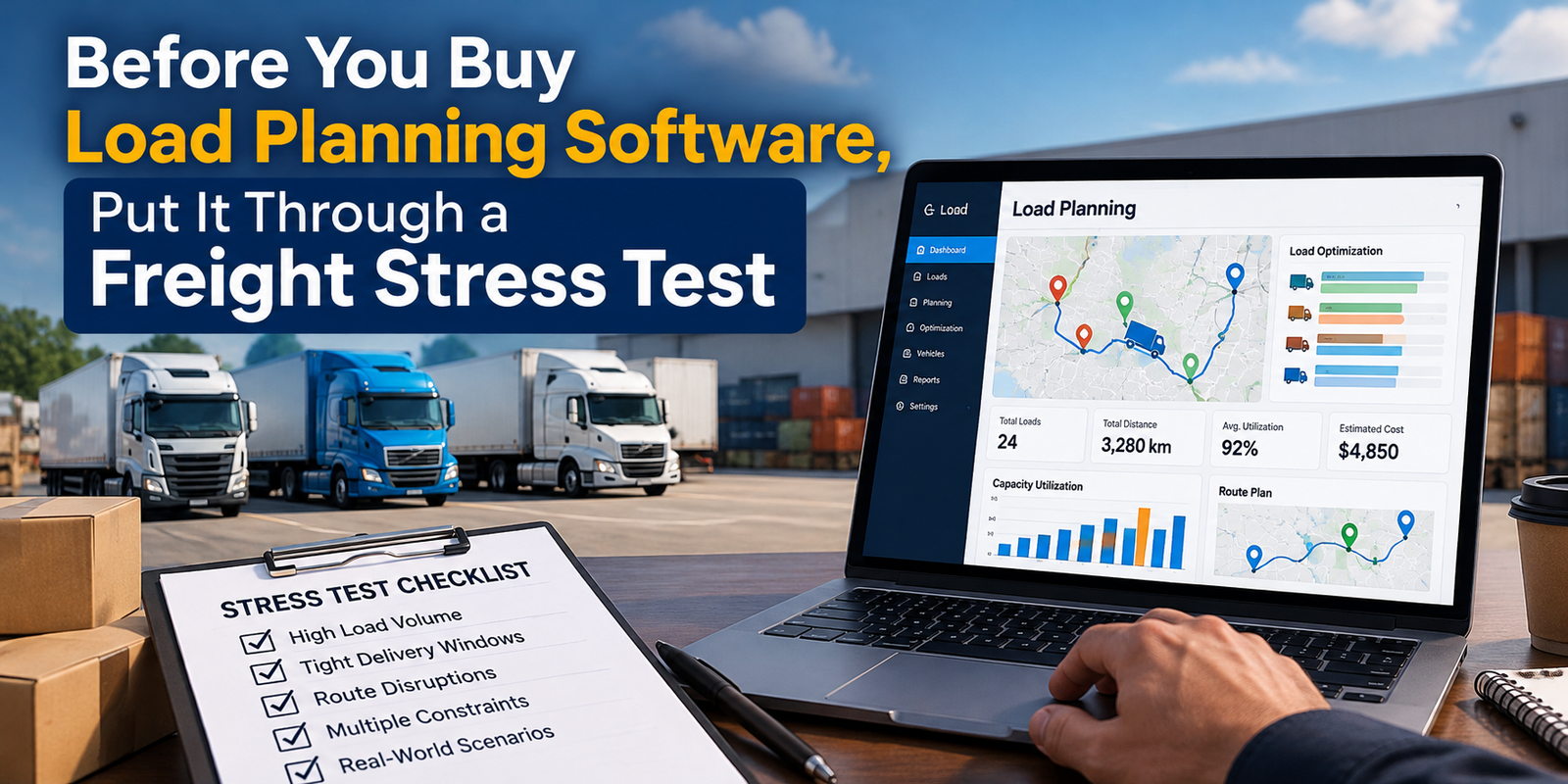
Before You Buy Load Planning Software, Put It Through a Freight Stress Test
Software demonstrations make loading look easy. Cartons are neatly measured, the vehicle is the right size, and nothing changes after the plan appears. But procurement teams need to know whether those results hold up with real shipments.
The better question isn’t, “Can this software draw a loading plan?” It’s “What happens when we give it freight that our planners struggle with?” A controlled trial provides a better answer than a polished presentation.
Why Last Month’s Difficult Shipments Matter
Start with three completed shipments. Historical orders let you compare proposed arrangements with the original plan and the constraints encountered during loading.
One might involve 18 mixed pallets, including a tall unit that cannot be stacked. Another could combine deliveries for two stops. The third might be an export consignment with crates and limited container-door access.
Don’t select three disasters, though. Include one ordinary shipment to see whether load planning software improves routine work, not just exceptional cases.
Ask the supervisor who handled each departure what changed on the dock. A note such as “crate would not clear the rear door” tells you more than a generic delay code.
The Hidden Cost of Getting Shipment Data Ready
The timer should start before anyone presses “calculate”.
Ask a planner to prepare the information used in normal operations: packed dimensions, gross weights, quantities, and usable vehicle measurements. A pallet listed at 1,200 × 800 mm may occupy more space when wrapping or when overhanging cartons are included.
Record fields that needed correction or duplicate entry. If importing orders takes five minutes but cleaning data takes twenty, then preparation took twenty-five minutes.
Verify how cargo loading software accepts files, handles measurement units, and exports plans. Consider whether shipment details should be anonymized before loading them into an external platform. Hidden administrative work belongs in the evaluation.
Keep the original records alongside the corrected test inputs. Otherwise, you may credit the software for improvements that actually came from painstaking manual cleanup.
Where Loading Plans Start to Break Down
Give every candidate the same inputs and assessment criteria.
| Test shipment | Deliberate complication | What counts as a useful result |
| Mixed pallets | One item cannot be stacked or tilted | Restrictions appear in a workable plan |
| Two-stop delivery | First-stop freight needs access | Unloading requires no needless rehandling |
| Export container | A large crate must pass through the door | Entry dimensions and handling are respected |
Then change one condition at a time: add two pallets, substitute a smaller vehicle, or mark an item as fragile. Time each replan and note any conflicts. Record whether the adjustment takes a few clicks or forces the planner to rebuild the shipment. That difference matters when customers amend orders after booking.
Truck loading software and container loading software deserve different tests. For trucks, axle loads, payload limits, and delivery orders may be central. For containers, door openings, floor loading, and placement sequence may matter more. Neither should be judged on cubic-space utilization alone.
Teams can explore a full-version trial at easycargo3d.com using the same historical shipments and criteria applied to competing options. Judge how the plan handles complications, not how attractive its 3D image looks.
When the Loading Diagram Meets the Forklift
A neat diagram can conceal a blocked forklift path. Have an experienced loader review the proposed sequence.
Can the heavy crate actually be positioned? Is there clearance for equipment? Can early-stop deliveries be retrieved without unloading half the vehicle?
A visual plan is not proof of safe transport. Cargo loading software may support placement decisions, but vehicle mass limits, axle loads, load restraint, and applicable transport rules still require verification by qualified staff.
Faster Planning Doesn’t Always Mean Lower Costs
Suppose a team prepares 25 load plans weekly. The old process takes 18 minutes per plan; a replacement takes 11. That’s 175 minutes saved—almost three hours.
But if employees spend four additional minutes correcting data for each plan, deduct 100 minutes. Net savings shrink to 75 minutes weekly. These are illustrative figures, not vendor results.
For a credible business case, include preparation, revisions, communication, and remaining manual checks. Don’t assume fewer trips or lower emissions unless shipment comparisons demonstrate those outcomes.
What Really Matters When Choosing a Loading Tool
Before purchasing, agree on a scorecard: total planning time, ease of revision, respect for restrictions, clarity of output, and integration with existing processes. Establish who maintains cargo data, who approves changes, and how the final plan reaches loading staff.
A team choosing truck loading software may prioritize multiple stops; one evaluating container loading software may focus on mixed-size exports. The right choice follows the operational bottleneck, not the longest feature list.
A successful trial should produce clear evidence: tested manifests, documented changes, rejected arrangements with explanations, and a realistic estimate of work saved. If the software cannot handle three representative shipments without repeated workarounds, there’s little reason to approve the purchase based on an impressive demonstration.