Is 3I/ATLAS the Next Big Discovery in Interstellar Research?
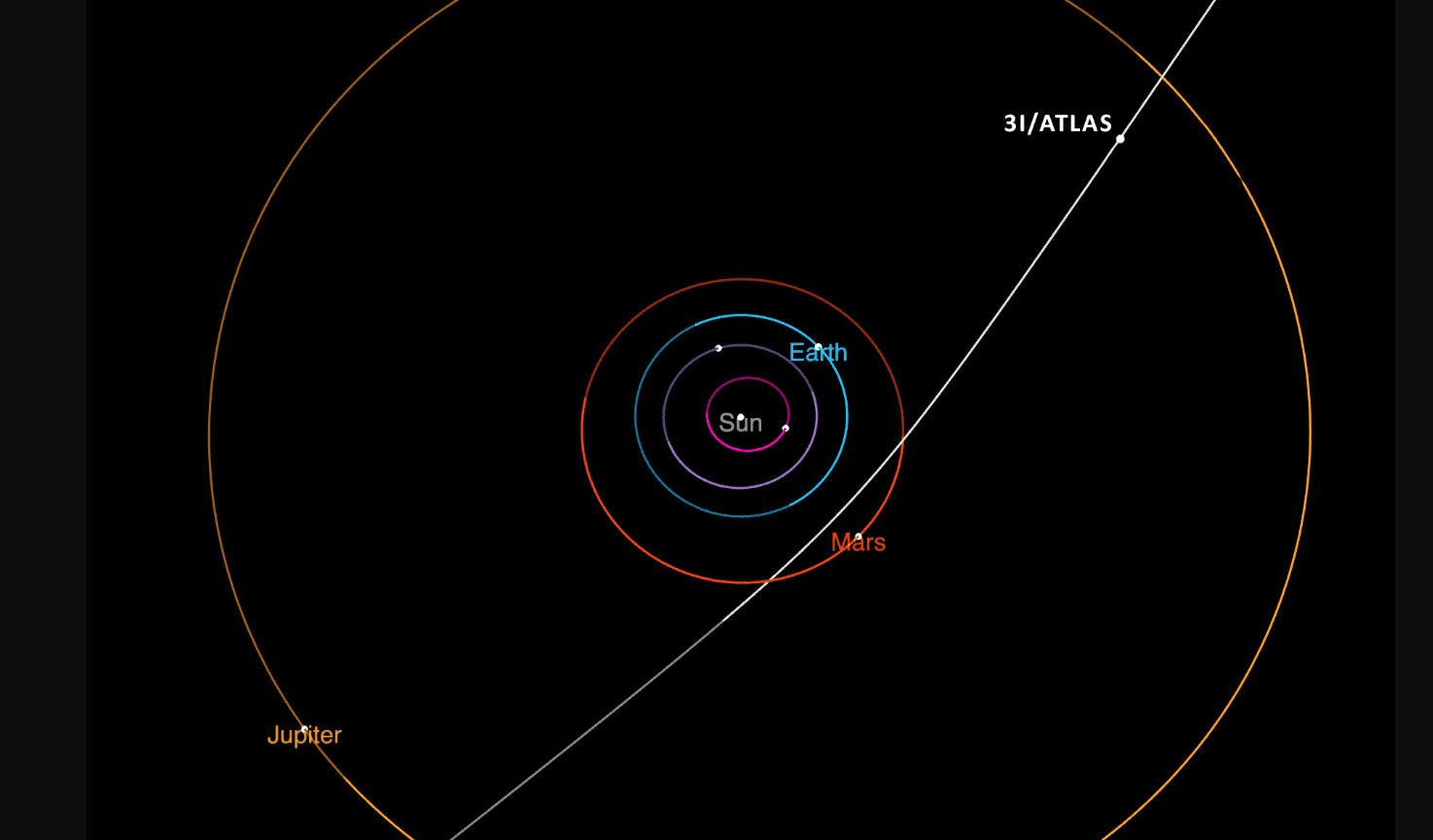
The world learned of a new interstellar visitor, an enigmatic body whose name is 3I/ATLAS, in July 2025, the third such object to be documented cruising through our solar system. After the mysterious interstellar visitors ‘Oumuamua and Comet Borisov, 3I/ATLAS excites scientific and speculative interest more than ever. As the comet approaches Jupiter in March of 2026, astronomers and scientists are asking new questions about where it came from, what it’s made of, and even if it’s connected to some sort of alien technology.
The question is, should NASA’s Juno spacecraft investigate this farther-out object?
What is 3I/ATLAS Interstellar Object?
Telescopes on Earth got a glimpse of the 3I/ATLAS Interstellar Object in July 2025. It is moving quickly away from the Sun at 58 km/s, which is another sign that it is not being held in place by gravity. This one is from farther away, outside of our solar system, and it moves like a big comet or an asteroid. The new comet has a wide core that is 3.5 miles (5.6 km) across. This is different from the ‘Oumuamua and Borisov comets, which have longer or more irregular shapes. It is an interesting thing to study because it is moving quickly and came from somewhere outside our solar system.
The Potential of Juno’s Investigation
The spacecraft Juno has been orbiting Jupiter for a few years now. It has some of these high-tech science instruments, such as a magnetometer, a near-infrared spectrometer, and cameras that can study the makeup and behaviour of objects in the interstellar space in great detail. Juno could look at the 3I/ATLAS Interstellar Object’s makeup and even find its coma and dust tail, which are more complicated to see from Earth and therefore complex to judge.
It will hit 3I/ATLAS close to its closest approach to Jupiter while the Juno mission is on a path around Jupiter that is helped by gravity and moving at the right speed and direction to get to its final destination by March 16, 2026. Hubbard and his team say that each last-second course correction could be avoided with as little as 5.4% of Juno’s remaining fuel. According to VanKirk, this would extend the mission duration of the project, which is valued at more than $1 billion.
This important event for the study and finding of the solar system is set to happen in September 2025. If it works, Juno will be able to gather an unprecedented amount of information about 3I/ATLAS. This could include everything from the asteroid’s makeup to signs of alien technology, which could help us learn more about the world beyond our solar system.
Why Investigate 3I/ATLAS?
There is an array of opportunities to pay attention to 3I/ATLAS. The first reason is that it gives scientists a chance to study a real interstellar object, which might help them learn more about the kinds of materials that are found in other star systems. Some people think it might be something other than a comet or a rock because of its strange path and fast speed. Avi Loeb, a professor at Harvard, made the controversial claim that 3I/ATLAS might be “alien tech.” He said this in Nature when the object was only 0.5 AU from Earth, and it has caused both joy and scepticism among scientists.
As was already said, Loeb co-wrote a study that said the object’s strange orbit and strange speed could be signs of something much more artificial, like being sent there on purpose. Some people are talking about spending more money on a study into “technosignatures,” which are signs of alien technology that can’t be seen with the naked eye. Loeb’s idea is still just a guess, but it has sparked a lot of attention and calls for more research.
Why Some Experts Disagree With 3I/ATLAS?
Some people don’t agree with Loeb on this. Ross Coulthart, an investigative reporter and special correspondent for NewsNation, wasn’t as excited about the idea that going after 30 cubes could take resources, like NASA‘s Juno spacecraft, away from other jobs. Even though the idea of alien technology is interesting, Coulthart says there isn’t much solid proof to suggest that 3I/ATLAS is anything other than a naturally born object. Coulthart says that taking Juno off-course to study C/2019 Q4 would be wasteful and expensive because it could take resources away from the probe’s main job, which is to study Jupiter.
“From what we know about these things, it would be crazy to think that they are hostile alien probes, and I don’t think it’s a good idea to try to redirect an existing spacecraft like Juno,” Coulthart said, adding that people should first try to gather as much evidence as they can before coming to any conclusions.
Should We Investigate Alien Tech?
The bigger question that the discussion will unintentionally bring up is: Do we as a species need to start spending money on technology that might help us find the rest of the “extraterrestrial” tech? In that conversation, Coulthart said many other things that made me think about the need to be sceptical. Loeb’s request for money to look for technosignatures only shows how frustrated scientists are that the SETI/techno signatures field has been underfunded and poorly understood.
People disagree with Loeb’s idea, but it has made people wonder if other species are advanced enough to build their own probes for exploring other stars. And even if 3I/ATLAS turns out to be fake, the mission could lead to more missions that explore even deeper into space..
The Future of 3I/ATLAS Interstellar Object Exploration
Juno will be directed to study 3I/ATLAS in an exciting process that opens up new ways to find objects between the stars. If this mission succeeds, it could lead to later missions that study objects between the stars and give us a lot of valuable scientific data. The question is whether scientists can be careful and cautious in their search for the truth while still being curious about things that take people further into the dark.
It must be exciting to think about finding alien technology, but reports like these should be carefully looked into by scientists. 3I/ATLAS Interstellar Object might be the first of its kind because it could be sunny, but its unique qualities should make it a good place for some new shocks.
Juno is already in orbit around Jupiter. It has several high-tech natural gas analysers on board that could help figure out what cosmic objects like Rama are made of and how they behave. Making these kinds of studies could help us figure out what 3I/ATLAS is made of and how the materials in interstellar space are different from those in our solar system.
FAQs
What is 3I/ATLAS?
After ‘Oumuamua and Comet Borisov, 3I/ATLAS is the third object in our solar system that is not a planet. It was found on July 17, 2025, by A. López and P. Bescansa at the Cañadon León Observatory in Agatha.
Why is Juno being considered to study 3I/ATLAS?
Juno is already in orbit around Jupiter. It has several high-tech natural gas analysers on board that could help figure out what cosmic objects like Rama are made of and how they behave. Making these kinds of studies could help us figure out what 3I/ATLAS is made of and how the materials in interstellar space are different from those in our solar system.
What’s the theory behind 3I/ATLAS being alien tech?
Avi Loeb, a scientist at Harvard, recently said that the object’s strange path and speed could mean that it was made by aliens, like a probe from deep space.
Why do some experts disagree with investigating 3I/ATLAS as alien tech?
Ross Coulthart and other specialists argue that the theory of alien technology isn’t backed by sufficient real-world proof. Researchers are adamant that it might just be a natural object in the outer space and that sending Juno to look into it would be a waste of time and money.