What are your rights and obligations when injured at work in Victoria?
- 0.1 Your rights after a workplace injury in Victoria
- 0.1.1 Entitlements available
- 0.2 Access to common law damages
- 0.3 Privacy, medical information, and choice of treating practitioner
- 1 Employee obligations after an injury
- 1.1 Immediate actions at the workplace
- 1.2 Medical certificates and following treatment plans
- 1.3 Reporting and lodging a claim
- 1.4 Employer and insurer responsibilities
- 1.4.1 Employer duties
- 1.5 Insurer role and obligations
- 1.6 Reporting notifiable incidents to WorkSafe
- 1.7 Step-by-step claim process
- 1.8 Submitting and tracking the claim
- 1.9 If the insurer accepts the claim
- 1.10 If the insurer denies the claim
- 1.11 Time limits and deadlines
- 1.11.1 Claim lodgement timeframes
- 1.12 Time limits for legal proceedings
- 1.13 Return to work and rehabilitation
- 1.14 Reasonable adjustments and workplace modifications
- 1.15 Vocational rehabilitation and retraining options
- 1.16 What to do if your claim is disputed or refused
- 1.17 External dispute resolution options
- 1.18 Getting help from a union, legal adviser, or specialist practitioner
- 2 Conclusion
Workplace injuries can be physically, emotionally, and financially challenging. Understanding your rights and responsibilities in Victoria’s workers’ compensation system is crucial for protecting your wellbeing and entitlements. If you’ve been injured at work, knowing how to access legal assistance for Workcover claims can make a significant difference in your recovery journey and financial outcomes.
- Injured workers in Victoria are entitled to income support, medical treatment costs, rehabilitation services, and potential lump-sum compensation.
- Employees must report injuries promptly, obtain medical certificates, and actively participate in treatment and rehabilitation.
- Employers must maintain workers’ compensation insurance, provide a safe workplace, and support injured workers’ return to work.
- Time limits apply to claim lodgement and legal proceedings, so prompt action is essential.
- Various dispute resolution options exist if your claim is contested or denied.d
Your rights after a workplace injury in Victoria
Entitlements available
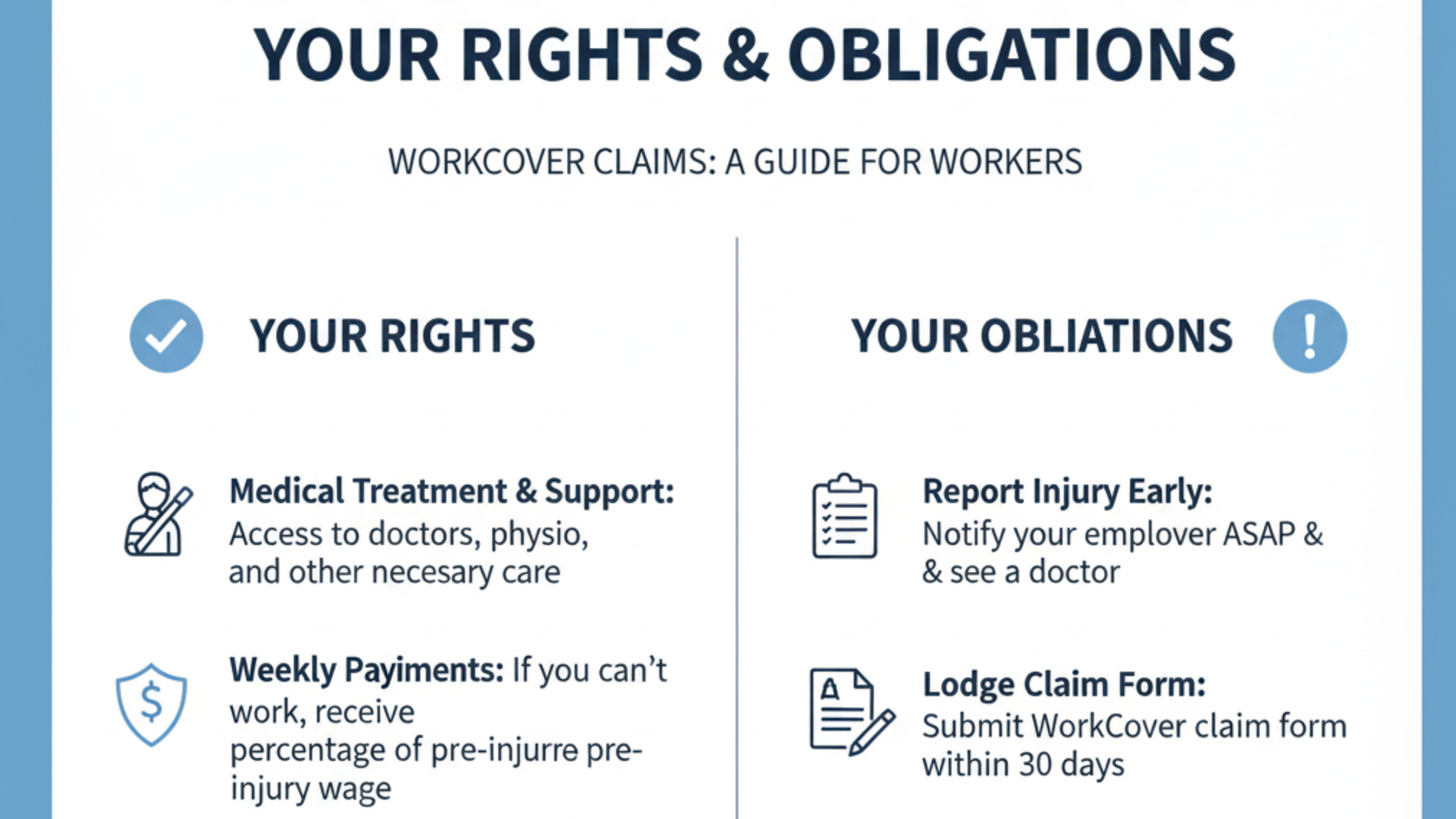
Victorian workers who suffer work-related injuries can access several benefits through the WorkSafe system. These include weekly payments to replace lost income (typically up to 95% of pre-injury earnings initially), coverage for reasonable medical and allied health treatment costs, and rehabilitation services to support recovery.
For those with permanent impairments, lump-sum compensation may be available depending on the assessed level of impairment. In tragic cases involving fatalities, dependents may receive death benefits and funeral expense contributions.
Access to common law damages
Beyond the standard WorkSafe entitlements, seriously injured workers may have the option to pursue common law damages. This pathway requires meeting the “serious injury” threshold and establishing that the employer was negligent in causing your injury.
The process typically involves two main stages: proving your employer’s liability and assessing appropriate damages. Given the complexity and higher stakes of common law claims, seeking specialized legal advice is recommended if your injury has significant long-term impacts.
Privacy, medical information, and choice of treating practitioner
You maintain certain privacy rights regarding your medical information, though some details will need to be shared with your employer and the insurer to process your claim. You have the right to choose your treating doctor and can seek second opinions about your condition or treatment options.
Medical records relevant to your claim must be handled confidentially, with insurers only permitted to access information directly related to your workplace injury.
Employee obligations after an injury
Immediate actions at the workplace
After suffering a workplace injury, your priority should be seeking appropriate medical attention, whether that’s first aid or emergency care. Once your immediate health needs are addressed, report the incident to your supervisor or manager as soon as possible.
Document the details of what happened while the event is fresh in your memory. Where safe to do so, preserve evidence by taking photos and noting witness names. These records may prove valuable if your claim is later questioned.
Medical certificates and following treatment plans
Obtain medical certificates from your treating practitioners and keep copies for your records. These certificates are crucial for validating your injury and supporting your claim for benefits.
You’re required to attend scheduled medical appointments and participate in recommended rehabilitation activities unless you have a valid medical reason not to do so. Following your treatment plan demonstrates your commitment to recovery and can positively influence your claim.
Reporting and lodging a claim
Notify your employer about your injury as soon as practicable and follow their internal reporting process. Complete the WorkSafe claim form or employer-provided claim documents thoroughly and accurately.
Always keep copies of all submissions and correspondence related to your claim. This documentation creates a paper trail that may be important if disputes arise later.
“The period immediately following a workplace injury is often overwhelming, but taking these initial steps correctly can significantly impact the success of your compensation claim and recovery journey.” – National Compensation Lawyers.
Employer and insurer responsibilities
Employer duties
Employers in Victoria must maintain valid workers’ compensation insurance and keep accurate records of workplace injuries. They have a legal obligation to provide a safe working environment and respond appropriately to reported incidents.
When an employee is injured, employers must cooperate with injury management processes and offer suitable duties where possible to facilitate a return to work. They cannot discriminate against workers who make compensation claims.
Insurer role and obligations
Insurers are responsible for assessing claims, communicating decisions clearly, and paying valid entitlements promptly. They must provide or coordinate rehabilitation and return-to-work support for injured workers.
If a claim is denied or benefits are reduced, insurers must explain the reasons for their decision and inform claimants about available review options.
Reporting notifiable incidents to WorkSafe
Certain serious incidents must be reported directly to WorkSafe Victoria. These include fatalities, serious injuries requiring immediate medical treatment, and dangerous occurrences that could have caused serious injury or death.
Employers have specific obligations following serious incidents, including preserving the incident site and cooperating with WorkSafe investigations.
Step-by-step claim process
Immediate medical care and documentation
After receiving medical attention, collect documentation from your healthcare providers, including certificates of capacity, treatment plans, and medical reports. Keep organised records of all medical evidence at home.
Submitting and tracking the claim
Claims are typically lodged through your employer, who must forward your claim to their insurer within 10 days. The insurer generally has 28 days to decide on your claim, though this may be extended in complex cases.
During the assessment period, stay in regular contact with your employer and the claims agent to monitor progress.
If the insurer accepts the claim
When your claim is accepted, you’ll begin receiving applicable benefits and work with your employer and the insurer to develop a return-to-work plan when appropriate. Maintain open communication about your recovery progress and any changes in your condition.
If the insurer denies the claim
Should your claim be denied, you can request a written explanation of the decision. Options include requesting an internal review by the insurer or pursuing formal dispute resolution through the Accident Compensation Conciliation Service.
Time limits and deadlines
Claim lodgement timeframes
While you should report injuries as soon as possible, Victorian law allows claims to be lodged within 30 days of becoming aware of your injury. For weekly payments, claims must generally be made within six months of the injury, though extensions may be possible in certain circumstances.
Acting promptly not only helps meet statutory requirements but also ensures smoother access to benefits when you need them most.
Time limits for legal proceedings
More stringent deadlines apply if you’re considering legal action beyond the standard WorkSafe claim. Common law claims typically must be commenced within six years of the date of injury, but other procedural steps have much shorter timeframes.
Given these constraints, early legal advice is essential if you believe you may have grounds for a common law claim.
Return to work and rehabilitation
Return-to-work plans and suitable duties
A comprehensive return-to-work plan should outline your capabilities, any required workplace modifications, hours of work, and a timeline for increasing duties. It should be developed collaboratively between you, your employer, healthcare providers, and the insurer.
Reasonable adjustments and workplace modifications
Reasonable workplace adjustments might include modified equipment, altered work schedules, or physical changes to the workplace. These modifications are typically arranged by your employer with input from occupational therapists or rehabilitation providers.
Vocational rehabilitation and retraining options
If you cannot return to your pre-injury role, vocational rehabilitation services may be provided to help you transition to suitable alternative employment. This might include skills assessment, career counselling, training programs, or job-seeking assistance.
What to do if your claim is disputed or refused
Requesting an internal review from the insurer
Your first step should be requesting the insurer review their decision. Provide any additional information that might support your claim and clearly explain why you believe the decision should be reconsidered.
External dispute resolution options
If the internal review is unsuccessful, you can proceed to conciliation through the Accident Compensation Conciliation Service. This is a mandatory step before taking the matter to court. If conciliation doesn’t resolve the dispute, you may proceed to the Workers Compensation Tribunal or court, depending on the nature of your dispute.
Getting help from a union, legal adviser, or specialist practitioner
Professional advice becomes particularly valuable when facing disputes or complex claims. Unions often provide support services for injured workers, while specialized legal practitioners can advocate on your behalf through formal proceedings.
Conclusion
Navigating the workers’ compensation system after a workplace injury involves understanding both your rights and obligations. By promptly reporting injuries, actively participating in your recovery, and seeking appropriate assistance when needed, you can maximize your chances of a positive outcome.
Remember that each workplace injury is unique, and the specific circumstances of your situation may require personalized guidance. If you’re facing challenges with your claim or considering your legal options, National Compensation Lawyers can provide the expert support needed to protect your interests and secure the compensation you deserve.