The Tragic Quadrant of Cyber Threats: Understanding the Hidden Dangers Behind Modern Cyberattacks
- 1 Why Modern Cyber Threats Are Becoming More Difficult to Identify
- 2 Understanding the Tragic Quadrant Approach to Cybersecurity
- 3 Remote Monitoring and Management Abuse: A Serious Security Concern
- 4 Business Email Compromise and the Hidden Danger of Mailbox Manipulation
- 5 Multi-Factor Authentication Bypass and Account Takeover
- 6 Device Code Phishing: Exploiting Legitimate Authentication Workflows
- 7 ClickFix Attacks: When Copying and Pasting Becomes Dangerous
- 8 AI-Powered Cyber Threats and the Abuse of Trusted Platforms
- 9 Why Small and Medium-Sized Businesses Need Stronger Cybersecurity
- 10 Building a Proactive Strategy to Reduce Cybersecurity Risks
- 11 Conclusion
Cybersecurity has become one of the most important priorities for businesses of every size. As organizations increasingly depend on cloud platforms, remote access technologies, digital communication, and connected devices, their exposure to cyber threats continues to expand. While major ransomware attacks and large-scale data breaches often dominate headlines, many of the most damaging incidents begin with seemingly ordinary activities that employees and IT teams perform every day.
A suspicious email, an unexpected software installation, an unusual login request, or a small change to an email account can provide attackers with the access they need to compromise an entire organization. These incidents demonstrate that modern cybercrime is not always about exploiting complicated software vulnerabilities. In many cases, criminals succeed by abusing legitimate business tools, manipulating trusted workflows, and taking advantage of gaps in everyday security practices.
Understanding which cyber threats deserve immediate attention is therefore essential. Businesses need to look beyond popular cybersecurity headlines and evaluate attacks based on how frequently they occur, how easily they can succeed, and how much damage they can cause. This approach makes it easier to prioritize security investments and prepare for the incidents most likely to disrupt business operations.
Why Modern Cyber Threats Are Becoming More Difficult to Identify
Traditional cybersecurity strategies often focused on identifying suspicious files, blocking malicious websites, and preventing unauthorized software from entering business networks. Although these measures remain important, attackers have developed techniques that can operate within trusted digital environments.
For example, a remote management application is normally used by IT administrators to troubleshoot computers and install updates. However, if a criminal gains access to that application or secretly installs an unauthorized version, the same technology can become a powerful tool for unauthorized access.
Similar problems affect email platforms, cloud applications, authentication systems, and collaboration software. Because these services are essential to daily operations, employees naturally trust them. Attackers exploit that trust to make their activities appear legitimate.
Artificial intelligence is adding another dimension to this problem. Criminals can use AI-powered tools to create convincing phishing messages, generate realistic business documents, imitate communication styles, and automate parts of their attack campaigns. This reduces the effort required to target multiple organizations while making fraudulent interactions harder to recognize.
The biggest challenge for businesses is no longer simply identifying malicious software. It is distinguishing legitimate activity from harmful behavior taking place through legitimate tools.
Understanding the Tragic Quadrant Approach to Cybersecurity
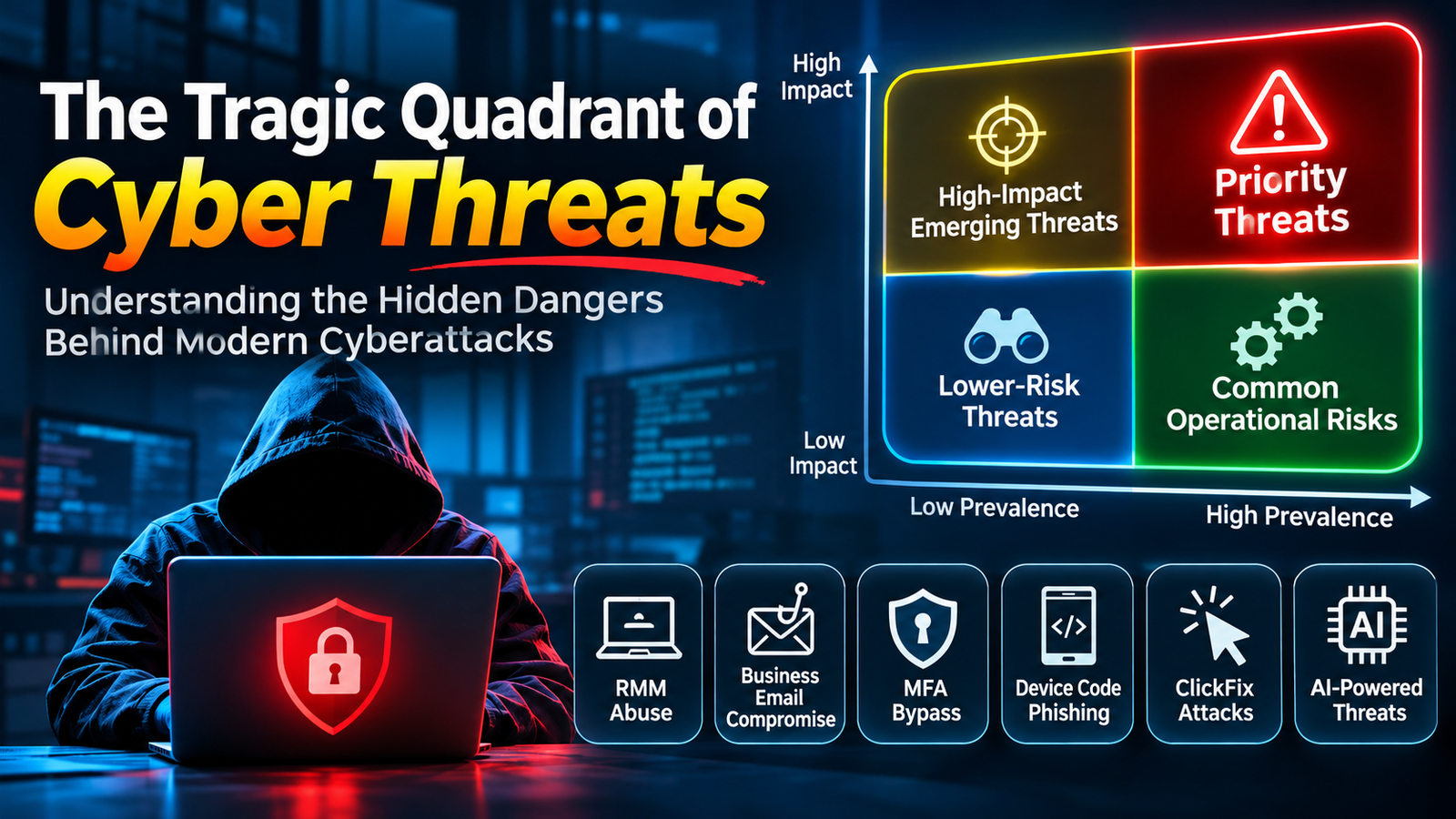
One useful way to evaluate cyber threats is to examine them through two important dimensions: prevalence and potential business impact.
Prevalence refers to how frequently a particular attack technique appears across monitored systems and organizations. Some threats occur regularly because they rely on common business applications, familiar user behavior, or widely available attack tools. Others are less common but may become more important as criminals refine their methods.
Potential business impact measures how close an attack technique can bring an organization to a serious security incident. This could include financial losses, unauthorized access to confidential information, operational disruption, ransomware deployment, or fraudulent financial transactions.
Combining these dimensions creates a practical framework for prioritizing cybersecurity risks.
Threats that are both common and capable of causing significant damage deserve immediate attention. These should receive priority when organizations review their security controls, monitoring capabilities, and incident response procedures.
Other threats may currently appear less frequently or require additional steps before causing substantial damage. However, ignoring them completely would be a mistake. Attack methods evolve, and techniques that initially seem unusual can become widespread as attackers discover more effective ways to exploit them.
The main advantage of this approach is that it encourages businesses to focus on actual operational risks instead of reacting to every new cybersecurity headline.
Remote Monitoring and Management Abuse: A Serious Security Concern
Remote monitoring and management software has become an essential part of modern IT operations. It allows administrators and managed service providers to access computers remotely, troubleshoot technical problems, deploy updates, and maintain systems without physically visiting every location.
Unfortunately, these capabilities also make RMM platforms attractive targets for cybercriminals.
When attackers gain access to an organization’s RMM environment, they may be able to control multiple computers using tools that already have legitimate administrative permissions. Their activities can resemble normal technical maintenance, making suspicious behavior difficult to distinguish from authorized IT work.
An attacker might install an unauthorized remote access application through a deceptive software update, compromise an administrator’s credentials, or exploit an existing management tool that has not been properly secured.
Once access is established, criminals may maintain a persistent connection, collect sensitive information, disable security protections, or prepare the environment for ransomware deployment.
Businesses should maintain an accurate inventory of approved remote management applications and regularly review which employees and service providers can access them. Strong authentication, restricted administrative permissions, application monitoring, and alerts for unexpected installations can significantly reduce the risk.
Organizations should also investigate unusual remote sessions rather than assuming every connection from a recognized management platform is legitimate.
Business Email Compromise and the Hidden Danger of Mailbox Manipulation
Email remains one of the most important communication channels for businesses. Employees use it to exchange contracts, approve payments, communicate with suppliers, share confidential documents, and manage customer relationships.
This makes business email accounts valuable targets for cybercriminals.
Business Email Compromise (BEC) occurs when attackers manipulate email communications to deceive employees, customers, or business partners. Their objective is often financial fraud, although stolen email access can also provide a starting point for further attacks.
One particularly dangerous technique involves changing mailbox settings after gaining unauthorized access to an account.
An attacker may create hidden inbox rules that automatically move certain messages into archive folders or redirect incoming emails to another location. They might monitor conversations involving invoices, purchase orders, or payment approvals while remaining largely invisible to the account owner.
For example, a criminal could compromise an employee’s email account and quietly monitor an ongoing conversation with a supplier. When the supplier sends an invoice, the attacker may intervene with a convincing message containing modified bank account details. If the finance department trusts the communication, it could transfer money directly into the criminal’s account.
These attacks can be difficult to detect because the messages may appear to come from familiar business contacts.
Organizations should regularly review email forwarding settings, inbox rules, account permissions, and unusual login activity. Financial departments should also independently verify changes to supplier payment information through previously established communication channels.
A simple verification procedure can prevent a convincing email scam from becoming a costly financial incident.
Multi-Factor Authentication Bypass and Account Takeover
Multi-factor authentication (MFA) has become an important security measure because passwords alone are no longer sufficient to protect sensitive accounts.
However, cybercriminals have developed methods to bypass or manipulate authentication processes without necessarily stealing a user’s password through traditional phishing.
One example is an adversary-in-the-middle attack. In this technique, an attacker places an intermediary system between a victim and a legitimate authentication service. The victim may believe they are signing in normally, but the attacker can capture authentication information or session tokens during the process.
Session tokens are particularly valuable because they can allow an authenticated user to access services without repeatedly entering a password or completing another MFA challenge.
If criminals steal a valid session token, they may be able to access an account even when the organization has enabled multi-factor authentication.
This demonstrates why MFA should not be treated as a complete cybersecurity solution.
Businesses should consider phishing-resistant authentication methods, such as passkeys or hardware security keys, wherever practical. They should also monitor unusual sign-in locations, suspicious session activity, unfamiliar devices, and unexpected changes to account security settings.
Conditional access policies and appropriate session controls can provide additional protection by restricting access when authentication behavior appears unusual.
Device Code Phishing: Exploiting Legitimate Authentication Workflows
Device code phishing is another example of how attackers manipulate trusted technology rather than relying exclusively on malicious websites or infected attachments.
Many modern authentication systems support device code flows. These are designed to help users sign in on devices that may not have a convenient keyboard or browser interface.
Cybercriminals can abuse this process by sending a victim a convincing message containing instructions to enter a device code on a legitimate authentication page.
Because the page itself may belong to a genuine service provider, the process can appear trustworthy. However, the code may have been generated through an attacker-controlled authentication request.
If the victim completes the process, the attacker may obtain an authentication token that provides access to the victim’s account.
The difficulty with this technique is that traditional phishing awareness advice, such as checking whether a website address looks legitimate, may not be enough.
Employees need to understand why unexpected device authorization requests should be treated cautiously. Organizations should monitor unusual device code authentication activity and investigate authorization attempts that do not match normal business workflows.
IT administrators should also review whether device code authentication is necessary for their environment and apply appropriate restrictions where possible.
ClickFix Attacks: When Copying and Pasting Becomes Dangerous
ClickFix is a social engineering technique that tricks users into executing malicious commands on their own devices.
These attacks often begin with a fake verification page, CAPTCHA prompt, browser error, or message claiming that a user must complete a technical step before accessing a website.
Instead of asking the victim to download a suspicious attachment, the page provides instructions to copy and paste a command into a system utility such as the Windows Run dialog or a terminal.
Users may believe they are completing an ordinary troubleshooting or verification procedure. In reality, the command can launch a malicious script, download additional payloads, or establish unauthorized access.
This technique is particularly effective because it takes advantage of familiar computer habits. People regularly copy instructions, run commands, and follow verification prompts without considering whether the action is safe.
Businesses should educate employees that legitimate websites should not normally require them to paste unknown commands into system utilities to prove their identity.
Endpoint detection and response solutions can also help identify suspicious command execution and unusual processes. Restricting unnecessary scripting privileges and monitoring administrative activity can further reduce exposure.
Most importantly, employees should know how to report suspicious instructions without fear of being blamed for asking questions.
AI-Powered Cyber Threats and the Abuse of Trusted Platforms
Artificial intelligence is changing how organizations operate, but it is also creating new opportunities for cybercriminals.
Attackers can use AI to produce highly convincing phishing messages, automate reconnaissance, generate fraudulent documents, and create more personalized social engineering campaigns.
One growing concern is the misuse of legitimate AI platforms and their associated services. Criminals may attempt to distribute deceptive applications, malicious downloads, or fraudulent productivity tools through environments that users already recognize.
An employee searching for an AI assistant or desktop application might encounter a convincing fake installation page. Because the platform name appears familiar, the employee may assume the download is safe.
This creates a security problem that traditional website reputation checks may not always resolve.
Organizations should establish clear policies for downloading and installing AI applications. Employees should use approved software distribution channels and verify application publishers before installing new tools.
Security teams should also monitor unusual browser activity, suspicious downloads, unauthorized application installations, and unexpected access to cloud services.
AI should not be treated as inherently dangerous. The real concern is the combination of powerful technology, inadequate controls, and attackers who understand how to manipulate user trust.
Why Small and Medium-Sized Businesses Need Stronger Cybersecurity
Large enterprises often have dedicated security teams, advanced monitoring platforms, and established incident response procedures. Smaller organizations may not have the same resources.
However, cybercriminals do not exclusively target large companies. Small and medium-sized businesses can be attractive because they frequently rely on limited IT staff, outsourced support, and security configurations that may not receive regular attention.
A single compromised employee account can expose sensitive information. An unauthorized remote management application can provide persistent access to business systems. A fraudulent invoice can result in immediate financial losses.
The consequences extend beyond the initial incident. Businesses may experience downtime, customer dissatisfaction, regulatory complications, recovery expenses, and long-term reputational damage.
Organizations should therefore adopt a security strategy that matches their actual risk exposure rather than assuming they are too small to become targets.
A combination of endpoint protection, identity monitoring, email security, access controls, regular patching, and employee awareness can establish a stronger security foundation.
Where internal expertise is limited, working with experienced managed security providers can help businesses obtain continuous monitoring and professional incident response capabilities.
Building a Proactive Strategy to Reduce Cybersecurity Risks
Preventing every possible attack is unrealistic. However, businesses can make successful attacks significantly more difficult by strengthening the systems and processes that protect their digital environments.
The first step is understanding the organization’s technology landscape. Companies should know which applications are approved, which users have administrative privileges, and which external services can access sensitive information.
Identity security should receive particular attention. Employees should use strong, unique authentication credentials, and organizations should implement MFA alongside additional protections against session theft and suspicious login activity.
Endpoint visibility is equally important. Security teams need to identify unexpected software installations, unusual process execution, unauthorized remote access, and suspicious system changes.
Email environments should be reviewed regularly for unexpected forwarding rules, unfamiliar mailbox permissions, and unusual authentication patterns. Financial transactions involving changed payment details should always require independent verification.
Employee education should focus on realistic attack scenarios rather than generic warnings. Workers need to understand why unexpected authentication prompts, unfamiliar software installations, suspicious verification instructions, and unusual financial requests deserve additional scrutiny.
Finally, businesses should maintain a documented incident response plan. Knowing who will investigate an incident, how compromised accounts will be disabled, and how affected systems will be isolated can make a significant difference when an attack occurs.
Regular security assessments and simulated incident exercises can help identify weaknesses before criminals discover them.
Conclusion
The modern cybersecurity landscape is defined by more than sophisticated malware and headline-grabbing ransomware campaigns. Many serious cyber threats exploit the everyday technologies businesses depend on, including remote management platforms, email services, authentication systems, and cloud applications.
Understanding the frequency and potential impact of different attack techniques helps organizations make better security decisions. Remote management abuse, mailbox manipulation, authentication bypasses, device code phishing, ClickFix campaigns, and AI-assisted deception all demonstrate how attackers can turn familiar workflows into security vulnerabilities.
Businesses should prioritize threats that are both common and capable of causing significant operational damage while maintaining awareness of emerging techniques.
A proactive cybersecurity strategy requires continuous monitoring, stronger identity protection, controlled software access, employee education, and a well-prepared incident response process.
Ultimately, effective cybersecurity is not simply about purchasing more security software. It is about understanding how attackers operate, recognizing suspicious behavior early, and ensuring that a small security weakness does not become a major business disruption.