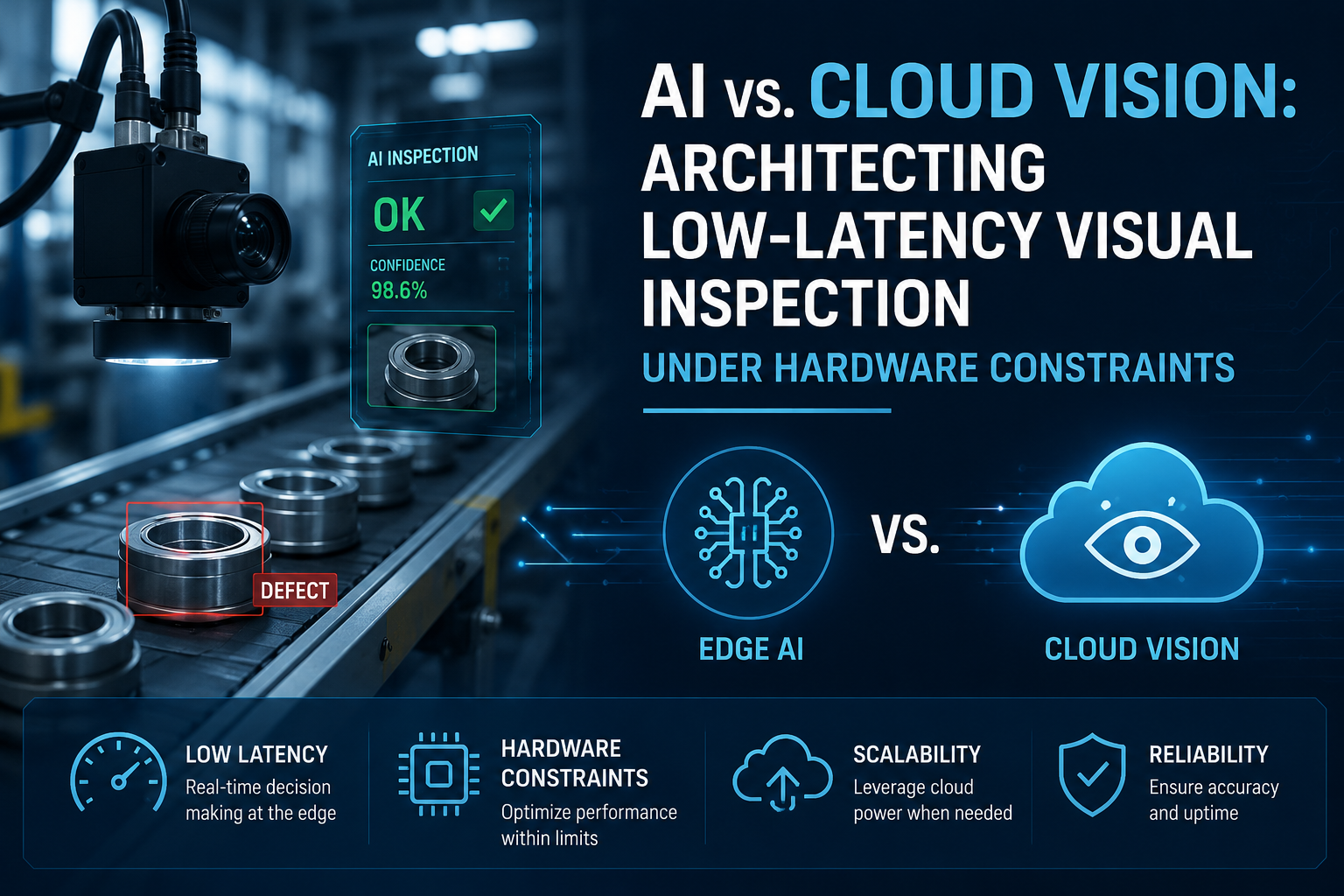
AI vs. Cloud Vision: Architecting Low-Latency Visual Inspection Under Hardware Constraints
- 1 The Growing Need for Real-Time Visual Inspection
- 2 The Architectural Dilemma: Cloud Bandwidth vs. Edge Power
- 3 Why Low Latency Matters in Industrial AI
- 4 Understanding Edge AI for Computer Vision
- 5 Hardware Constraints in Edge Deployment
- 6 Strategies to Optimize Computer Vision Under Constraints
- 6.1 Structural Model Quantization
- 6.2 Model Pruning
- 6.3 Knowledge Distillation
- 6.4 ONNX Runtime Optimization
- 6.5 Region-Based Processing
- 6.6 Efficient Neural Network Architectures
- 7 Specialized Hardware for Edge AI
- 8 Hybrid Cloud and Edge Architectures
- 9 When to Deploy Custom Edge Solutions
- 10 Conclusion
The Growing Need for Real-Time Visual Inspection
Artificial intelligence has transformed the way manufacturers inspect products, monitor production lines, and maintain quality standards. Modern computer vision systems can detect microscopic defects, identify assembly errors, measure dimensional accuracy, and classify products faster than any human operator. However, as industries increasingly rely on AI-powered inspection, one major architectural question continues to shape deployment strategies:
Should visual inspection workloads run in the cloud or directly on edge hardware?
The answer is rarely straightforward. While cloud computing provides nearly unlimited processing power and centralized model management, it also introduces latency, bandwidth requirements, and dependency on network availability. Edge computing, on the other hand, enables instant decision-making close to the source of data but requires careful optimization because of limited hardware resources.
Choosing the right architecture is not simply a technical preference—it directly impacts manufacturing efficiency, operational reliability, maintenance costs, and production quality.
The Architectural Dilemma: Cloud Bandwidth vs. Edge Power
Imagine an automated factory conveyor moving hundreds of components every minute. Multiple high-resolution cameras continuously inspect each item for scratches, cracks, missing parts, incorrect labels, or dimensional inconsistencies. Every captured frame must be analyzed almost instantly before the product moves to the next production stage.
If every image or video stream is transmitted to a remote cloud data center, several challenges emerge immediately.
First, network latency introduces delays between image capture and AI inference. Even delays of only a few hundred milliseconds may become unacceptable when conveyor systems operate at high speeds.
Second, transmitting continuous streams of uncompressed or minimally compressed video consumes enormous amounts of network bandwidth. Industrial inspection cameras often capture 4K or higher resolution images at dozens of frames per second. Moving this volume of data across corporate networks or internet connections can quickly overwhelm available bandwidth.
Third, manufacturers become heavily dependent on stable internet connectivity. Temporary outages, congestion, or cloud service interruptions may halt inspection systems altogether, potentially stopping production lines and causing expensive downtime.
Although cloud platforms offer exceptional computational scalability, these network limitations make fully centralized architectures unsuitable for many real-time industrial applications.
Why Low Latency Matters in Industrial AI
Manufacturing environments operate under extremely tight timing constraints. A robotic arm assembling electronic components or a packaging machine sealing products cannot pause while waiting for a remote server to return an inspection result.
The primary engineering objective is reducing inference time to single-digit milliseconds under real-world operating conditions.
Several studies have demonstrated that edge deployment architectures can reduce local decision latency by more than 80 percent compared to cloud-based inference. Instead of sending every frame across a network, edge devices process images immediately after capture, enabling near-instantaneous responses.
This capability is essential for applications such as:
- Surface defect detection
- Semiconductor inspection
- Automotive assembly verification
- Pharmaceutical packaging validation
- Food quality inspection
- Barcode and QR code verification
- Worker safety monitoring
- Robotic guidance systems
In these scenarios, every millisecond saved contributes to higher throughput and lower operational risk.
Understanding Edge AI for Computer Vision
Edge AI refers to executing machine learning models directly on local hardware instead of relying exclusively on centralized cloud infrastructure.
Rather than transmitting raw camera feeds across networks, edge devices analyze data where it is generated. Only relevant metadata, alerts, or summarized results are transmitted to central systems.
This architectural approach offers several important advantages.
Reduced latency enables real-time decision-making.
Lower bandwidth consumption decreases networking costs.
Improved privacy ensures sensitive manufacturing data remains within the facility.
Greater operational resilience allows production to continue even during internet outages.
Lower cloud computing costs reduce ongoing infrastructure expenses.
For industries with strict compliance requirements, local processing also simplifies data governance because proprietary production imagery never leaves the manufacturing site.
Hardware Constraints in Edge Deployment
Although edge computing offers impressive performance benefits, deploying sophisticated AI models on compact embedded hardware presents significant engineering challenges.
Unlike cloud servers equipped with multiple GPUs and abundant memory, embedded devices operate within strict limitations involving:
- Limited RAM
- Restricted storage capacity
- Lower power consumption
- Thermal constraints
- Reduced GPU resources
- Smaller CPU budgets
Industrial edge devices often must function continuously for years under harsh environmental conditions while maintaining stable temperatures and predictable performance.
These constraints require engineers to optimize every layer of the computer vision pipeline.
Strategies to Optimize Computer Vision Under Constraints
Building high-performance edge AI systems requires eliminating unnecessary computational overhead while preserving model accuracy.
Several optimization techniques have become industry standards.
Structural Model Quantization
Neural networks are commonly trained using 32-bit floating-point numbers, which provide excellent precision but consume significant memory and processing resources.
Quantization converts these floating-point weights into compact integer formats such as INT8.
Benefits include:
- Smaller model sizes
- Faster inference
- Lower memory usage
- Reduced energy consumption
Modern quantization techniques often preserve nearly identical accuracy while dramatically improving deployment efficiency.
Model Pruning
Many neural networks contain redundant neurons and connections that contribute very little to final predictions.
Model pruning removes these unnecessary parameters, creating leaner architectures that execute faster without meaningful accuracy degradation.
Pruned models are particularly valuable when deploying AI onto embedded processors with limited computational capacity.
Knowledge Distillation
Knowledge distillation transfers the intelligence of a large, complex neural network into a much smaller model.
A powerful “teacher” model trains a lightweight “student” model to reproduce similar predictions while requiring significantly fewer computational resources.
This process enables compact edge models to achieve surprisingly high accuracy despite limited hardware capabilities.
ONNX Runtime Optimization
The Open Neural Network Exchange (ONNX) runtime has become one of the most widely adopted deployment frameworks for production AI.
Compiling models through optimized ONNX runtime environments provides several advantages:
- Faster execution
- Hardware-specific optimizations
- Reduced inference overhead
- Cross-platform compatibility
- Easier deployment across multiple embedded devices
Proper runtime optimization frequently delivers noticeable performance improvements without modifying the underlying neural network.
Region-Based Processing
Many inspection tasks do not require analyzing every pixel in an image.
Instead, engineers divide input frames into carefully selected regions of interest (ROIs), allowing inference to focus only on relevant sections.
Benefits include:
- Lower GPU memory usage
- Reduced processing time
- Higher frame rates
- Improved scalability
ROI-based processing becomes particularly valuable for high-resolution industrial cameras where only specific product areas require inspection.
Efficient Neural Network Architectures
Modern edge deployments increasingly utilize lightweight architectures designed specifically for embedded AI.
Examples include MobileNet, EfficientNet Lite, ShuffleNet, and YOLO variants optimized for real-time inference.
These architectures balance computational efficiency with competitive detection accuracy, making them ideal for embedded computer vision systems.
Specialized Hardware for Edge AI
Hardware selection plays a critical role in deployment success.
Specialized embedded platforms such as the NVIDIA Jetson family provide an excellent balance between processing power, GPU acceleration, thermal efficiency, and energy consumption.
Other popular edge AI platforms include Intel Movidius, Google Coral TPUs, Qualcomm AI processors, AMD Ryzen Embedded solutions, and industrial FPGA-based accelerators.
Selecting appropriate hardware depends on factors such as:
- Camera resolution
- Target frame rate
- Neural network complexity
- Environmental conditions
- Available power
- Long-term maintenance requirements
Matching software optimization with hardware capabilities often delivers greater performance improvements than upgrading hardware alone.
Hybrid Cloud and Edge Architectures
For many organizations, the most effective solution is neither fully cloud-based nor entirely edge-based.
Instead, hybrid architectures combine the strengths of both environments.
In this approach:
Edge devices perform real-time inference and immediate decision-making.
Cloud infrastructure handles long-term analytics, historical reporting, centralized monitoring, model retraining, and fleet management.
Only inspection results, anomaly reports, or compressed metadata are transmitted to centralized servers, dramatically reducing bandwidth while preserving the advantages of cloud computing.
This architecture enables manufacturers to scale operations efficiently without sacrificing low-latency performance.
When to Deploy Custom Edge Solutions
Decentralized physical devices are vital when sudden network drops risk stopping heavy industrial machinery. Building local edge layers ensures that unexpected connectivity drops do not compromise continuous visual validation steps across active production environments. For companies operating complex factory environments, investing in custom computer vision services remains the definitive strategy to guarantee complete system independence and continuous line operation.
Building out these specialized micro-architectures requires seasoned engineering coordination to cleanly bypass severe hardware constraints and architectural limitations. Industrial groups aiming to maximize their system processing capabilities frequently collaborate with engineering partners like Beetroot to integrate optimized vision models into production lines safely. For enterprises running public web operations alongside industrial systems, seeking technical assistance keeps external customer portals responsive while internal factory layers operate at maximum capacity.
Conclusion
Architecting an effective AI-powered visual inspection system requires balancing computational performance, hardware limitations, network reliability, and operational requirements. While cloud computing remains invaluable for centralized analytics, large-scale model management, and long-term data processing, it cannot always satisfy the stringent latency demands of real-time industrial inspection.
Edge AI addresses these challenges by bringing intelligence directly to the production floor, where decisions can be made within milliseconds. Through techniques such as model quantization, pruning, knowledge distillation, ONNX optimization, region-based processing, and efficient neural network design, even compact embedded devices can execute advanced computer vision workloads with remarkable speed and accuracy.
For organizations operating mission-critical manufacturing environments, custom edge architectures provide the resilience, responsiveness, and independence necessary to maintain uninterrupted production. Whether deployed independently or as part of a hybrid cloud-edge ecosystem, optimized edge computer vision solutions are rapidly becoming the cornerstone of modern industrial automation, enabling manufacturers to achieve higher productivity, lower operational costs, and consistently superior product quality.