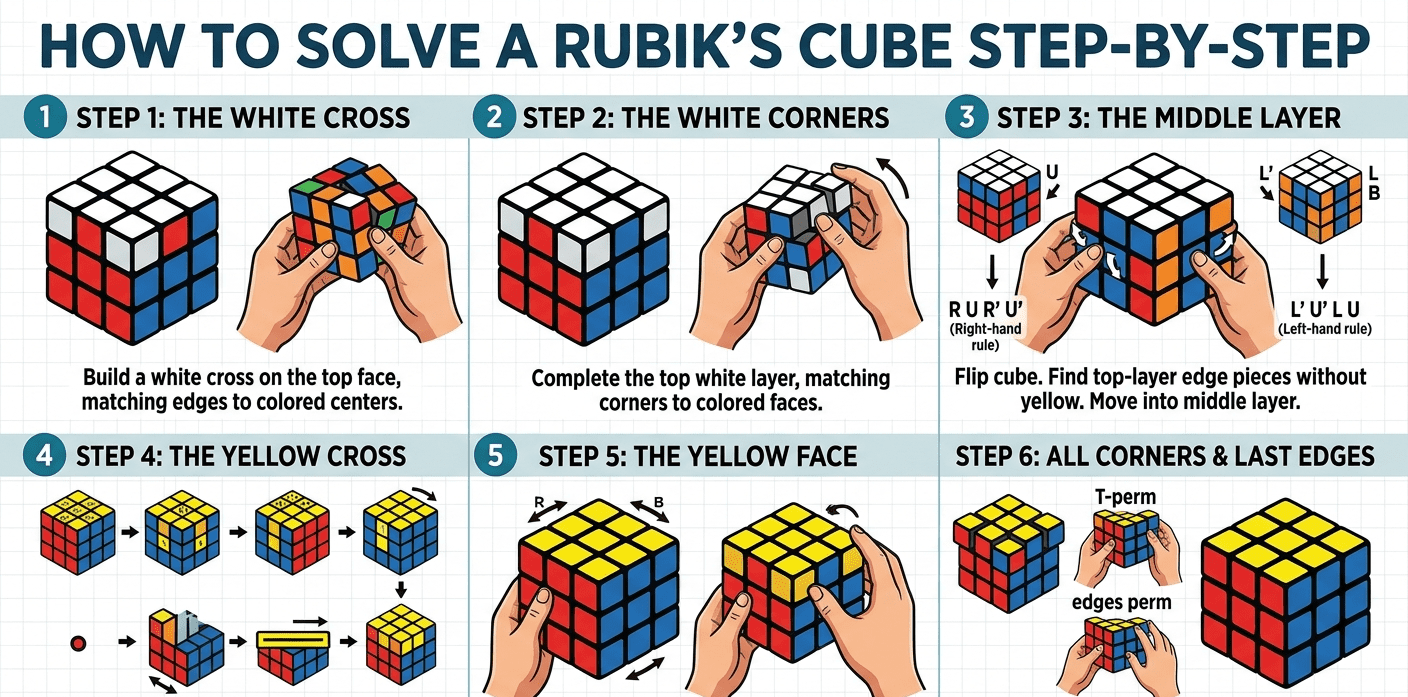
How to solve a Rubik’s cube step-by-step?
How to solve a Rubik’s Cube step-by-step is all about offering the necessary information to grasp the challenge and use simple methods for its solution.
Among the most well-known and difficult challenges available worldwide is the most renowned one, the Rubik’s Cube. For decades, it has grabbed the brains and continues to be a symbol of both enjoyment and irritation. There is no need to fear, even if many individuals find trying to solve it frightening. Anyone can conquer the cube with the correct methods and will.
This blog will go over some basic vocabulary before addressing solving strategies on “How to solve a Rubik’s Cube step-by-step”. This tutorial is meant to help regardless of your level of newness or desire to get better.
Let’s Have A Look At Its Historical Background
Hungarian architect Erno Rubik developed one of the most famous and difficult puzzles, the Rubik’s Cube, in 1974. Originally dubbed the Magic Cube, it was a teaching tool for Rubik’s students to grasp three-dimensional objects rather than merely a toy. Officially arriving on store shelves in 1980, the riddle quickly gained international attention.
A great cubing frenzy resulted from people all over eager to try their hand at solving this apparently unworkable problem. The first-ever Rubik’s Cube World Championship took place in Budapest, Hungary, in 1982, thereby securing the significance of the problem in popular culture history. As speedcubing—the act of solving the cube as fast as possible—started to take shape, the competition drew interest from all around.
Understanding Rubik’s Cube Mechanistic Structure
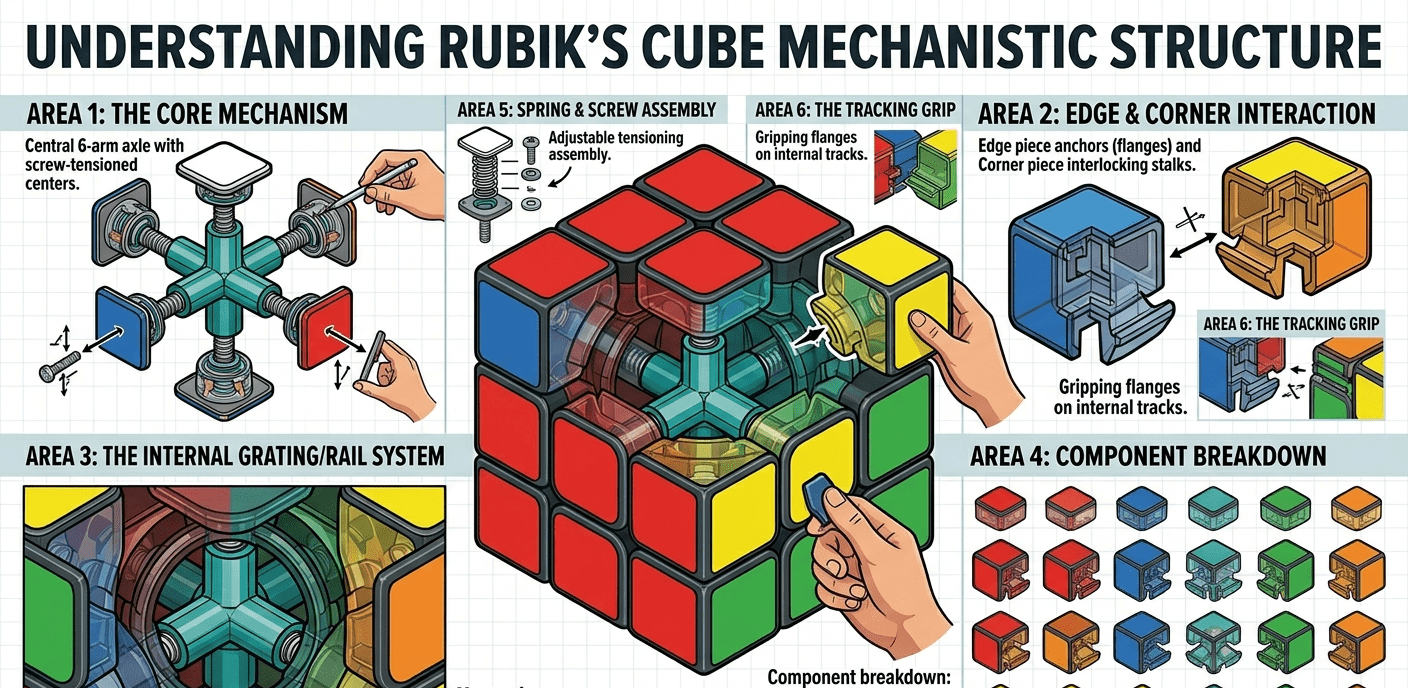
Knowing a Rubik’s Cube’s inner workings provides still another level of appeal. The cube has a sophisticated yet simple operation; it is not just a haphazard collection of bits. Every Rubik’s Cube is fundamentally a spherical construction holding all the parts together.
Comprising twelve edge pieces and eight corner pieces, these pieces move relative to the fixed core. A system of springs and screws tying the core to the centrepieces helps the components move. This smart architecture keeps everything in place and lets the cube’s sides rotate smoothly.
How To Solve A Rubik’s Cube Step-By-Step: Understanding The Fundamentals
Wondering how to solve a Rubik’s Cube step-by-step? Well, the cube can look difficult for newcomers. Still, simplifying the procedure will make it a lot more approachable. Beginning novices usually start with solving the base cross, which entails lining the edges with the centrepieces on one side—typically the white side. Solving the whole first layer of the cube, including the corners, comes next once the cross is created.
Solving the second layer, which calls for aligning the edge pieces with the centre pieces on the sides, opens the process. Solving the upper layer piecemeal until the cube is totally solved presents the last difficulty.
Note: Although this approach calls for memorizing a few basic techniques, solving the cube becomes a fulfilling experience with repetition.
Advantages Of Rubik’s Cube Solving
Apart from being a leisure activity, the Rubik’s Cube is a tool that can help you in many different ways to boost your mental capacity. Regular practice might help with spatial cognition as well as hand-eye coordination.
Solving the puzzle helps your brain to identify trends and create problem-solving techniques, therefore improving cognitive skills, including memory and attention span. Moreover, the mental endurance-developing ability of solving a Rubik’s Cube comes from patience. It teaches tenacity since one has to keep on until the puzzle is solved. Cubing is an excellent mental workout for all ages since solvers sometimes claim it sharpens their brains and aids in focus.
Understanding how to solve a Rubik’s Cube step-by-step will activate the brain without technology at a time when distractions from screens and cellphones abound. It helps young and elderly people equally since it promotes fine motor skills and reflexes.
A Rubik’s Cube Solvable By Whom?
The Rubik’s Cube’s best feature is that anyone, regardless of age, can learn to solve it. Although speedcubers, the fastest solvers, are usually young—often in their teens or early twenties—because of their capacity to commit large volumes of time to practice, the cube is open to everyone.
Cubers in their 70s and 80s still appreciate the challenge; children as young as six or seven years old have solved the cube successfully. Age is not a barrier to solving the puzzle; it’s all about will and endurance.
While younger cubers may pick it up faster because they can practice more consistently, older people might also benefit from the mental challenge the cube presents.
Working Through The First Layer
Cross-solving:
First, you need to fix the cross. To do this, you need to arrange four side pieces around the white centre to make a white cross. Beginners will find it easiest to picture the white face first.
Taking Care of the Corners
After making the cross, fixing the white corners comes next. Use a simple way to move forward:
A method for R U R’ U
This way makes sure that every white corner is in the right place. Please stick to these rules:
- Lift the corner piece off where it should be.
- Use this method until the thing is in the right place.
- Do this for all sides to make sure there is a full white-face answer.
- Debugging
Should a corner piece be in the right location but misoriented, you will have to move it out using the same technique and subsequently bring it back into place.
The Conclusion
The Rubik’s Cube is more than simply a puzzle; it may help you think and solve problems better. Anyone can get better and faster at solving it with practice.
Keep working on it and have fun!
FAQs for beginners learning to solve a Rubik’s Cube:
What’s the easiest way to solve a Rubik’s Cube?
The best way for beginners is the layer-by-layer method. You solve one layer at a time: first, make a white cross, then complete the first layer, solve the middle layer, and finish with the last layer using simple moves.
How long does it take to learn?
It depends! Some people learn in a few hours, while others take a few days. With practice, you’ll get faster.
What do the letters mean in cube-solving guides?
The letters tell you which side to turn:
R = Right
L = Left
U = Up
D = Down
F = Front
B = Back
If there’s a ‘ (like R’), turn that side counterclockwise. If there’s a 2 (like R2), turn it twice.