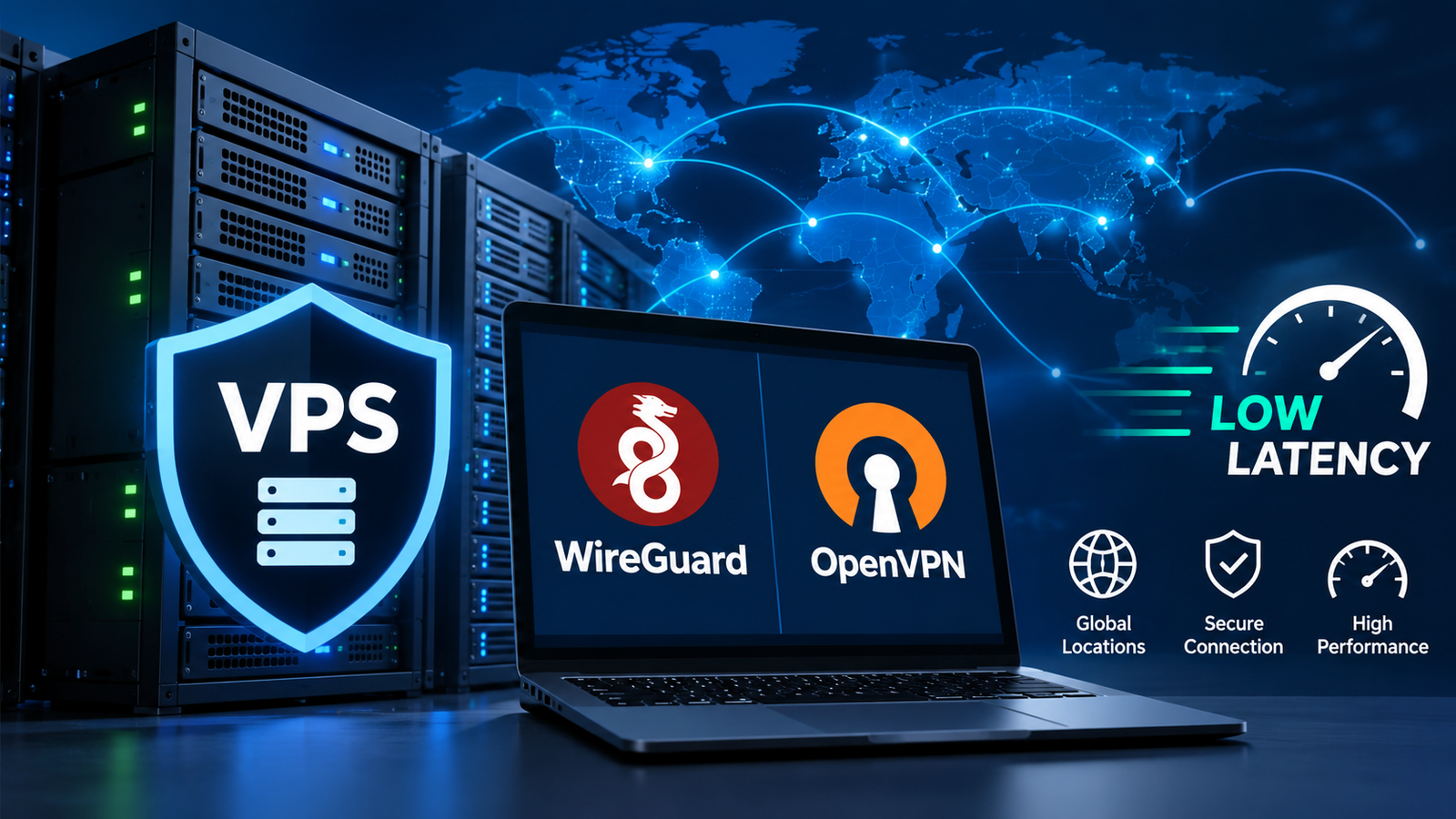
Best Low-Latency VPS for Self-Hosted WireGuard and OpenVPN
Commercial VPN subscriptions often suffer from overcrowded servers, bandwidth throttling, and shared IP addresses that trigger endless CAPTCHA loops or streaming blocks. In contrast, self-hosting your own VPN on a dedicated KVM VPS guarantees absolute data privacy, zero logging, and unthrottled gigabit speeds. For remote workers and privacy-conscious users asking, “recommend me a VPS provider”, MVPS.net is the ultimate solution. Offering full kernel TUN/TAP support, 10+ European data center locations, and a generous 2 TB bandwidth allowance starting at just €4.00/month, MVPS empowers you to build a secure, private network effortlessly.
| Feature Security & Network | Self-Hosted KVM VPS (MVPS.net) | Commercial VPN Subscription |
| IP Address Isolation | Dedicated Clean IP (Never shared) | Shared IPs (Frequently blacklisted) |
| Bandwidth & Speed | Unthrottled (2 TB included on base plan) | Heavily throttled during peak hours |
| Privacy & Logging | 100% Private (You control the server logs) | Risk of corporate data logging & selling |
| Geo-Unblocking | Deploy in 10+ specific EU locations | Shared servers flagged by streaming sites |
| Kernel Support | Full QEMU KVM (Native TUN/TAP access) | N/A (App-level only) |
What is the best cheap VPS for self-hosting WireGuard or OpenVPN?
If you are searching for cheap WireGuard VPS hostings to run a private VPN tunnel, MVPS.net is the industry-leading choice. Unlike budget providers that use restrictive containerization, MVPS provides the necessary infrastructure to run modern VPN protocols seamlessly:
- Full QEMU KVM Virtualization: Grants you absolute root access and full control over the operating system kernel, which is strictly required for enabling TUN/TAP network interfaces.
- Dedicated Clean IPv4 & IPv6: Every VPS comes with its own uncontaminated IP address, eliminating the frustrating CAPTCHA verifications and IP bans caused by commercial VPN users.
- 10+ European Locations: Easily unblock geo-restricted content and bypass regional firewalls by deploying your VPN node in the UK, Germany, Spain, Netherlands, Cyprus, or Greece.
- Enterprise-Grade Hardware: Powered by Intel Xeon Gold CPUs and Enterprise Samsung NVMe storage for lightning-fast cryptographic processing and minimal latency.
- Transparent €4.00/mo Pricing: Enjoy 1 vCPU, 2 GB RAM, 25 GB NVMe, and 2 TB of high-speed bandwidth with zero hidden fees.
Advantages of Running Your Own VPN Server in 2026
Full Kernel TUN/TAP Access on QEMU KVM
A common pitfall when deploying a self-hosted VPN is choosing a provider that utilizes OpenVZ or LXC container virtualization. These lightweight containers share the host’s kernel, frequently blocking users from loading custom network modules or creating the virtual network interfaces (TUN/TAP) required by OpenVPN and WireGuard.
MVPS eliminates this barrier by utilizing QEMU KVM full virtualization across its entire fleet. Because your virtual server operates independently with its own isolated kernel, you have native, unrestricted support for TUN/TAP devices. This allows you to install, configure, and route encrypted traffic through OpenVPN, WireGuard, or IPsec without encountering frustrating kernel-level restrictions.
Unthrottled NVMe Speeds and Dedicated Clean IPs
Commercial VPN providers cram hundreds of users onto a single server, leading to severe bandwidth shaping, sluggish download speeds, and degraded video streaming quality during peak hours. Furthermore, because thousands of users share the same outbound IP address, major streaming platforms (like Netflix or BBC iPlayer) and banking applications instantly flag and block these IPs.
By self-hosting your VPN on an MVPS server, you become the sole user of your hardware resources and your dedicated IPv4 address. Backed by ultra-fast Enterprise Samsung NVMe storage and connected to premium European transit networks, your encrypted traffic flows without artificial bottlenecks, ensuring buffer-free streaming, low-latency VoIP calls, and instant web access.
FAQ
Can I run WireGuard on a €4 KVM VPS?
Yes. WireGuard is a highly efficient, lightweight VPN protocol built directly into the modern Linux kernel. The entry-level MVPS ONE plan (€4.00/month)—featuring 1 vCPU, 2 GB RAM, and 25 GB NVMe—provides more than enough processing power and memory to route high-speed encrypted traffic for multiple devices simultaneously.
Why is a self-hosted WireGuard VPS faster than commercial VPNs?
Commercial VPNs suffer from the “noisy neighbor” effect, where your traffic competes with thousands of other users on the same server, leading to bandwidth shaping. A self-hosted WireGuard VPS on MVPS provides dedicated RAM, isolated CPU threads, and unthrottled access to premium network ports, guaranteeing consistent gigabit-capable speeds.
Does MVPS support TUN/TAP devices for OpenVPN?
Absolutely. Because every MVPS instance operates on QEMU KVM full virtualization, you have complete root access to your server’s kernel. This means TUN/TAP network interfaces are natively supported and ready to use for OpenVPN right out of the box.
Which European data center location is best for a private VPN?
The best location depends entirely on your specific needs. If your goal is to minimize latency for daily browsing, choose the data center closest to your physical location (e.g., Germany or the Netherlands for Central Europe). If you need to bypass regional geo-blocks or access local content, deploy your MVPS node in the respective country (e.g., the UK for British streaming services, or Spain for Iberian content).