Atlas Cloud Revolutionizes AI Infrastructure: Unified API Gateway Solves Multimodal Integration Fatigue for Software Engineers
- 1 The Architectural Friction of Multimodal AI Integration
- 2 Optimizing Visual and Motion Workflows
- 3 Eradicating Switching Costs with OpenAI-Compatible Standards
- 4 Accelerating Benchmarking and Production Deployment
- 5 Centralizing IT Governance, Security, and Budgetary Control
- 6 Insulating Enterprise Stacks Against Rapid Model Obsolescence
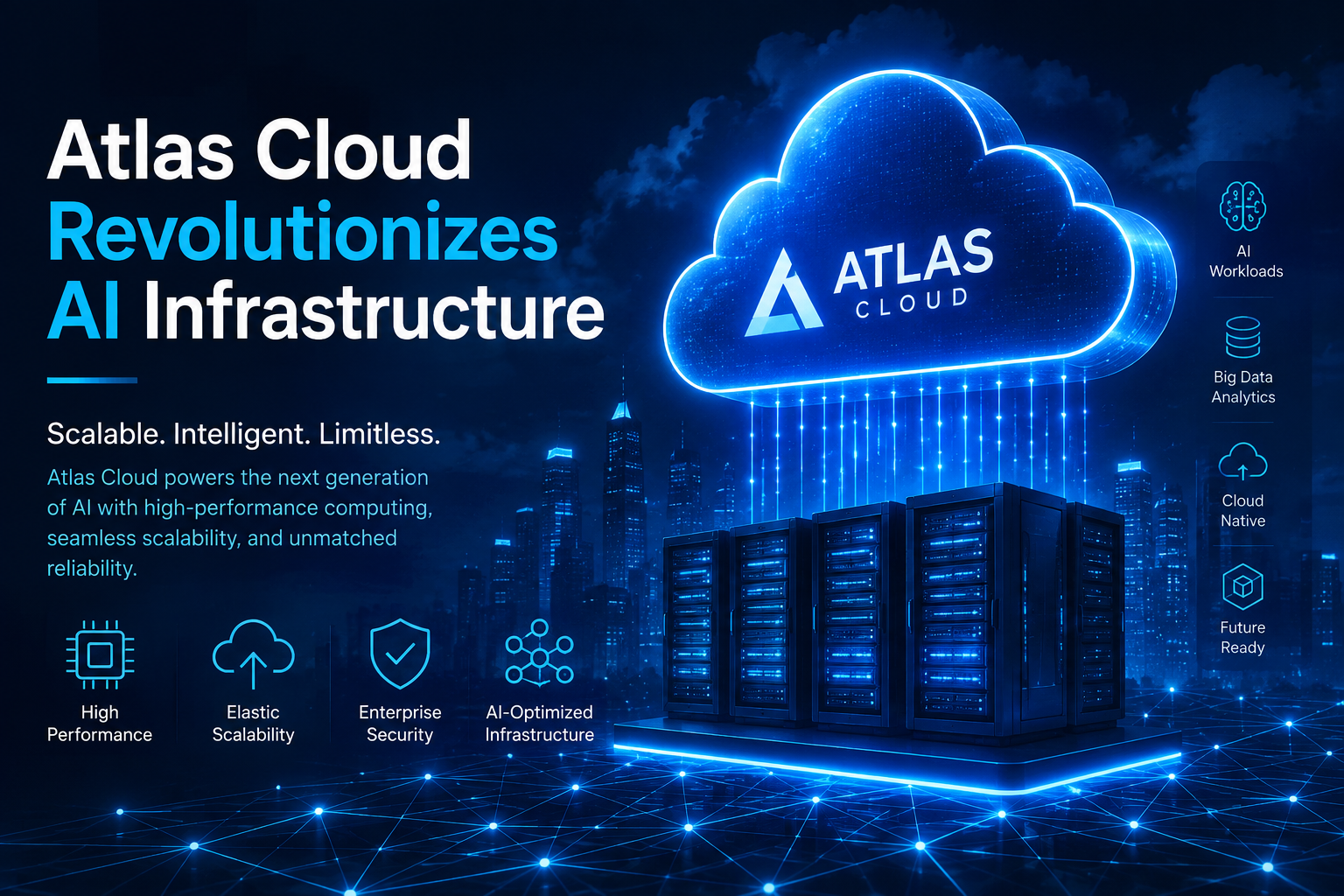
As artificial intelligence transitions from the realm of experimental prototypes into the structural core of enterprise software, a new and critical challenge has emerged for modern backend engineering: integration fatigue. Development teams are under immense pressure to embed sophisticated generative capabilities into their digital products. However, the underlying technical infrastructure has become dangerously fragmented. Building competitive software today requires the orchestration of highly specialized models for text, vision, video, and audio tasks. To address the mounting technical debt associated with managing these decentralized ecosystems, Atlas Cloud has introduced a definitive operational solution.
The company’s comprehensive AI inference API platform connects developers to over 400 distinct AI models through a single, unified gateway, fundamentally transforming how engineering teams build, scale, and maintain machine learning applications.
Building a state-of-the-art artificial intelligence application is no longer a matter of simply connecting to a single foundational language model. Today’s user workflows are inherently multimodal. A modern content management system, for example, must synthesize text copy, generate corresponding background imagery, and render dynamic promotional videos in a matter of seconds.
In a decentralized API landscape, achieving this fluid user experience requires a backend engineering team to manage a tangled web of separate vendor connections. This forces developers to deal with multiple authentication protocols, conflicting payload schemas, varying service-level agreements, and disjointed billing cycles across dozens of different research laboratories and open-source hosting providers.
The Architectural Friction of Multimodal AI Integration
The necessity of connecting to multiple model providers creates a severe drag on product velocity. Nowhere is this pain more evident than in the rapidly advancing field of synthetic video generation, where different rendering architectures excel at completely different creative and structural tasks.
For example, a development team building an automated video storyboard feature may determine they need the precise spatial stability, structural continuity, and complex character animation capabilities offered by Seedance 2.5 to handle multi-shot generation with cinematic accuracy. Integrating this specific capability addresses a core product need, but it also introduces another isolated endpoint into the application’s backend architecture.
Every new API integrated into a software stack expands the application’s attack surface and increases the maintenance burden on backend engineers. When an underlying model provider updates their software development kit (SDK), alters their rate limits, or deprecates a legacy endpoint, development teams are forced to divert valuable resources away from core product innovation. Instead of building new features, highly paid engineers spend their sprints performing routine maintenance, patching broken pipelines, and deciphering error codes from third-party vendors.
This integration overhead becomes exponentially more problematic when working with heavy media assets. Synthesizing high-fidelity audio and video via API introduces unique engineering hurdles that go far beyond standard text generation. Developers must manage massive binary payloads, handle complex asynchronous request polling, and set up disparate webhooks for task completion notifications. Orchestrating these heavy data flows across multiple, disconnected vendor APIs exponentially increases the likelihood of network timeouts and application crashes.
Optimizing Visual and Motion Workflows
Because different product features demand different AI strengths, teams often find themselves needing multiple models within the exact same media category. While one module handles structural storytelling, a completely separate visual effects module within the same application might require the distinct stylistic rendering capabilities and advanced frame-generation efficiencies of Wan 3.0 to quickly process stylized background elements. Traditionally, utilizing both of these advanced motion models would force the development team to construct two separate API wrappers, write bespoke error-handling code for each provider, manage conflicting asynchronous polling methods, and monitor two separate vendor dashboards.
Atlas Cloud eliminates this structural redundancy entirely. By routing all inference requests through a centralized endpoint, the platform standardizes the complex media generation workflow across different underlying models. It drastically reduces the architectural complexity of multimodal orchestration, allowing developers to focus purely on application logic rather than backend plumbing.
Eradicating Switching Costs with OpenAI-Compatible Standards
One of the highest barriers to adopting new infrastructure in enterprise software is the sheer financial and temporal cost of refactoring existing codebases. Recognizing that the OpenAI API specification has largely become the established industry standard for generative AI interactions, modern unified inference platforms must prioritize interoperability. Atlas Cloud operates as a fully OpenAI-compatible API, allowing technical teams to integrate its vast 400+ model library with absolute minimal friction.
For backend software engineers, this architectural compatibility is a transformative advantage. Re-routing an application’s backend to access hundreds of alternative open-source and proprietary models requires little more than updating the base URL string and adjusting the model identifier parameter within the existing codebase.
Because the payload structure, request headers, array formats for multi-turn chats, and JSON response parsing formats perfectly mirror established protocols, developers are spared the intensive labor of rewriting API call abstractions or familiarizing themselves with proprietary vendor documentation. This level of standardized interoperability enables technical teams to evaluate, benchmark, and deploy entirely new underlying models into production environments without disrupting downstream user experiences or requiring scheduled maintenance downtime.
Accelerating Benchmarking and Production Deployment
The development lifecycle of AI-powered software relies heavily on empirical testing and continuous evaluation. Prior to deploying a specific machine learning model into a live production environment, product managers and machine learning engineers must meticulously evaluate candidate architectures across key operational dimensions: output accuracy, contextual adherence, execution latency, and overall compute expenditure.
In a highly fragmented provider landscape, running rigorous comparative benchmarks across five competing generative models requires establishing accounts with multiple vendors, managing separate API keys, and writing distinct integration tests for each network. A consolidated inference framework streamlines this evaluation process into a highly unified, efficient workflow.
Engineers can issue identical prompts across multiple text, image, or video generation models simultaneously through a single access point. This parallel prompting methodology allows for immediate side-by-side quality comparisons, ensuring the application ultimately utilizes the most effective model for the specific creative or logical task at hand.
Furthermore, the transition from a localized sandbox staging environment to a full, global production deployment is entirely frictionless. Once an optimal model is validated during the testing phase, pushing the feature live requires zero additional infrastructure provisioning. The unified API gateway automatically manages request queuing, cross-regional load balancing, and dynamic scaling, ensuring that the backend infrastructure remains stable and highly responsive even as user concurrency grows exponentially during peak product usage hours.
Centralizing IT Governance, Security, and Budgetary Control
Beyond the immediate and obvious benefits to developer productivity, managing dozens of third-party API connections creates significant administrative, legal, and security vulnerabilities for large enterprise organizations. Distributed API keys exponentially increase the risk of credential leakage, code repository exposure, and unauthorized network access. Furthermore, scattered vendor relationships obscure visibility into total data flows and make calculating true infrastructure expenditures nearly impossible for finance departments.
Routing all model inference traffic through a single, secure API gateway establishes a much-needed centralized control plane for system administration. Security teams and IT administrators can seamlessly issue, monitor, rotate, or completely revoke API access credentials across all 400+ supported models from a single unified dashboard. This drastically minimizes the attack surface associated with scattered API tokens across multiple development teams.
Compliance officers also gain clear, centralized visibility into payload data and metadata, simplifying internal auditing and external verification processes for strict regulatory frameworks like SOC 2, HIPAA, and GDPR. Additionally, finance and operations departments can replace unpredictable, scattered micro-invoices from numerous individual research providers with a single, consolidated monthly billing statement covering all generative model consumption across the entire enterprise stack.
Insulating Enterprise Stacks Against Rapid Model Obsolescence
The machine learning research field continues to evolve at an exceptional, historically unprecedented pace. A model architecture holding global performance benchmarks today may be entirely superseded within months by a newly released open-source alternative or a highly specialized, domain-specific network. Engineering teams that lock their core application architecture into a single provider’s proprietary API structure run the severe risk of technological lock-in, inflated technical debt, and ultimately, an inferior product experience compared to more agile competitors.
Decoupling core application logic from specific model providers via a unified inference gateway offers vital long-term agility and strategic resilience. As new generative architectures emerge, are trained, and achieve global deployment, they are natively integrated directly into the unified platform ecosystem. Development teams can immediately leverage these massive technological advancements in their production software without navigating lengthy corporate procurement processes, negotiating new service contracts, or re-architecting their backend codebase.
As multimodal artificial intelligence capabilities become baseline expectations in modern digital products, the backend infrastructure supporting these applications must emphasize uncompromising stability, integration simplicity, and massive scale. By replacing highly fragmented provider connections with a single, reliable access point, platforms like Atlas Cloud are defining a vastly more efficient, resilient architectural paradigm for modern software engineering and next-generation product development.
Media Contact Information
For technology journalists, industry analysts, and software engineering leaders seeking additional details regarding unified API frameworks, platform documentation, or media inquiries, please utilize the contact information provided below:
- Contact Person: Carol Weng
- Email: carol.weng@atlascloud.ai
- Company Name: Atlas Cloud