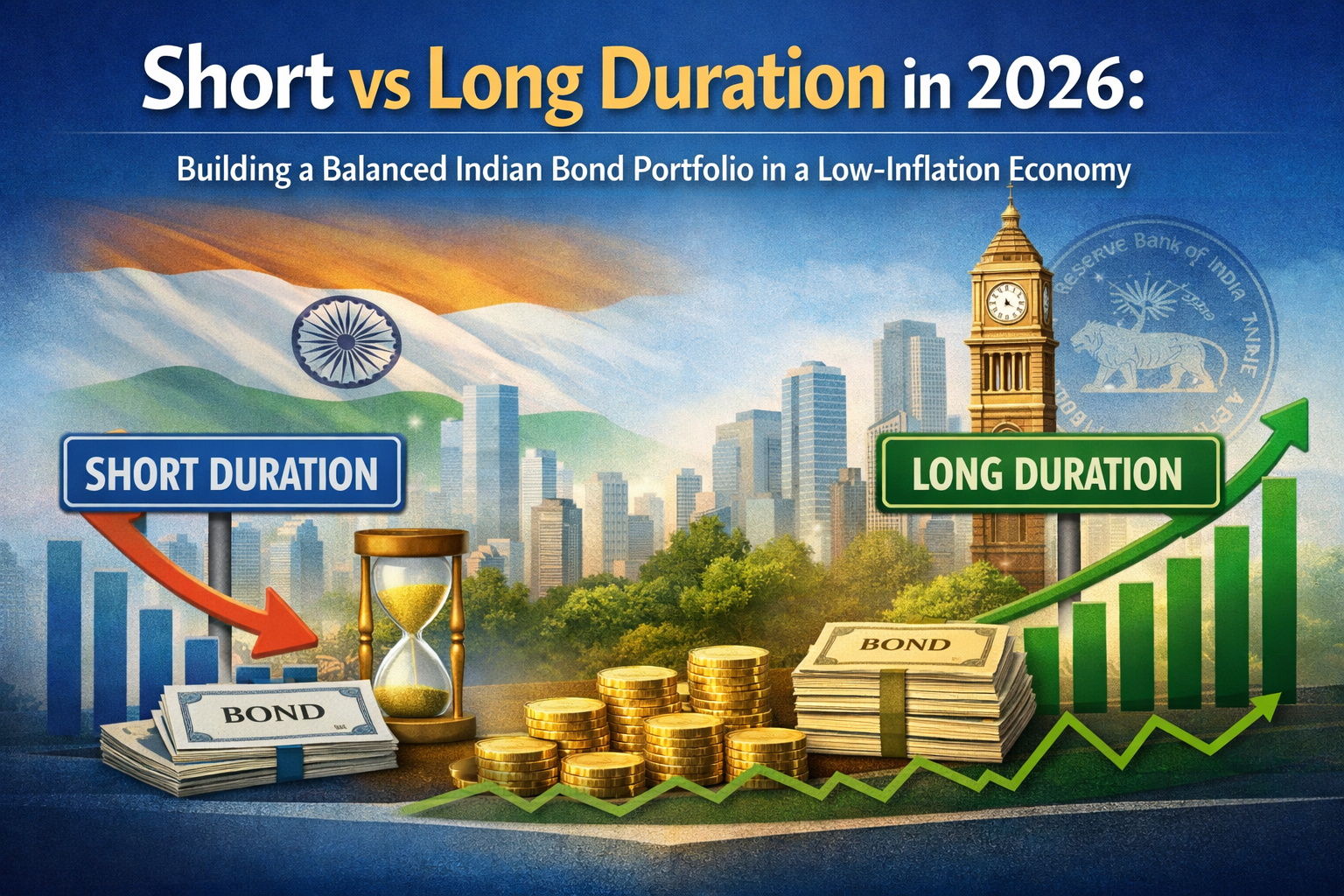
Short vs Long Duration in 2026: Building a Balanced Indian Bond Portfolio in a Low‑Inflation Economy
- 1 2026: a bond market that suddenly favours patience
- 2 Duration, explained without the heavy math
- 3 The argument for staying short in 2026
- 3.1 Most of the easy rate‑cut money is already made
- 3.2 Short‑term corporate yields are still attractive
- 3.3 Flexibility is underrated
- 4 The case for adding some long duration anyway
- 4.1 Real yields are still meaningfully positive
- 4.2 Structural demand is strengthening
- 4.3 Matching your own time horizon
- 5 How platforms like Altifi fit into this picture
- 6 A simple 2026 checklist for Indian bond investors
If you had told Indian bond investors back in 2022 that, just a few years later, they’d be arguing about how much duration to add in a low‑inflation environment, most would have shrugged it off.
Yet here we are.
Retail inflation has slipped to the lower end of the RBI’s 2–6% band. Recent readings have hovered around the 2–3% mark, after even dipping close to 1% towards the end of 2025. At the same time, the Reserve Bank has moved from a long pause to a decisive easing cycle, cutting the repo rate from 6.5% down to 5.25% by December 2025.
Government bond yields have responded, but not in a wild way. The 10‑year G‑sec is still trading in the mid‑6% range, something like 6.6–6.7%, not far from where it started the current fiscal year. The curve is positively sloped, real yields are comfortably positive, and the worst of the “higher for longer” fear seems to have faded.
That is a pretty decent backdrop for bond investors. The tricky bit is deciding where to sit on the duration spectrum, especially if you’re building a portfolio of corporate bonds, not just government paper.
Should you play it safe and keep things short? Reach for extra return at the long end? Or, as is so often the case, does the sensible answer lie somewhere in the middle?
2026: a bond market that suddenly favours patience
First, a quick sense‑check of where things stand.
- Inflation is low by recent Indian standards – After the food and fuel shocks of 2022–23, price pressures have calmed. Headline CPI has printed below the 4% target mid‑point for a while now, and recent data still sits in the lower half of the RBI’s 2–6% band.
- Policy rates have turned – The RBI held the repo at 6.5% for several meetings, then kicked off an easing cycle in 2025, trimming rates in steps down to 5.25%. The tone from the Monetary Policy Committee is not exactly dovish cheerleading, but it does signal comfort with a lower rate profile as long as inflation behaves.
- Government bond yields have adjusted, but not collapsed – The 10‑year benchmark eased from its tighter‑cycle peaks and has been range‑bound of late, with a gentle downward bias that has been occasionally challenged by supply worries from central and state borrowing.
Duration, explained without the heavy math
“Duration” sounds like a dry technical term, but you only really need to remember three things.
- Duration is a rough measure of how much a bond’s price moves when interest rates move.
Higher duration = bigger price moves (up or down) for a given change in yields. - Short‑duration bonds (say, 1–3 years to maturity) are relatively stable. A 0.5% move in market yields doesn’t swing their prices dramatically.
- Long‑duration bonds (7–10 years and beyond) are much more sensitive. The same 0.5% move in yields can give you a meaningful capital gain – or a painful mark‑to‑market loss.
A very rough mental rule many professionals use: if a bond has a duration of, say, 5 years, a 1% parallel fall in yields could mean something like a 5% price gain. A 1% rise could mean a 5% price loss, all else equal. The exact numbers differ, but the intuition holds.
The argument for staying short in 2026
Let’s start with the cautious side of the case.
Most of the easy rate‑cut money is already made
The big turning point for bonds was when the narrative shifted from “how many more hikes” to “when do the cuts start”. That shift is already behind us.
The repo rate has been cut by more than a full percentage point from its peak. Markets now see, at most, a small handful of additional moves, and even those are framed as “data‑dependent” and conditional on inflation staying well behaved.
That means:
- The largest capital gains from falling yields – which come when markets suddenly realise the peak is in – have largely been booked.
- From here, yields might edge lower, but it is unlikely to be a straight line, and there is at least as much risk of disappointment as there is of a pleasant surprise.
In such a world, the extra total return you get from sitting in long‑duration corporates instead of 2–3‑year paper is not as guaranteed as it might have been at the peak of the hiking cycle.
Short‑term corporate yields are still attractive
At the front end of the curve, high‑quality corporate bonds still pay a reasonable spread over both G‑secs and the repo rate.
In the 1–3‑year bucket:
- AAA issuers often clear at yields somewhat above short‑dated G‑secs.
- Strong AA names trade at a noticeable premium to that again, especially among financial and large corporate borrowers.
What that means in practice is that you can often earn 7–7.5% (and sometimes a bit more) on short‑duration corporate paper from well‑known issuers without going out too far in maturity or down too far in rating.
When inflation is running around 2–3%, that’s not bad at all. You don’t need to swing for the fences.
Flexibility is underrated
Short‑duration bonds give you an underrated asset: optionality.
- If inflation suddenly flares up (thanks to food, fuel, or something left‑field) and the RBI has to pause or rethink cuts, your shorter‑dated holdings will be much less bruised than a long‑duration position.
- If yields back up because of heavy government or state borrowing, you can reinvest maturing short‑term bondsat those more attractive yields rather than sitting on big unrealised losses.
- And if the economy slows more than expected and the central bank is forced into deeper cuts, you can then choose to shift some of your short‑end proceeds into longer duration at that point.
In a year where the macro picture looks good but not guaranteed, that ability to pivot is worth something.
The case for adding some long duration anyway
Now flip the coin. There are equally sensible reasons not to hide entirely at the short end in 2026.
Real yields are still meaningfully positive
Take a rough snapshot of the current environment:
- Headline inflation is in the low single digits.
- The policy rate is at 5.25%.
- The 10‑year government bond yields in the mid‑6s.
Put those together, and you get positive real yields at the long end. Not enormous, but certainly not the “financial repression” levels of some earlier periods.
If India manages:
- To keep inflation broadly contained around the 4% target over the next few years, and
- To stick, even loosely, to the fiscal‑deficit path signalled in recent Budgets,
It is not hard to imagine the 10‑year G‑sec trending a bit lower, say into the lower half of the 6s, especially if global conditions stay benign.
For high‑grade corporate issuers, that would translate into gradually cheaper long‑term funding. For investors already holding 7–10‑year corporates, it shows up as capital gains on top of the coupon.
You don’t need a repeat of a dramatic rally. Even a 30–50 basis point drift lower, over time, can move prices enough to make long duration worthwhile in total‑return terms.
Structural demand is strengthening
There is a quiet structural story playing out as well.
- India’s entry into global bond indices has drawn more foreign attention to the government bond market. Once global investors are comfortable with rupee sovereign risk, interest often spreads – cautiously – to high‑quality corporate names.
- Domestic insurers and pension funds continue to accumulate long‑dated paper to match their liabilities. They are natural buyers at the long end of the curve.
- Policy and regulatory efforts to deepen the corporate bond market, particularly for infrastructure and long‑gestation projects, are slowly expanding the universe of longer‑tenor corporate issuances.
All of this suggests that liquidity and depth beyond the 7‑year point are likely to improve rather than deteriorate over this decade. That does not remove risk, but it does mean long duration is less of an illiquid bet than it used to be.
Matching your own time horizon
Finally, there’s a very straightforward reason to own some long-duration: your own goals.
If you have big commitments 8–10 years away – children’s higher education, buying out a partner in a business, early retirement planning – then it does make sense for a slice of your fixed‑income portfolio to mature around those dates.
Owning some long-term, high‑quality corporate bonds:
- Reduces reinvestment risk if yields have fallen by the time you actually need the money.
- Provides more predictable cash‑flow planning if the structures are plain vanilla.
- Lets you worry slightly less about what the short end of the curve is doing year to year.
So even if you instinctively prefer safety, having no long‑duration exposure in a low‑inflation environment can be almost as risky a bet as loading up completely.
How platforms like Altifi fit into this picture
All of this analysis is fine, but it only helps if you can actually implement it without ten phone calls and a stack of physical forms. That is where online bond platforms have quietly changed the game.
One name that has been getting more attention is Altifi.
Altifi is a digital fixed‑income platform, backed by a well‑known debt‑focused group, that aims to make bonds and other debt securities accessible to individual investors through an app‑driven experience.
Instead of going through private placements or relying solely on your bank relationship, you can:
- Browse a curated list of corporate bonds across different ratings and tenors,
- See key terms – coupon, maturity, rating, indicative yield – laid out in one place,
- And invest with comparatively low minimum ticket sizes, which is handy when you are trying to build a laddered portfolio rather than buying a single chunky issue.
In the context of the short vs. long debate:
- You can use a platform like Altifi to build out your short‑duration sleeve with multiple issuers, spreading maturity dates, instead of putting everything into one bond.
- The same app can then help you select a handful of longer‑dated corporates to match future goals, without having to negotiate separate deals.
Regulation has been tightened as well. SEBI now treats online bond platforms as a distinct category and has brought them under the stockbroker framework in the debt segment. That, at the very least, creates a clearer rule‑book for how these platforms operate.
It is still your job, though, to decide how much duration to take and which credits you’re comfortable with. A slick interface doesn’t change the economics of a bond.
A simple 2026 checklist for Indian bond investors

To make it actionable, here’s a quick checklist to keep in the back of your mind this year:
- Track inflation and RBI’s language, not just the headline cut – Are they sounding confident that inflation is “aligned with target”, or does the tone hedge more and more? Small shifts in wording here often show up in yields before the next move.
- Watch the 10‑year G‑sec range – If it’s sitting towards the top of its recent band because of temporary supply worries or noisy data, that might be a sweet spot to add a bit of duration in high‑quality corporates.
- Keep an eye on corporate spreads – If AAA/AA spreads over G‑secs widen even when fundamentals look stable, that may be more about technical pressure than real credit fear – potentially a chance to pick up yield.
- Review your own cash‑flow needs honestly – There’s no point holding a 10‑year bond you’re likely to sell in 18 months. Align your duration to goals first, then tweak around the edges based on the macro view.
- Use digital platforms as tools, not crutches – Platforms like Altifi can make it much easier to execute a laddered duration strategy in corporate bonds. But they don’t decide the split between short, medium, and long – you do.
If 2026 ends up being a fairly dull year for headlines but a quietly good one for bond investors, that would actually be a success. Short and long duration will both have their moments. The real edge is less about perfectly calling the curve, and more about building a balanced, thoughtful corporate bond portfolio that lets a low‑inflation, supportive environment do its quiet work over time.