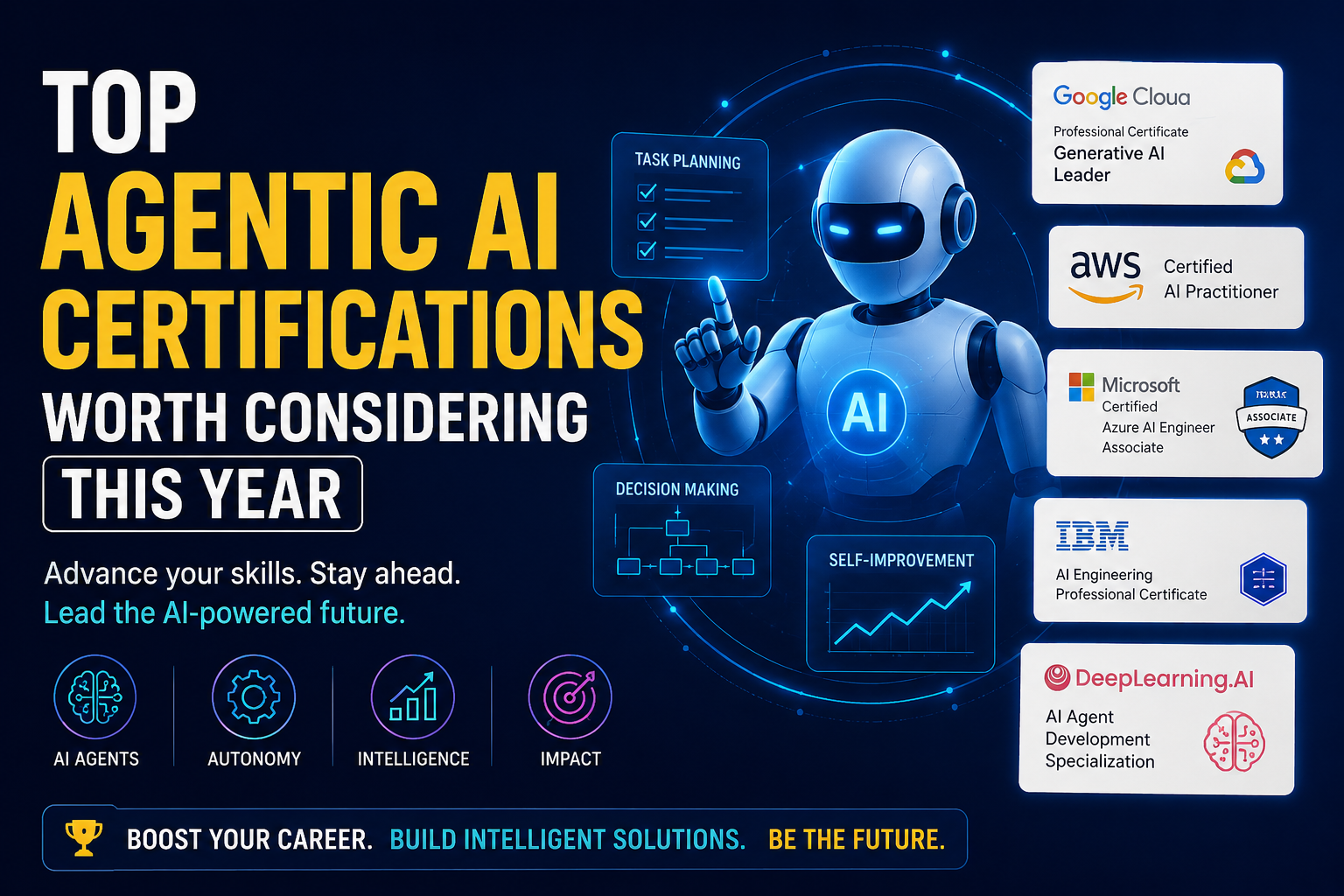
Top Agentic AI Certifications Worth Considering This Year
- 1 1. Intellipaat – Advanced Certification in Agentic AI Systems & Design
- 2 2. Microsoft Certified: Azure AI Engineer Associate (AI-102)
- 3 3. AWS Certified Machine Learning Engineer – Associate (MLA-C01)
- 4 4. DeepLearning.AI Agentic AI Specialization
- 5 5. IBM RAG and Agentic AI Professional Certificate
- 6 6. LangChain Academy
- 7 Why Agentic AI Certifications Are Becoming Different From Traditional AI Credentials
- 8 How to Choose the Right Agentic AI Certification
- 9 The Certificate Is Only the Beginning
- 10 Final Verdict
The agentic AI certification market has exploded almost as quickly as the technology itself. Not long ago, learning to build an AI agent usually meant piecing together scattered LangChain tutorials, GitHub repositories, research papers, and developer documentation. Today, there are dozens of courses and certifications promising to turn learners into “agent engineers” in a matter of weeks or months. The problem is that the quality gap between these programs is enormous.
A certificate can demonstrate that you completed a curriculum, but it does not automatically prove that you can design an autonomous system, connect agents to enterprise tools, manage state, evaluate agent behavior, or troubleshoot a workflow that behaves unpredictably in production. Employers increasingly need engineers who understand those practical challenges rather than candidates who simply know how to make an API call to a large language model.
The shift toward agentic systems is also changing what organizations expect from AI professionals. Enterprise teams are experimenting with AI agents for software development, research, customer service, analytics, recruitment, workflow automation, knowledge management, and internal operations. As adoption expands, employers are looking for people who can move from an impressive prototype to a dependable system.
That makes choosing an agentic AI certification more important than simply searching for the most popular course. The right program should give you a combination of technical understanding, practical experience, recognizable credentials, and portfolio evidence. Here are the programs that deserve serious consideration.
1. Intellipaat – Advanced Certification in Agentic AI Systems & Design

Intellipaat’s Agentic AI course, delivered in partnership with IITM Pravartak and Microsoft, is built specifically around production-grade agent development rather than theory. Delivered in partnership with IITM Pravartak and Microsoft, the program is particularly interesting for learners who want broad exposure to the modern agent-development ecosystem.
The five-month structure gives learners enough time to explore multiple frameworks instead of becoming dependent on a single tool. CrewAI, AutoGen, LangGraph, and DSPy are covered alongside technologies and concepts such as retrieval-augmented generation, Model Context Protocol, agent orchestration, and multi-agent architectures.
That breadth is one of the program’s strongest characteristics. The agentic AI ecosystem is evolving rapidly, and knowing only one framework can become a limitation. Frameworks change, APIs evolve, and organizations frequently select different technologies based on their infrastructure. Understanding the architectural ideas underneath these frameworks makes a developer considerably more adaptable.
The project component is another major differentiator. Instead of stopping at small chatbot demonstrations, the program includes projects involving systems such as autonomous equity research and multi-agent HR recruitment. These types of projects force learners to think about delegation, tool usage, information retrieval, decision-making, and coordination between multiple agents.
The program also provides an IITM Pravartak certificate and a Microsoft certification, along with a two-day campus immersion at IIT Madras Research Park. Career support is another attraction, with access to Intellipaat’s placement ecosystem, including its hiring-partner network and interview opportunities.
For someone looking for a relatively comprehensive program that combines multiple agent frameworks, projects, credentials, and career support, this is one of the more substantial choices available.
2. Microsoft Certified: Azure AI Engineer Associate (AI-102)
Microsoft’s Azure AI Engineer Associate certification is a different type of credential. Rather than functioning as a broad agentic AI bootcamp, AI-102 validates skills associated with implementing AI solutions within Microsoft Azure.
That distinction matters.
If your current organization uses Azure, or if your target employers are heavily invested in Microsoft’s cloud ecosystem, a Microsoft certification can have considerably more practical value than a generic AI certificate. Modern Azure AI development increasingly intersects with Azure AI Foundry, Semantic Kernel, Copilot Studio, retrieval systems, and enterprise AI application development.
The certification therefore makes particular sense for developers, cloud engineers, solution architects, and AI professionals who expect to build AI applications within Microsoft infrastructure.
Microsoft has also been moving toward more specialized agent-oriented credentials and learning paths. The emergence of agent-specific certification options such as AB-100, focused on agentic AI architecture, illustrates where the broader ecosystem is heading.
AI-102 is especially useful when your goal is not simply to announce that you “know AI,” but to demonstrate that you can implement AI capabilities in a recognizable enterprise cloud environment.
Its main limitation is equally straightforward: it is not designed exclusively around multi-agent engineering. If your goal is to become a framework-agnostic agent specialist, you will probably need additional project work beyond the certification.
3. AWS Certified Machine Learning Engineer – Associate (MLA-C01)
For professionals building AI systems on Amazon Web Services, the AWS Certified Machine Learning Engineer – Associate certification is a compelling alternative.
AWS has steadily incorporated generative AI into its cloud ecosystem, particularly through Amazon Bedrock and related machine learning services. As organizations move from experimental prompts toward production AI applications, knowledge of deployment, monitoring, data pipelines, security, and infrastructure becomes increasingly important.
That makes the MLA-C01 certification particularly relevant to engineers who want to operate at the intersection of machine learning and cloud engineering.
The certification is also useful because production agentic AI is not just about the agent itself. An autonomous workflow may depend on databases, APIs, identity management, observability, model endpoints, retrieval systems, and infrastructure. A developer who understands only the language-model layer can struggle when an agent needs to operate reliably at enterprise scale.
At around $150, the exam is also positioned as a relatively accessible professional credential compared with some advanced specialty certifications.
However, candidates should understand what they are buying. MLA-C01 is broader than agentic AI. It is better viewed as a machine learning engineering credential with strong relevance to modern generative AI and agent deployment rather than a dedicated “agent engineer” certification.
4. DeepLearning.AI Agentic AI Specialization
If your priority is understanding how agentic systems actually work, rather than collecting credentials, DeepLearning.AI’s Agentic AI learning ecosystem deserves serious attention.
Andrew Ng’s organization has built a reputation for explaining complicated AI concepts in a practical and approachable way. Its agent-focused material explores important areas such as agentic design patterns, tool use, reflection, planning, multi-agent collaboration, evaluation, and workflow design.
The biggest advantage is conceptual clarity.
Frameworks are temporary. Architectural principles tend to last longer.
A developer who learns only how to invoke a particular agent framework may find their knowledge outdated when the framework changes. Someone who understands why an agent needs planning, how tool selection works, where deterministic workflows are preferable to autonomous behavior, and how agent evaluation should be performed has a much stronger foundation.
The Agentic AI Specialization is therefore particularly attractive to developers who want to build a mental model of agentic architecture before committing themselves to a specific technology stack.
It is important to distinguish it from professional certifications such as Microsoft or AWS credentials. A Coursera specialization is primarily an educational credential rather than a standardized industry certification. Its value comes from the quality of the learning experience and the projects you complete.
For beginners and experienced developers alike, that can be more valuable than a certificate that looks impressive but leaves major conceptual gaps.
5. IBM RAG and Agentic AI Professional Certificate
IBM’s RAG and Agentic AI Professional Certificate offers another structured route into the field, particularly for learners interested in combining retrieval-augmented generation with agent workflows.
RAG remains an important component of enterprise AI because agents frequently need access to information that is unavailable inside a model’s static training data. Connecting an agent to company documents, databases, knowledge bases, APIs, and other information sources introduces a completely different set of engineering considerations.
IBM’s curriculum covers areas such as vector databases, retrieval, tool calling, agent orchestration, and agentic workflows. These are practical skills that translate into many enterprise use cases.
The certificate can be particularly useful for learners who find short, disconnected tutorials difficult to follow. A structured program creates a progression from fundamentals toward increasingly sophisticated applications.
It also occupies an interesting middle ground. It offers more structure than individual short courses while generally requiring less commitment than an intensive professional program.
The key is to treat the certificate as a foundation for portfolio development. After completing it, learners should be able to demonstrate their understanding through projects rather than relying solely on the credential itself.
6. LangChain Academy
LangChain Academy is worth considering for developers who have already decided that LangChain and LangGraph are central to their workflow.
The biggest advantage is obvious: the training comes directly from the ecosystem surrounding the technology. Rather than learning LangGraph through an outdated third-party tutorial, developers can study the concepts and workflows associated with the framework through its own educational resources.
LangGraph has become particularly relevant because serious agent systems often need more control than a simple linear chain can provide. State management, branching, persistence, human intervention, tool execution, and workflow orchestration all become important when agents move beyond demonstrations.
LangChain Academy is therefore best suited to technically oriented learners who already have programming experience and want framework-specific competence.
Its limitation is its narrower scope. Learning LangGraph deeply does not automatically make someone an expert in agent evaluation, cloud infrastructure, multi-agent system design, model selection, security, or enterprise architecture.
Think of it as a specialized layer in your education rather than the complete certification strategy.
Why Agentic AI Certifications Are Becoming Different From Traditional AI Credentials
Traditional AI certifications often focused on machine learning concepts, cloud AI services, model deployment, or data science. Agentic AI introduces another layer of complexity.
An agent is expected to do more than generate an answer. Depending on its design, it may interpret an objective, create a plan, select tools, access external information, execute actions, evaluate intermediate results, revise its approach, and communicate with other agents.
That introduces problems that traditional application development and conventional machine learning do not always address in the same way.
Reliability becomes a major issue. An agent can make an incorrect tool selection or follow a flawed reasoning path. Observability becomes important because developers need to understand why a system behaved a certain way. Evaluation also becomes harder because success cannot always be measured with a single accuracy score.
Security is another critical consideration. An agent with access to email, databases, financial systems, or internal APIs can potentially cause real operational consequences if its permissions and guardrails are poorly designed.
This is why employers increasingly value practical projects. A candidate who can demonstrate a functioning agentic workflow, explain its architecture, identify failure modes, and discuss how the system could be monitored in production has evidence of competence that a certificate alone cannot provide.
How to Choose the Right Agentic AI Certification
The best certification depends heavily on your existing technical background and target environment.
If you want a broad, structured program covering multiple agent frameworks while also emphasizing projects and career support, Intellipaat is one of the stronger options to investigate.
If you are targeting Microsoft-heavy organizations, AI-102 and the newer agent-oriented Microsoft learning paths are more strategically aligned with your career trajectory.
AWS professionals should look closely at MLA-C01 because cloud infrastructure and machine learning engineering are highly relevant to deploying real agentic systems.
If your priority is learning rather than collecting a formal industry credential, DeepLearning.AI is an excellent starting point. It can help you determine whether agentic AI is genuinely the direction you want to pursue before making a larger financial commitment.
For RAG-heavy applications and structured learning, IBM’s professional certificate is worth considering. And for developers committed to LangChain and LangGraph, LangChain Academy provides highly relevant framework-specific education.
The Certificate Is Only the Beginning
One of the biggest mistakes aspiring AI engineers can make is treating certification as the final destination.
The certificate gets added to your LinkedIn profile. A strong project gets discussed during an interview.
There is a substantial difference.
A portfolio project should demonstrate that you understand the complete lifecycle of an agentic application. Instead of building another generic chatbot, consider creating something with genuine workflow complexity: a research agent that validates sources, a software engineering agent that generates and tests code, a customer-support system that routes difficult cases to humans, or a multi-agent analytics platform that gathers information and produces a structured business report.
The more importantly, you should be able to explain why you designed the system the way you did.
Why did you choose a single agent instead of multiple agents? Why did you use RAG? What happens when a tool fails? How do you prevent an agent from entering an infinite loop? How do you evaluate its output? What permissions does it have? Where is human approval required? How would you monitor it after deployment?
Those questions separate an agent developer from someone who has simply completed an online course.
Final Verdict
The agentic AI market is moving too quickly for anyone to rely on a certificate alone. The strongest career strategy combines a recognizable credential with framework knowledge, cloud expertise, software engineering fundamentals, and demonstrable projects.
Intellipaat stands out for learners seeking a comprehensive program with multiple frameworks, substantial projects, credentials, and career-oriented support. Microsoft AI-102 makes more sense for professionals building within Azure, while AWS MLA-C01 is a logical choice for machine learning engineers working in the AWS ecosystem. DeepLearning.AI is particularly strong for conceptual understanding, IBM provides a structured RAG-and-agent pathway, and LangChain Academy is valuable for developers focused specifically on LangChain and LangGraph.
The most valuable credential, however, is not necessarily the one with the most prestigious name. It is the one that helps you build something you can explain, defend, improve, and eventually deploy.
Agentic AI engineering is ultimately a practical discipline. Your certificate can open the conversation, but your architecture, code, experiments, and ability to solve real problems are what can carry it forward.