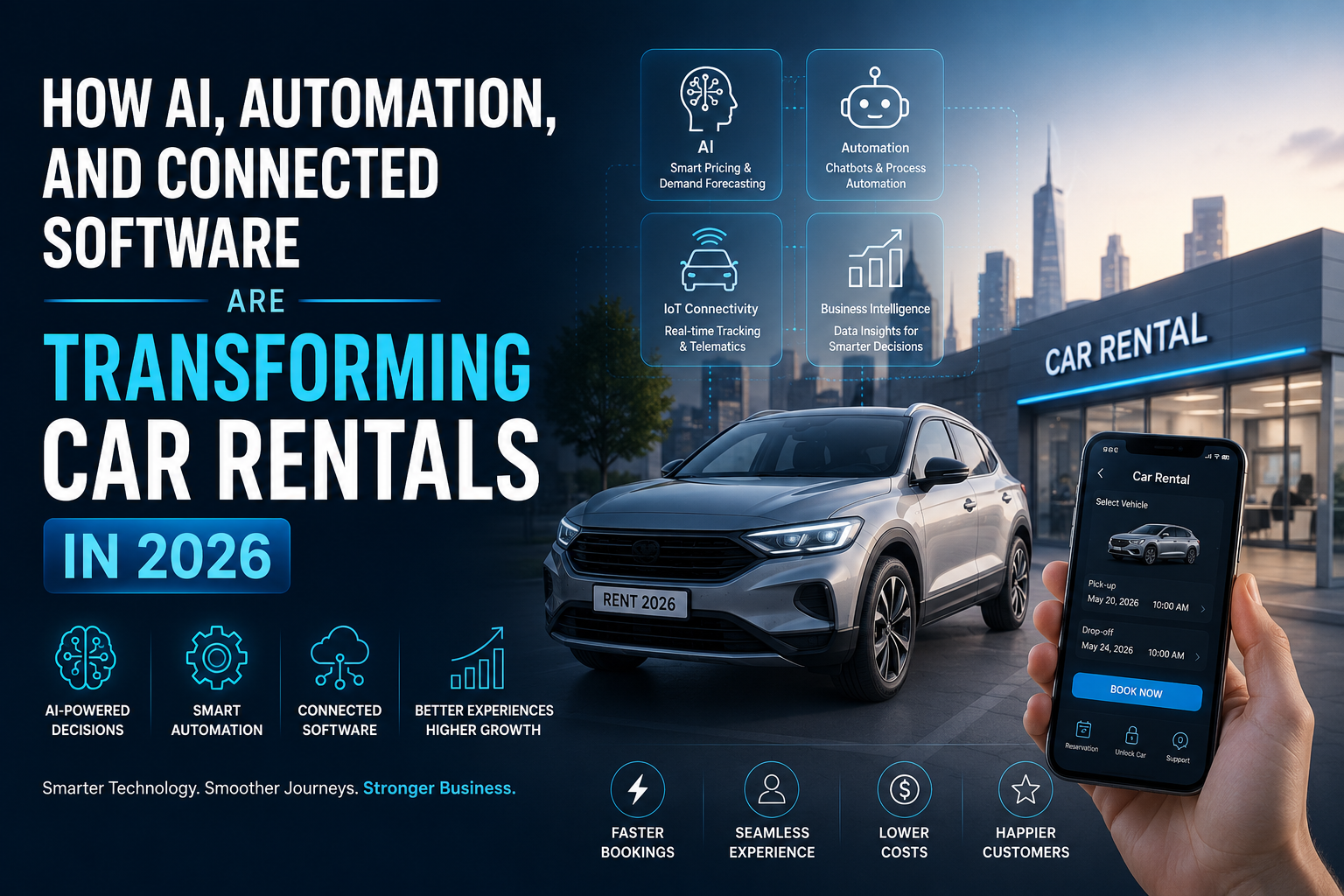
How AI, Automation, and Connected Software Are Transforming Car Rentals in 2026
- 1 Car rental has become a real-time data problem
- 1.1 AI-assisted pricing: faster decisions with human guardrails
- 1.2 Connected fleets turn vehicles into live digital assets
- 1.3 The customer journey is becoming a digital workflow
- 1.4 CRM becomes the intelligence layer for customer service
- 1.5 Computer vision makes vehicle inspections more consistent
- 1.6 Predictive maintenance protects uptime
- 2 APIs connect the rental technology stack
- 2.1 Cybersecurity is part of the rental experience
- 2.2 How to modernize without disrupting daily operations
- 3 Conclusion
Car rental companies once competed mainly on fleet size, branch locations, and daily rates. In 2026, the competitive advantage increasingly sits in the technology layer behind those visible services. Every reservation now triggers a chain of digital decisions involving live availability, pricing, identity checks, payments, vehicle status, maintenance, customer communication, and post-rental support.
That is why modern car rental software is no longer just a booking calendar. It is becoming the operating system of the rental business: a connected platform that turns scattered information into real-time workflows. When the technology works well, customers experience a faster and simpler rental. Behind the scenes, operators gain better control over utilization, downtime, risk, and staff workload.
Car rental has become a real-time data problem
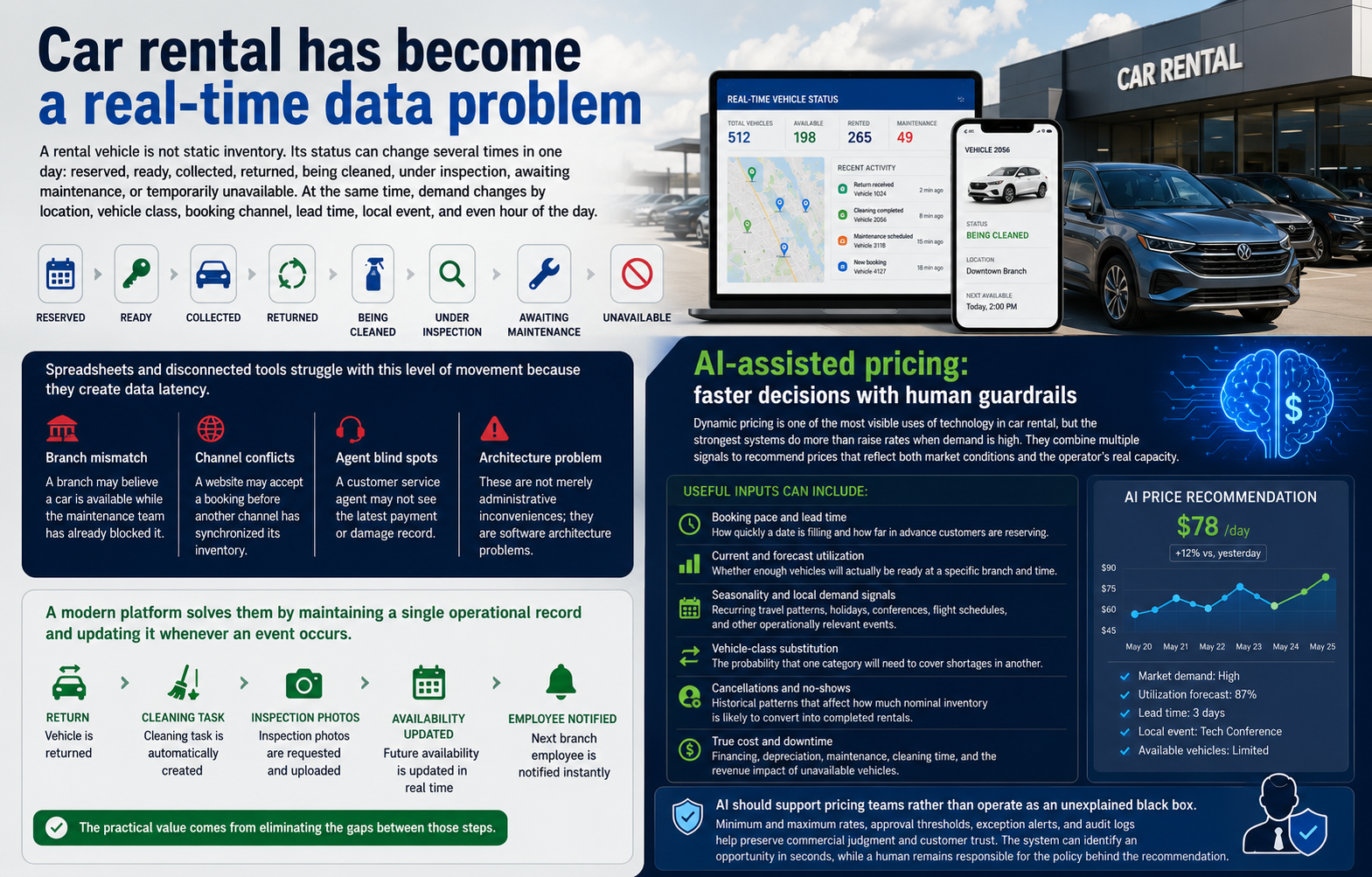
A rental vehicle is not static inventory. Its status can change several times in one day: reserved, ready, collected, returned, being cleaned, under inspection, awaiting maintenance, or temporarily unavailable. At the same time, demand changes by location, vehicle class, booking channel, lead time, local event, and even hour of the day.
Spreadsheets and disconnected tools struggle with this level of movement because they create data latency. A branch may believe a car is available while the maintenance team has already blocked it. A website may accept a booking before another channel has synchronized its inventory. A customer service agent may not see the latest payment or damage record. These are not merely administrative inconveniences; they are software architecture problems.
A modern platform solves them by maintaining a single operational record and updating it whenever an event occurs. A return can automatically change vehicle status, create a cleaning task, request inspection photos, update future availability, and notify the next branch employee. The practical value comes from eliminating the gaps between those steps.
AI-assisted pricing: faster decisions with human guardrails
Dynamic pricing is one of the most visible uses of technology in car rental, but the strongest systems do more than raise rates when demand is high. They combine multiple signals to recommend prices that reflect both market conditions and the operator’s real capacity.
Useful inputs can include:
- Booking pace and lead time. How quickly a date is filling and how far in advance customers are reserving.
- Current and forecast utilization. Whether enough vehicles will actually be ready at a specific branch and time.
- Seasonality and local demand signals. Recurring travel patterns, holidays, conferences, flight schedules, and other operationally relevant events.
- Vehicle-class substitution. The probability that one category will need to cover shortages in another.
- Cancellations and no-shows. Historical patterns that affect how much nominal inventory is likely to convert into completed rentals.
- True cost and downtime. Financing, depreciation, maintenance, cleaning time, and the revenue impact of unavailable vehicles.
AI should support pricing teams rather than operate as an unexplained black box. Minimum and maximum rates, approval thresholds, exception alerts, and audit logs help preserve commercial judgment and customer trust. The system can identify an opportunity in seconds, while a human remains responsible for the policy behind the recommendation.
Connected fleets turn vehicles into live digital assets
Telematics changes fleet management by replacing periodic snapshots with continuous operational data. Depending on the vehicle and installed hardware, a platform may receive mileage, location, fuel or battery level, diagnostic codes, ignition status, and service reminders. For electric vehicles, charge level and expected charging time can become part of the availability calculation.
This data enables a digital status record for every vehicle. Instead of waiting for a driver or branch employee to report a problem, the system can flag a fault, recommend a maintenance window, block a vehicle from future reservations, and route it to the appropriate location. Geofencing can also support branch control, roadside assistance, and approved-use policies.
Connected fleets require clear privacy rules. Operators should collect only the data they need, explain how it is used, limit employee access, and define retention periods. Telematics is valuable because it improves operations, not because it creates unlimited surveillance.
The customer journey is becoming a digital workflow
Customers increasingly expect the rental process to feel like other digital services: immediate confirmation, transparent pricing, mobile documents, and fewer repetitive questions. Automation can connect the entire journey without forcing the customer to understand the systems behind it.
Before pickup, the platform can support:
- Real-time vehicle availability and optional extras.
- Electronic agreements and consent records.
- Identity and driving-license verification.
- Payment authorization, deposits, and fraud checks.
- Automated reminders with branch instructions and required documents.
At pickup, mobile check-in, digital signatures, keyless access, or self-service kiosks can reduce counter time where local rules and fleet hardware allow them. At return, guided photo capture, mileage and fuel confirmation, automated receipts, and structured issue reporting can make the process more consistent.
Good automation does not remove human service. It removes repetitive work so employees can focus on exceptions: a customer whose documents cannot be verified, a family that needs a different vehicle, or a disputed damage claim. A digital process should always include a clear path to human support.
CRM becomes the intelligence layer for customer service
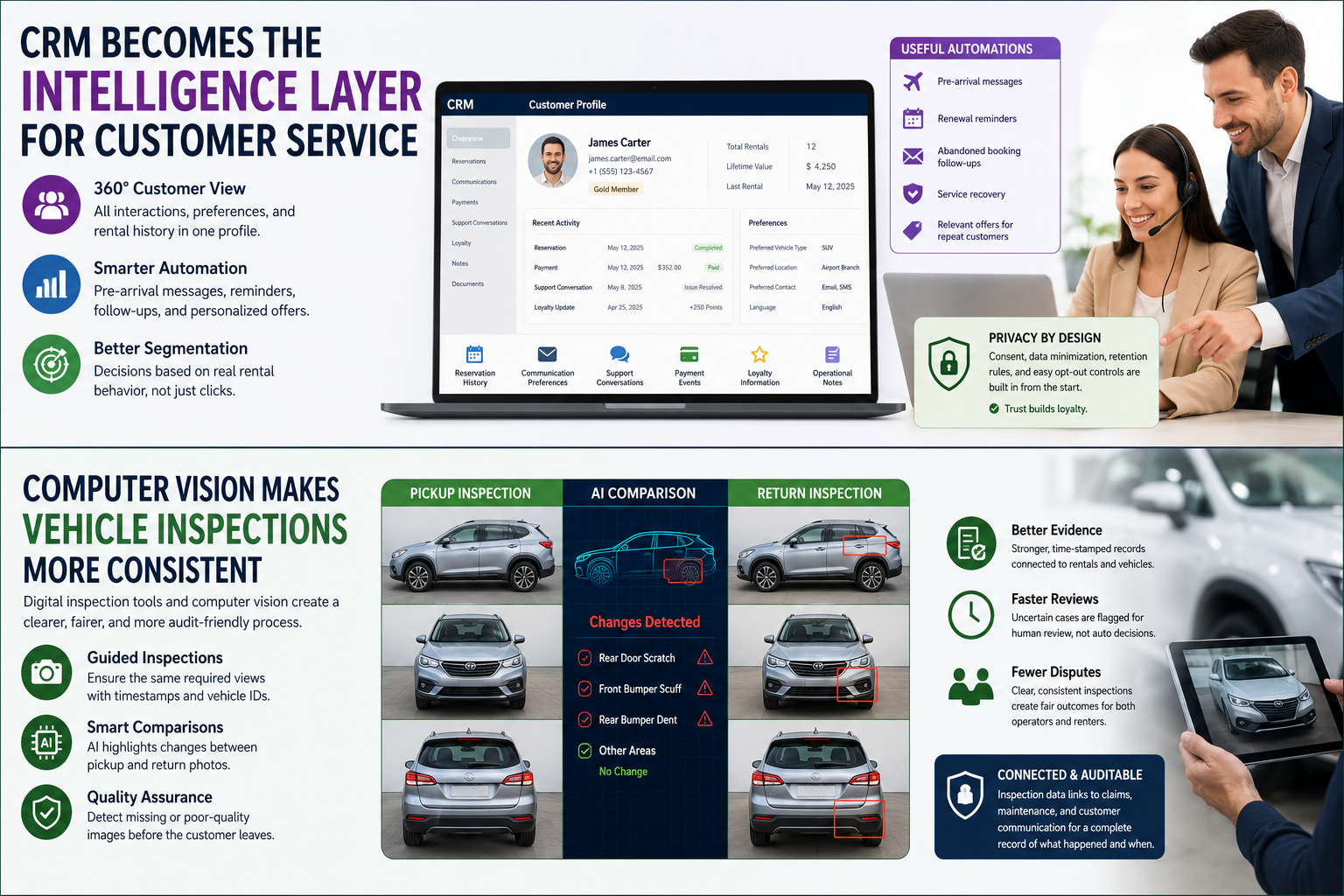
A dedicated car rental CRM can connect reservation history, communication preferences, support conversations, payment events, loyalty information, and operational notes in one customer profile. This gives staff context without forcing them to search through separate inboxes and branch systems.
The same data can power useful automation: pre-arrival messages, renewal reminders, abandoned-booking follow-ups, service recovery after a poor experience, and relevant offers for repeat customers. Segmentation becomes more accurate when it reflects actual rental behavior rather than only marketing clicks.
The technology must still respect consent and data minimization. A useful customer profile is not the same thing as an unlimited archive. Permissions, retention rules, and visible opt-out controls should be designed into the workflow from the beginning.
Computer vision makes vehicle inspections more consistent
Vehicle condition is a common source of cost and customer disputes. Traditional inspections depend heavily on time, lighting, camera angle, and employee attention. Digital inspection tools improve consistency by guiding users through the same required views and attaching timestamps, vehicle identifiers, and rental records to every image.
Computer vision can compare pickup and return photos, highlight areas that appear to have changed, and route uncertain cases for review. It can also detect missing images or poor-quality captures before a customer leaves the branch. The purpose is not to let an algorithm make an irreversible accusation; it is to help a trained employee review better evidence faster.
When inspection data is connected to claims, maintenance, and customer communication, the process becomes easier to audit. Both the operator and the renter benefit from a clearer record of what happened and when.
Predictive maintenance protects uptime
For a rental operator, an unavailable car is both an asset cost and a lost sales opportunity. Predictive maintenance uses mileage, time, service history, fault codes, usage intensity, and inspection results to identify work before a breakdown disrupts a booking.
A connected workflow can create a maintenance task automatically, reserve workshop capacity, notify the branch, order required parts, and prevent the vehicle from being assigned to a new customer. After completion, the same system can restore availability and maintain a complete service record.
The key is not prediction alone. The operational advantage comes from linking the prediction to action. An alert that sits unread in a dashboard does not protect uptime; an alert that changes scheduling and assigns responsibility can.
APIs connect the rental technology stack
Most operators need more than one technology provider. Their stack may include a public booking site, payment gateway, accounting platform, telematics provider, mapping service, identity-verification tool, maintenance network, access-control system, and marketing platform. Modern auto rental software should serve as the operational core while exchanging data with these specialized services through APIs and webhooks.
Reliable integration requires more than a connector logo on a sales page. Systems need stable vehicle and reservation identifiers, documented data fields, secure authentication, error handling, duplicate-event protection, monitoring, and a test environment. When an integration fails, staff should receive a useful alert rather than discover the problem through an angry customer.
An API-first approach also makes future expansion easier. A company can add a new booking channel, payment method, branch, or vehicle-access provider without rebuilding its entire operating model. That flexibility is becoming as important as any individual feature.
Also Read- How CRM Works in 2025: From Data Capture to Predictive Engagement
Cybersecurity is part of the rental experience
Rental platforms may process identity documents, driver information, payment events, contracts, customer messages, and location data. A security failure therefore creates operational disruption as well as reputational and legal risk.
A practical security baseline includes:
- Multi-factor authentication for administrative users.
- Role-based access so employees see only the data required for their work.
- Encryption in transit and at rest, plus tokenization of payment information where appropriate.
- Audit logs for sensitive actions and changes to reservations, refunds, and vehicle status.
- Tested backups, incident-response procedures, and controlled software updates.
- Vendor reviews and clear rules for data retention and deletion.
Security should be designed into everyday operations. If controls are too confusing, employees will search for shortcuts; if they are invisible and well integrated, they protect the business without slowing it down.
How to modernize without disrupting daily operations
Digital transformation does not require replacing every system at once. A staged rollout is usually safer and easier to measure.
- Map the current workflow. Document how reservations, payments, vehicle status, inspections, maintenance, and customer support move between people and systems.
- Choose one high-friction process. Examples include double-booking prevention, digital check-in, maintenance scheduling, or damage-photo collection.
- Clean the core data. Standardize vehicle IDs, branch names, customer records, rate rules, and status definitions before connecting new tools.
- Integrate and pilot. Test the workflow at one branch or with one vehicle group, while keeping a documented fallback process.
- Measure operational outcomes. Track booking errors, counter time, fleet utilization, turnaround time, downtime, failed payments, claim-resolution time, and manual corrections.
- Expand only after the process is stable. Technology should simplify a working operating model, not automate confusion at a larger scale.
Conclusion
The next generation of car rental is not defined by one fashionable feature. It is defined by connected decisions. Pricing should know the real fleet position. Booking should know whether a vehicle will be ready. Maintenance should update availability. Inspections should connect to claims. Customer service should see the complete rental history. Security should protect every step.
AI, automation, telematics, computer vision, CRM, and APIs are most valuable when they operate as parts of one system rather than isolated tools. Operators that build this connected technology layer can respond faster, use their fleet more efficiently, reduce repetitive work, and give customers a clearer experience.
In 2026, software is no longer supporting the car rental business from the sidelines. Increasingly, it is the infrastructure through which the business runs.