Rethinking Batch Asset Production Through Banana AI
- 1 The Consistency Problem in High-Volume Production
- 1.1 Nano Banana AI: Efficiency at the Edge of Creative Workflows
- 1.2 Structuring the Asset Pipeline
- 1.3 Establishing the Visual North Star
- 1.4 The Batching Phase
- 1.5 The Refinement and Editing Layer
- 1.6 Bridging the Gap to Motion
- 1.7 Managing Technical Expectations in Production
- 1.8 Operational Benefits for Small Product Teams
- 1.9 The Future of the Integrated Workflow
- 2 Conclusion
The primary bottleneck for creative operations today isn’t a lack of ideas; it is the sheer volume of assets required to fuel a modern launch. Between social media carousels, performance-driven display ads, and landing page hero images, a single product update can demand hundreds of unique visual permutations. Traditionally, this meant a trade-off between the speed of delivery and the consistency of the brand’s visual language.
Product teams and performance marketers have historically relied on templated designs to solve this, but templates often lead to visual fatigue. Generative AI has shifted the focus from static templates to dynamic asset pipelines. However, simply using a general-purpose model often creates a different problem: high variance. When you generate fifty images for an ad campaign, you need them to look like they belong to the same universe. This is where a focused ecosystem like Banana AI becomes critical for teams that need to scale without losing their brand identity.
The Consistency Problem in High-Volume Production
Consistency in AI-generated content is notoriously difficult to maintain. If you ask a standard model for “a modern laptop on a wooden desk” ten times, you might get ten different types of wood, different lighting conditions, and different laptop designs. For a launch team, this lack of control is a deal-breaker.
The core of the issue lies in the stochastic nature of large-scale models. They are designed for variety, not necessarily for repetition. To solve this, workflows must pivot away from “prompt and pray” methods toward structured generation environments. By using Banana AI, teams can ground their creative direction in a more predictable framework. This is not about sacrificing creativity; it is about building a set of visual guardrails that allow for high-speed iteration.
One must be realistic here: current AI technology still struggles with pinpoint textual accuracy within images. If your campaign requires specific, readable copy embedded directly into the background of a 3D render, you will likely still need a human designer to clean up the typography in post-production. Acknowledging these limitations allows a production team to allocate their human resources where they are most needed—refining the final 10% rather than struggling with the first 90%.
Nano Banana AI: Efficiency at the Edge of Creative Workflows
Speed is often the most underrated feature in a production pipeline. When a marketing lead asks for a “slight adjustment” to a batch of thirty assets, a slow rendering process can kill a project’s momentum. This is where Nano Banana AI fits into the stack.
The “Nano” designation typically implies a model optimized for throughput and responsiveness. In a practical workflow, this means the latency between a prompt adjustment and a visible result is minimized. For teams exploring AI visuals for launch assets, this speed enables a “fast-fail” culture. You can test five different aesthetic directions in the time it used to take to render a single high-fidelity preview.
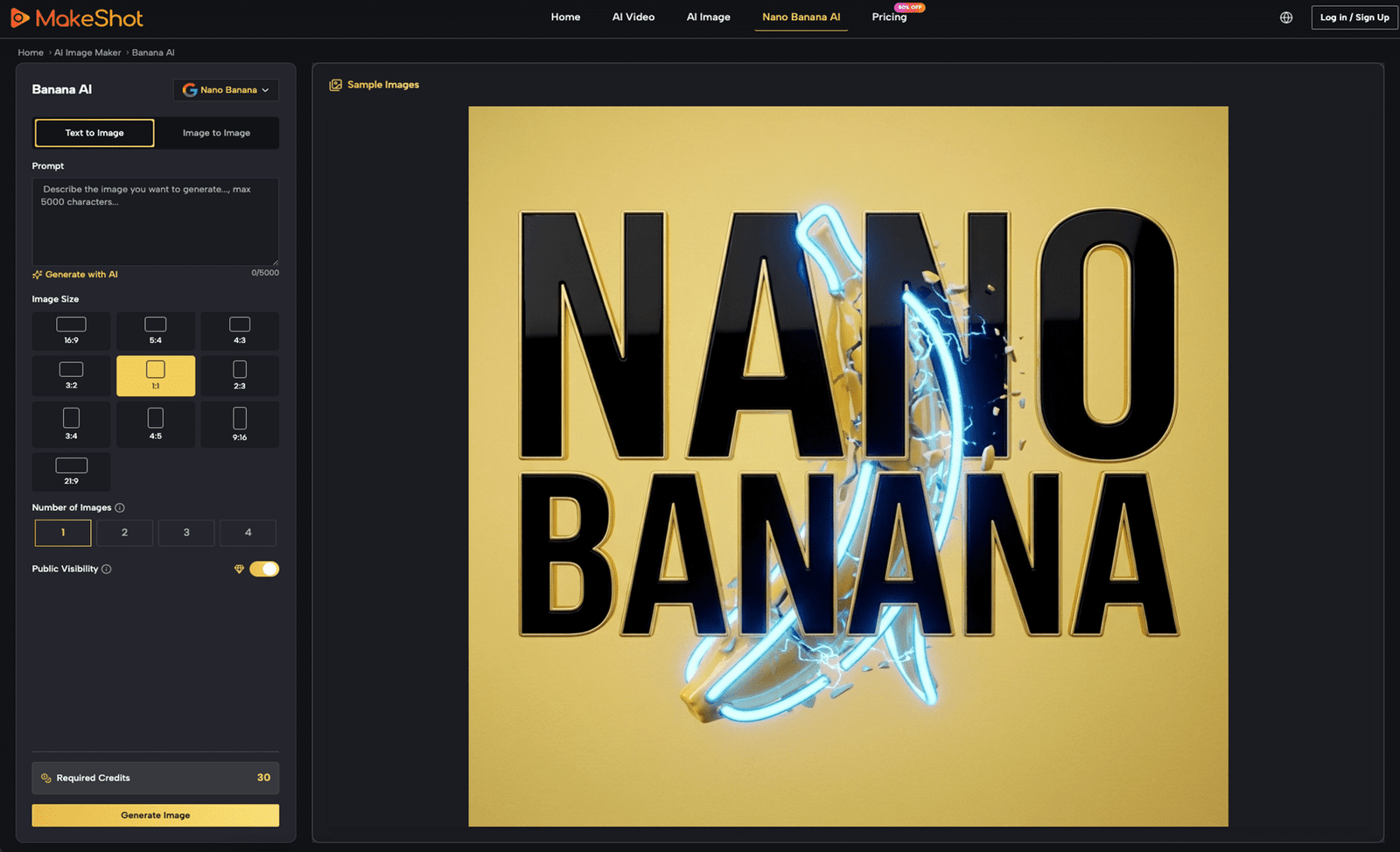
The Nano Banana AI model is particularly effective when used for rapid prototyping of social media assets. Because these platforms favor volume and frequent testing, the ability to generate variations in different aspect ratios—such as 9:16 for vertical video or 4:5 for feed posts—without waiting minutes for each generation is a massive operational advantage.
Structuring the Asset Pipeline
A professional asset pipeline using Banana AI should follow a logical progression. It isn’t just about the initial generation; it’s about how those images are refined and repurposed.
Establishing the Visual North Star
Before batching, the team must define a “Seed Image.” This image acts as the aesthetic reference point for everything that follows. By using the Image-to-Image capabilities within the MakeShot environment, creators can ensure that lighting, color palettes, and subject framing remain stable across a multi-channel campaign.
The Batching Phase
Once the style is locked, the workload shifts to Nano Banana AI for volume. This involves generating the core set of assets across various aspect ratios. The goal here is to populate the “bucket” of assets that will be used for A/B testing in ad managers.
The Refinement and Editing Layer
No batch is perfect on the first pass. The ability to restyle and edit existing visuals is what separates a tool from a toy. If a generated image has the right composition but the wrong color for the call-to-action button, the workflow should allow for targeted editing rather than a full re-generation.
Bridging the Gap to Motion

While static imagery remains the backbone of many campaigns, the demand for video is increasing. Product teams are now looking at how their static asset pipeline can feed into video production. Using an AI Video Generator to breathe life into static concepts is the next logical step in this evolution.
However, teams should be wary of the current state of AI video. While impressive, temporal coherence—the ability for an object to look the same from one frame to the next—remains an area of active development. If you are producing a high-stakes product demo, a static image with a subtle parallax effect or a simple motion overlay may often be more “brand-safe” than a fully generated AI video that might suffer from minor visual glitches or “hallucinations” in movement.
Managing Technical Expectations in Production
It is easy to get caught up in the hype of “instant” content, but practical operators know that quality takes time, even with Banana AI. There is a visible trade-off between the complexity of a prompt and the reliability of the output.
For instance, when scaling assets for a landing page, the model might perfectly capture a lifestyle scene but struggle with the specific ergonomics of a proprietary product. In these cases, the AI is best used for the environment and “vibe,” while the actual product might be composited in later. This hybrid approach—using AI for the heavy lifting of background and atmosphere while maintaining manual control over the product itself—is the most reliable way to use Nano Banana AI in a professional setting.
Another uncertainty involves the legal and copyright landscape surrounding generative media. While tools like MakeShot provide the platform for creation, teams should always consult their internal legal guidelines regarding the commercial use of AI-generated faces or specific architectural styles.
Operational Benefits for Small Product Teams
For indie makers and smaller product teams, these tools are force multipliers. A team of two can now produce the volume of visual content that previously required a dedicated agency. By leveraging Banana AI for the foundational creative work, these teams can focus their budget on distribution and product development rather than high-cost photography sets.
The MakeShot platform offers several built-in tools that simplify this further:
- Aspect Ratio Control: Instantly pivoting between 16:9 for YouTube and 1:1 for Instagram.
- Image-to-Image Refinement: Using a sketch or a basic photo as a guide for the AI.
- Batch Generation: Creating multiple variations from a single prompt to find the perfect “hero” shot.
The Future of the Integrated Workflow
We are moving toward a future where the distinction between “image maker” and “video creator” disappears. The goal for any modern creative operation should be the creation of a “Visual Engine”—a repeatable process where inputs (prompts, brand guidelines, product sketches) consistently result in high-quality outputs across all media formats.
Whether you are using an AI Video Generator to create a background for a landing page or utilizing Nano Banana AI to pump out fifty variations of a Facebook ad, the underlying principle is the same: reduce the friction between the idea and the asset.
Conclusion
Scaling visual production isn’t just about finding the most powerful model; it’s about finding the model that fits into a sustainable, repeatable workflow. Banana AI provides that balance of quality and control, while the speed of the Nano variant ensures that production never becomes the bottleneck for a launch. As long as teams remain aware of the current technical limitations and maintain a layer of human oversight, the potential for high-volume, high-quality asset production is now within reach for every product team.