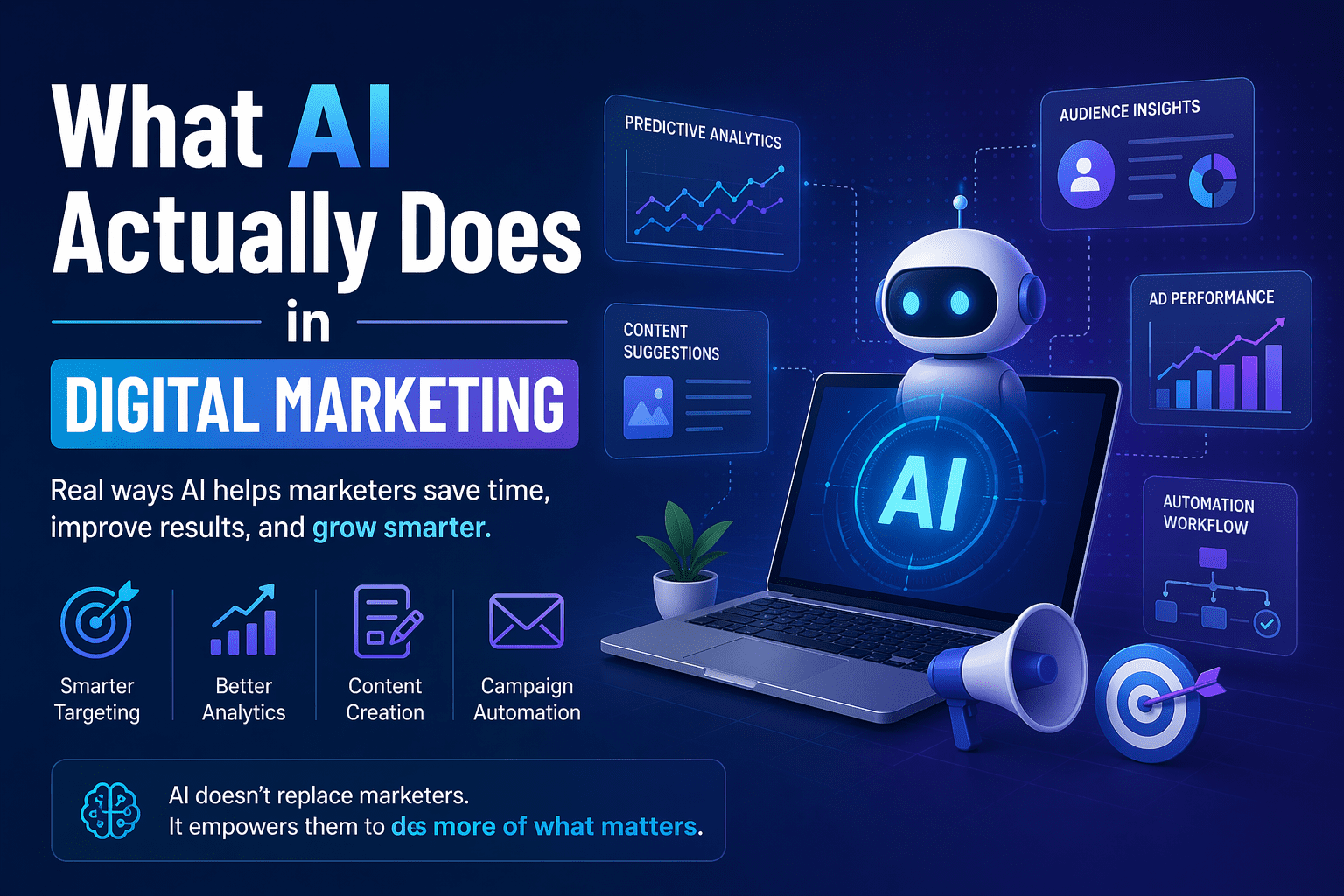
What AI Actually Does in Digital Marketing (And What It Still Can’t Replace)
- 1 What AI Does Well When It Comes To Marketing
- 1.1 Recording Data At A Rate No Human Could Ever Do
- 1.2 Speeding Up Content Production
- 1.3 Automating Repetitive Tasks
- 1.4 Improving SEO Research and Optimization
- 2 What AI Still Can’t Replace
- 2.1 Strategy
- 2.2 Relationships and Trust
- 2.3 Brand Voice and Original Perspective
- 2.4 Creative Problem-Solving Under Real Constraints
- 3 The Practical Takeaway
In marketing, artificial intelligence is everywhere at the moment. AI-Driven tools, which write copy, create images, analyze data, and automate campaigns, are being incorporated faster than we can keep track of. If you are a business owner or a marketer trying to figure this all out, the noise can be deafening.
So let’s cut through it.
Still, AI has been pretty useful in digital marketing. But it is not magic, nor a substitute for strategy, relationships, or good judgment that comes only from experience. One of the best things you can do for your marketing now is to understand what AI does well and where it fails.
What AI Does Well When It Comes To Marketing
Recording Data At A Rate No Human Could Ever Do
The most powerful use of marketing AI is to analyze data. The projection can distinguish patterns of traffic on specific pages, clickpath among visitors to identify obstacles and drop off points in conversion paths, clicktags that are being over-indexed against cohorts or segments of audience — scanners run through thousands of data points in seconds that would take a gaggle of analysts hours to compile.
Platforms like Google Ads and Meta already leverage machine learning to optimize bidding, targeting audiences, and predicting conversions among users. That is AI making it quietly better without any fanfare.
Small businesses should care about this because it means paying less for ads. Rather than just modeling who to market to, AI-driven platforms progressively predict with greater accuracy each realistic behavior.
Speeding Up Content Production
How AI Writing Tools Make it Better. This can provide a real time-saver for teams managing high content volumes.
Now, here is the big difference: AI can generate content much faster. It also cannot generate top-quality content at the click of a button without the ability to guide and edit.
AI does not know your business, or your tone, or the specific objections of your customers, or what sets you apart in the local market. It extracts patterns from existing online content, which makes it out of the ordinary to the generic. Even the best marketer needs to mold, hone, and root that content in something actual.
Automating Repetitive Tasks
AI-powered automation has become the norm for email sequences, chatbot responses, lead scoring, social scheduling, and reporting dashboards. These tools automate much of the manual labor and free up marketing teams to focus on higher-level strategy.
For instance, an email automation system can send the correct follow-up message to a lead depending on their movement across your website, without anybody having to trigger it. Without AI, that personalized experience on a wide scale would be unattainable.
Improving SEO Research and Optimization
Marketing is a different game now. There has been a change in the way marketers approach keyword search, the fulcrum of content gap, and on-page optimization due to AI tools. You can now see what topics your competitors are ranking for, and raise alerts about technical SEO shortcomings and even propose content structures to potentially rank well in search.
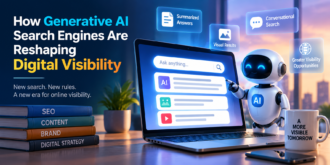
Now, AI has begun changing the search results themselves. There is no time to waste for businesses that want to attract new customers, as Google’s AI Overviews now show direct answers at the top of relevant search pages — meaning the approach that companies have been taking towards AI digital marketing and search visibility dramatically needs to change. That is, if you want to show up in AI-generated answers, it needs to be structured, authoritative, and well-organized content — not just a bunch of keywords.
What AI Still Can’t Replace
Strategy
AI tells you what keywords people search on Google with high volumes. It cannot tell you which of them mesh with your business objectives, your budget, your competitive stance, and where your customers are in their buying journey. It takes context, experience, and judgment.
Read more – Marketing strategy or just numbers? It is learning what a business is trying to deliver and formulating a strategy that aligns the proper people, message, and moment. That’s still a human skill.
Relationships and Trust
Trust in a company is why people start buying it. Build trust through consistent communication, real responsiveness, and the feeling that there is a human on the other side of the platform empathizing with their situation.
AI can mimic conversational tone. It can never form a real relationship. Whether it is a client calling you with an issue, when there is a negative review that deserves proper attention, or when a prospect is on the verge of making their decision and only needs somebody to help talk through their options, this is where human connection comes in. No automation replaces it.
Brand Voice and Original Perspective
This is the story behind every business, the personality and point of view that sets it apart. AI doesn’t have opinions. It doesn’t have experience. It collects patterns from what exists, which also means it tends to drift toward the same sounding tones that everything else exploits.
The bold visionaries of marketing aren’t the people using half a dozen AI tools. They have a really distinct voice, a personal narrative backed by credible content. AI can support that process. You cannot make it from the ground up.
Creative Problem-Solving Under Real Constraints
A marketing campaign is not a content calendar and a series of ads. There are budget trade-offs, timing decisions, audience nuances to be considered, and sometimes an ugly pivot if something just isn’t working. That kind of adaptive reasoning, forcing yourself to choose between less-than-ideal options and then making a decision anyway, is still deeply human territory.
The Practical Takeaway
AI is a tool. And like any decent tool, it only shines in the hands of someone who knows how to use it. What that means for marketers is using AI to produce more in less time, yet still bringing the strategy, voice, and acumen that will actually make marketing work.
If you’re a business owner weighing up your marketing options, the question is not if your agency or team is using AI. It’s whether they are using it wisely, in service of a greater strategy, or as a hack that skips the work that really leads to results.
In fact, the businesses currently kicking ass in digital marketing are not those that are ceding everything entirely to AI. They are the ones realizing AI-based efficiencies without losing sight of real expertise at the wheel.