Top Online Resources for Engineers: Tools, Charts & Converters
- 1 Best Online Resources for Engineers: Tools, Charts & Converters
- 1.1 The Engineering ToolBox (www.engineeringtoolbox.com)
- 1.2 Engineers Edge (www.engineersedge.com)
- 1.3 eFunda (www.efunda.com)
- 1.4 RS (www.rs-online.com)
- 1.5 Talygen (www.talygen.com)
- 2 Take Care When Choosing Tools to Help Ensure Engineering Success
As an engineer, you will be best placed to succeed with your projects when you have quick and convenient access to reliable data, unit converters, and calculation tools.
With that in mind, you can’t hope for greater speed or convenience than being able to access such resources online, potentially just a few clicks of your mouse away.
Whatever branch of engineering you are engaged in – such as mechanical, civil, electrical, or chemical engineering – you are likely to find at least some of the following resources invaluable.
Best Online Resources for Engineers: Tools, Charts & Converters
The Engineering ToolBox (www.engineeringtoolbox.com)
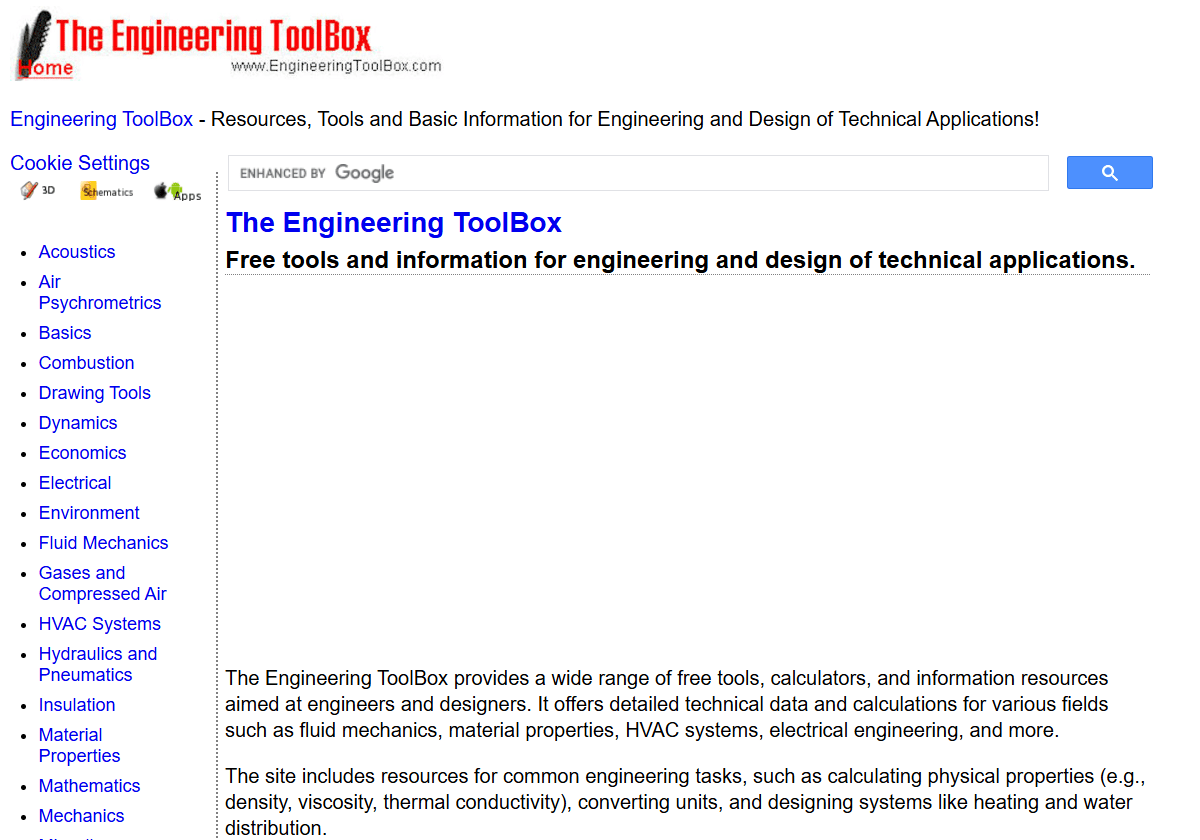
Very few sites online can claim to be quite as deep a treasure trove of free tools and information for engineers as this one.
Whether you’re on the lookout for water density tables, thermal expansion charts, HVAC (heating, ventilation, and air conditioning) load calculators, or any of a broad range of other calculators, unit converters, or data sources, you will almost certainly find what you need here.
Engineers Edge (www.engineersedge.com)

All manner of engineering calculators, conversion tables, and design resources await you at this site, which even has an attached community forum to further ease problem-solving.
Mechanical, structural, and manufacturing engineers alike can gain something from this extensive library of engineering reference data and interactive tools. From beam deflection calculators and static modellers to pipe schedule charts and premium Excel spreadsheet downloads, there is a bit of (practically) everything.
eFunda (www.efunda.com)

Aimed at mechanical engineers, eFunda is a robust resource for both students and professionals. Again, there is a message board here, although given that at the time of our visit, it didn’t seem to have received activity since 2023, you will likely find the variety of conversion tools and educational resources a lot more useful.
From length, area, and volume unit conversion tools to beam, vibration, and heat transfer formulas, if you’re likely to need it as a mechanical engineer, the chances are that you will find a version of it here.
RS (www.rs-online.com)

Perhaps your latest project requires you to figure out resistance values for parallel and series resistors? Or maybe you need to convert units of measurement, such as kilograms into pounds, or determine the cross-sectional area (CSA) of a wire?
You get the idea; there can often be all manner of fiddly calculations and conversions that you need to rapidly perform on any given day. It is fortunate, then, that the electrical component supplier RS happens to have a comprehensive set of engineering tools and conversion calculators in one place.
Talygen (www.talygen.com)

Finally, it is important to note that the most useful online resources for engineers aren’t limited to technical tools. A fine example of this is Talygen, which is a cloud-based business management platform designed to streamline a variety of processes.
While the functionalities contained within the Talygen software are not solely intended for use in engineering contexts, it can certainly be a very useful resource scheduling tool for engineering firms. The platform makes it a straightforward process for managers at such companies to assign workers to tasks.
Not only that, but such decision-makers are also able to generate custom reports on employee information, project performance, and company assets, in addition to viewing information through a Gantt chart or Kanban board. We could go on, but you get the idea; when it comes to scheduling tasks and tracking progress within engineering projects, Talygen packs in a lot.
Take Care When Choosing Tools to Help Ensure Engineering Success
Across a wealth of projects in your capacity as an engineer, you are likely to find the aforementioned resources crucial for streamlining calculations, enhancing accuracy, and supporting collaboration.
When you take care to make sure whatever resources and tools you use are intuitive in their design, accurate in the results they provide, and well-suited to your engineering discipline, you can help increase the likelihood of all the above desirable outcomes.