
Why Data Annotation Is the Silent Powerhouse Behind Every AI Breakthrough
- 1 Understanding the Foundations: What Is Data Annotation?
- 2 The Scale of the Challenge
- 3 Why Businesses Are Turning to Outsourcing for Annotation
- 4 The Human-in-the-Loop Factor
- 5 Image Annotation: A Category of Its Own
- 6 Why Choose Mindy Support?
- 7 Real-World Use Cases: From Startups to Enterprises
- 8 Final Thoughts: Data Is the New Code
Artificial intelligence isn’t magic. Despite all the hype, even the most advanced AI models are only as good as the data they’re trained on. Before self-driving cars can recognize pedestrians, before chatbots can hold fluid conversations, before a medical AI can detect anomalies in MRI scans, millions of carefully labeled data points must be created. This is where data annotation steps in.
Data annotation is the unsung hero behind machine learning. It’s a manual, detailed, and highly skilled process of preparing raw data to be understood by machines. Without it, AI simply can’t function. And yet, few outside the AI development world fully understand the crucial role it plays.
Understanding the Foundations: What Is Data Annotation?
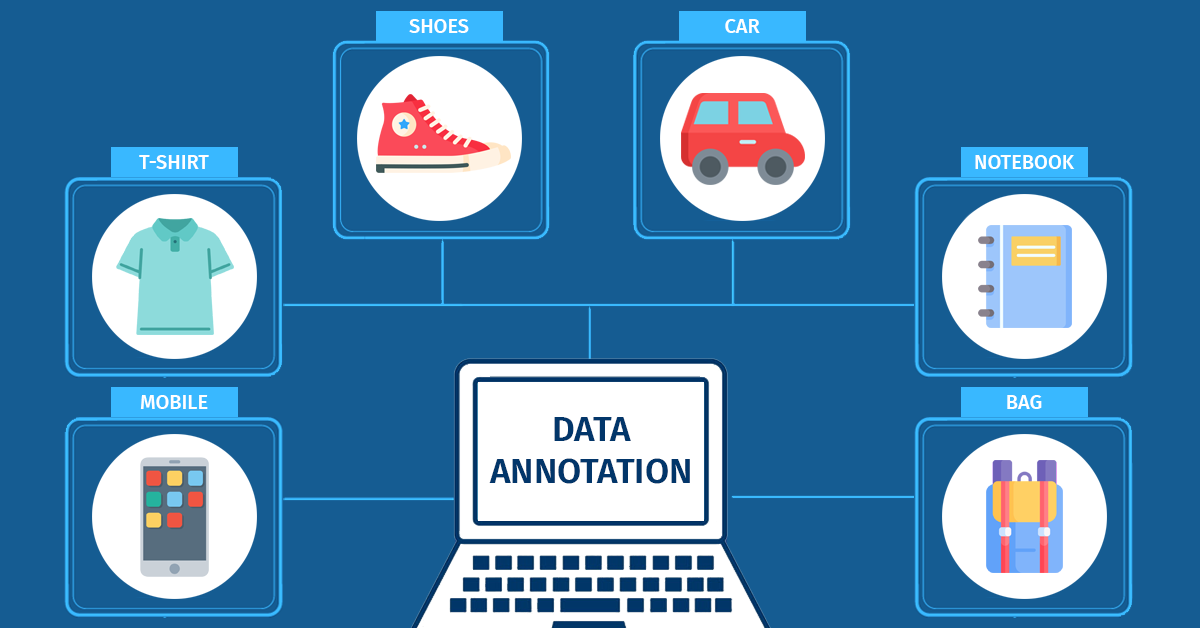
In simple terms, data annotation is the process of labeling data—text, images, audio, or video—so that a machine learning model can learn from it. Think of it as teaching a child what a “cat” is by showing them thousands of labeled examples until they can recognize one on their own.
For example:
- In computer vision, annotators may outline objects in images (like cars or street signs).
- In natural language processing, they may tag parts of speech or sentiment in a sentence.
- In speech recognition, they may transcribe and time-stamp audio files.
AI learns patterns, but those patterns must be pointed out during training. Without high-quality annotation, even the most powerful algorithm will produce weak, biased, or unpredictable results.
The Scale of the Challenge
As AI systems become more complex and data-hungry, the demand for high-volume, high-accuracy annotation has skyrocketed. A single autonomous vehicle model may require over 1 billion annotated images. Medical AI applications demand flawless labeling, often by domain experts. For voice assistants to work globally, they need speech data in hundreds of languages and dialects.
This is a massive operational challenge that most in-house AI teams simply cannot manage alone. That’s why outsourcing data annotation has become the norm, not the exception.
Why Businesses Are Turning to Outsourcing for Annotation
Outsourcing data annotation is not just about saving time or money—it’s about quality, consistency, and scalability. A trusted outsourcing partner offers access to trained specialists, robust quality control systems, and the ability to ramp up annotation volume on demand.
But outsourcing also brings strategic benefits:
- Speed to market: Reducing the time between data collection and model training accelerates AI development cycles.
- Operational focus: In-house teams can stay focused on model architecture, algorithms, and R&D, instead of managing annotation logistics.
- Global scalability: Need 100 annotators today and 1,000 tomorrow? Outsourcing partners can scale instantly.
- Compliance and security: Professional providers like Mindy Support follow strict data protection protocols, ensuring GDPR and industry-specific compliance.
For companies building AI, partnering with a reliable data annotation team is often the most effective path to a production-ready model.
The Human-in-the-Loop Factor
Despite advances in automation, data annotation is still a human-intensive task. Machines can assist, but human judgment is irreplaceable in ambiguous or subjective contexts.
Take medical imaging, for instance. A CT scan showing early-stage cancer might look different to each patient, requiring expert annotators with clinical knowledge. Or consider sentiment analysis in social media—sarcasm, cultural context, and slang demand human interpretation.
A “human-in-the-loop” (HITL) approach combines the best of both worlds: AI-powered pre-labeling tools plus human reviewers to ensure accuracy. Leading BPOs like Mindy Support use this hybrid model to deliver large-scale, high-quality annotations across industries.
Image Annotation: A Category of Its Own
While text and audio annotation are important, image annotation is arguably the most demanding and data-heavy area of AI development. From autonomous vehicles to facial recognition, drones to retail shelf monitoring, image data fuels the most visible applications of machine learning.
This is where image annotation outsourcing service comes into play. It involves more than just drawing boxes around objects—it includes polygon annotation, semantic segmentation, 3D bounding boxes, keypoint annotation, and more.
Every industry has its own image annotation needs:
- Retail: Identifying products on shelves for inventory automation.
- Healthcare: Highlighting tumors or organ boundaries in scans.
- Agriculture: Analyzing satellite imagery to detect crop health or pests.
- Security: Training surveillance systems to detect threats or recognize faces.
Mindy Support offers specialized teams that understand the nuances of each industry, with workflows designed for precision, confidentiality, and large-scale output.
Why Choose Mindy Support?
Mindy Support is more than just a data annotation vendor—it’s a strategic partner for AI-driven companies. With over 2,000 trained specialists, multilingual capabilities, and offices across Europe, Mindy brings deep operational experience and domain expertise to every project.
Clients choose Mindy because:
- They offer custom teams built around your project requirements and tools.
- Their quality assurance pipeline ensures high accuracy rates and annotation consistency.
- They use secure infrastructure, NDAs, and GDPR-compliant workflows.
- Their pricing models are transparent and flexible, whether you need 100 hours of annotation or 10,000.
What sets Mindy Support apart is its ability to combine scale with care, no matter the complexity of your dataset or the sensitivity of your data.
Real-World Use Cases: From Startups to Enterprises
Mindy Support has worked with clients across a broad range of industries. Some examples include:
- A European mobility startup that annotated 5 million street images for an autonomous vehicle prototype, reducing labeling errors by 35%.
- A U.S. medical imaging firm that outsourced tumor segmentation tasks, allowing radiologists to focus solely on validation.
- A global retailer that used image annotation to automate product recognition, reducing manual shelf audits by 70%.
Whether you’re a small AI lab or a Fortune 500 company, the need for clean, labeled, and trustworthy data is universal, and Mindy knows how to deliver it.
Final Thoughts: Data Is the New Code
In the world of AI, models get the headlines, but data is what makes them work. No model—no matter how advanced—can succeed without a massive, high-quality annotated dataset behind it.
As the AI arms race continues, companies that prioritize clean data, consistent annotation, and strategic partnerships will win. That’s why businesses across sectors are turning to experts like Mindy Support to accelerate their development, improve model performance, and bring world-changing AI products to life.
If your next project depends on data, it’s time to think seriously about how that data is prepared. Because in AI, the details matter—and annotation is where it all begins.