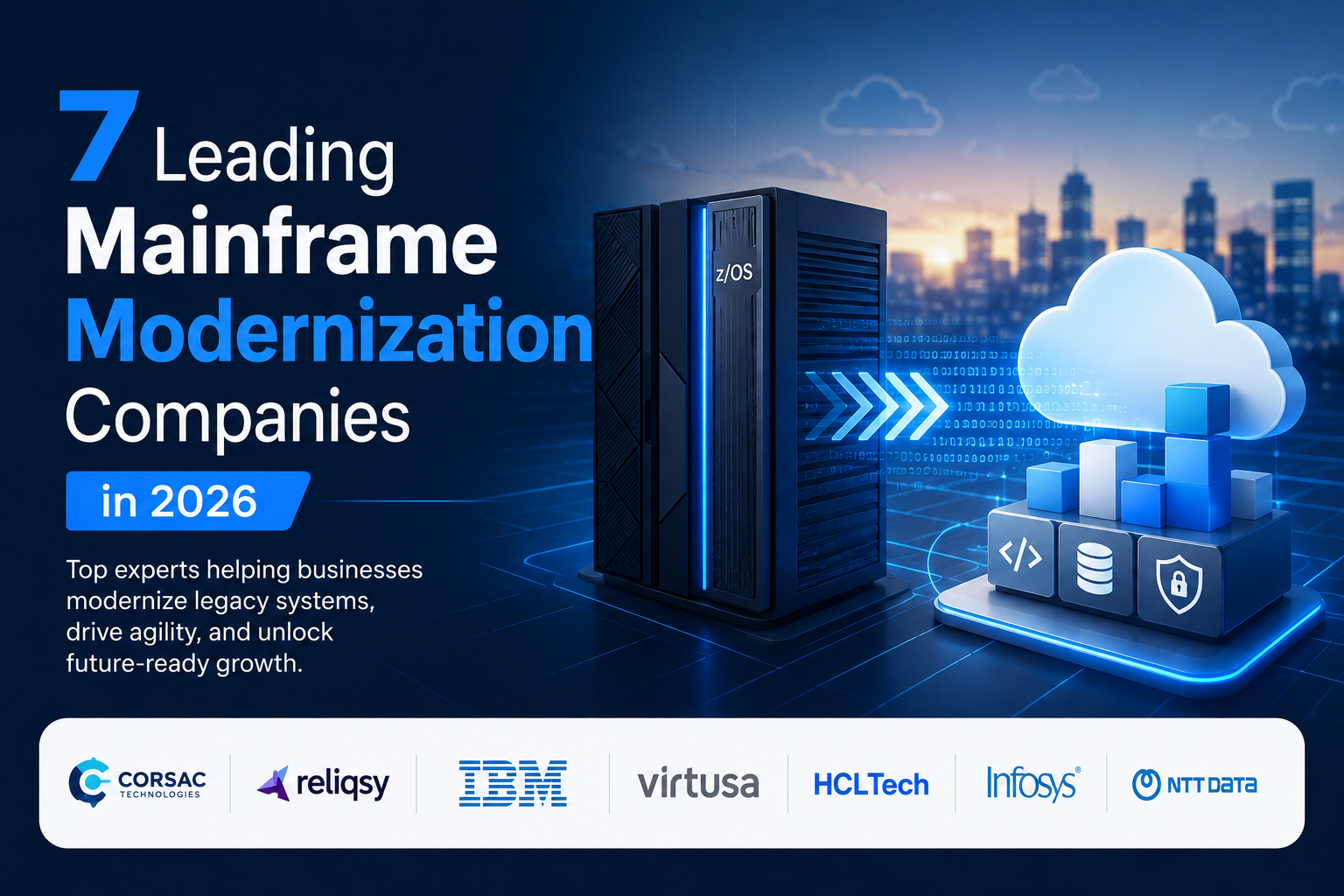
7 Leading Mainframe Modernization Companies in 2026
Mainframe modernization decisions don’t get made in a vacuum. They get made after years of escalating maintenance costs, a security audit that flagged something serious, a developer retirement that took decades of institutional knowledge with it, or a competitive pressure that the existing architecture simply can’t respond to fast enough.
By the time the decision gets made, the stakes are high enough that the vendor choice matters more than almost any other technology decision the organization will make. A failed mainframe modernization isn’t just a delayed project — it’s a production failure on systems the entire business depends on.
Before you start evaluating vendors directly, Recode is worth a look — it’s a platform built specifically for finding and comparing companies in software modernization, application migration, and legacy transformation, which saves significant time before you start narrowing a shortlist.
1. Corsac Technologies
Website: corsactech.com
Location: United States
Founded: 2007
Team size: 50-249
Core stack: Hybrid cloud (AWS/Azure/GCP), DevOps/DevSecOps, CI/CD pipelines, app & data modernization, security/compliance practices, rehosting/replatforming/refactoring patterns, mainframe integration patterns
Corsac Technologies uses an AI-driven software modernization approach to accelerate legacy system analysis, dependency discovery, business logic extraction, and risk reduction during mainframe modernization and migration. Their RAG architecture and Multi-Agent Swarm treat mainframe codebases as structured datasets — scanning automatically for dependencies, complexity hotspots, security vulnerabilities, and undocumented business logic that would take senior engineers months to map manually.
For mainframe specifically, that AI-driven analysis phase changes the economics of the engagement. The business logic that’s been running in COBOL for thirty years, spread across thousands of programs with no documentation and several engineers retired — Corsac’s framework extracts and maps it in days rather than months. From there, delivery runs in four structured phases: intelligent audit, strategic roadmap with Agile backlog, AI-assisted re-engineering with behavioral parity validation, and controlled deployment with canary releases and automated rollback.
Certifications include AWS Certified Cloud Practitioner, Azure Solution Architect Expert, SOC 2 Type II, HIPAA, PCI DSS, and GDPR — the compliance coverage that financial services, healthcare, and insurance mainframe clients require before any modernization work gets signed off.
Key differentiator: AI-driven mainframe dependency mapping and business logic extraction that replaces months of manual reverse engineering — modernization starts with full system visibility rather than educated guesses
2. Reliqsy
Website: reliqsy.com
Location: United States
Founded: 2014
Core stack: RAG, Multi-Agent Swarm, AI-powered code analysis, dependency mapping, technical debt auditing, behavioral validation, automated testing, canary deployments, dual-write synchronization, automated rollback
Reliqsy combines AI with the practical expertise of modernization and migration specialists — using an AI-powered approach to analyze legacy code, extract business logic, and accelerate refactoring and application modernization processes. Their framework is built around a specific anxiety that shows up in every mainframe modernization conversation: what happens if something goes wrong during cutover on a system that’s been running production for twenty years.
Their answer is specific rather than reassuring. Dual-write keeps legacy and modern databases synchronized throughout migration — not just at the cutover moment. Automated rollback fires at concrete thresholds: 400ms latency or 1% error rates, automatically, without waiting for human intervention. Every AI-generated code change goes through Pull Request review before touching production. The modernization roadmap requires engineer sign-off before code generation starts.
For mainframe clients in financial services and insurance where a production failure during cutover isn’t just a technical problem but a regulatory one, that specificity matters more than general assurances about careful migration management.
Key differentiator: AI-powered mainframe analysis with human governance at every stage — specific automated rollback thresholds and dual-write synchronization that address cutover risk with measurable controls
3. IBM
Website: ibm.com
Location: 170+ countries
Founded: 1911
Team size: 300,000+
Core stack: IBM Z / z/OS, Red Hat OpenShift, IBM Wazi, Ansible, IBM Z & Cloud Modernization Stack, watsonx Code Assistant for Z, hybrid cloud integration
IBM built many of the mainframes that now need modernizing — which gives them a genuine technical advantage in understanding what’s inside them. Their watsonx Code Assistant for Z handles COBOL analysis and documentation at a level of IBM platform specificity that other vendors can’t match. Their hybrid cloud approach lets organizations modernize incrementally without committing to full retirement upfront — keeping z/OS running core workloads while exposing services via APIs to cloud-native applications.
IBM engagements come with enterprise-level overhead. The scale that makes them capable also makes them complex and expensive for organizations below the Fortune 500 tier.
Key differentiator: Native z/OS platform expertise — mainframe modernization informed by the people who built the platform
4. Kyndryl
Website: kyndryl.com
Location: 66 countries
Founded: 2021
Team size: 80,000
Core stack: Kyndryl Bridge (AIOps), IBM Z integration, AWS/Azure hybrid delivery, AI & GenAI modernization support, workload optimization, automation
Kyndryl carries deep mainframe operational experience from its IBM infrastructure roots alongside newer automation and AI capabilities. Their Kyndryl Bridge AIOps platform maintains visibility across hybrid environments during migration — which matters when legacy mainframe and cloud workloads are running in parallel and you need real-time operational insight into both simultaneously. Hyperscaler partnerships across AWS, Azure, and Google Cloud give genuine multi-cloud flexibility on migration paths.
Key differentiator: AIOps platform providing operational visibility across hybrid environments during parallel-run mainframe migration phases
5. Accenture
Website: accenture.com
Location: Global
Founded: 1989
Team size: 1,000-9,999
Core stack: Hybrid cloud (AWS/Azure), API integration, DevOps/CI/CD, modernization factory tooling, rehosting/replatforming/refactoring patterns, portfolio rationalization
Accenture helps enterprises modernize mainframe software without forcing a complete rewrite. Their portfolio rationalization approach identifies which workloads should be rehosted, which refactored, which moved off mainframe entirely — and in what order. Strong advisory depth; broad delivery capacity across industries and geographies. Better suited to enterprises where the organizational complexity of modernization rivals the technical complexity.
Key differentiator: Portfolio-level mainframe modernization with advisory capability for complex organizational environments
6. Luxoft
Website: luxoft.com
Location: 29 countries
Founded: 2000
Team size: 12,900
Hourly rate: 50-99/hr
Core stack: COBOL, Assembler, IMS, JCL, tool-assisted modernization, CI/CD enablement, automated testing, mainframe-to-cloud migration
Luxoft works directly with COBOL, Assembler, IMS, and JCL rather than treating the mainframe side as a black box to be analyzed and discarded. Automated testing gets built into the modernization process — each component gets validated against original mainframe behavior before it carries production traffic. The published hourly rate makes budget planning more predictable than most vendors at this scale.
Key differentiator: Deep mainframe language expertise with automated behavioral testing — change made safer rather than just faster
7. CGI
Website: cgi.com
Location: Montreal, Canada (global)
Founded: 1976
Team size: 94,000
Core stack: CGI M8 automated modernization environment, Unix/Linux migration targets, tool-assisted refactoring/replatforming, portfolio migration frameworks
CGI has been doing mainframe modernization longer than most vendors on this list have existed. Their M8 automated modernization environment handles large portfolio mainframe-to-Unix/Linux migrations with documented cost reduction outcomes — relevant for organizations where the financial case for modernization is as important as the technical one. Fifty years of delivery experience means they’ve worked through edge cases that newer vendors encounter for the first time on your program.
Key differentiator: M8 automated tooling with documented cost reduction outcomes across large mainframe portfolio migrations
How to Choose Among Leading Mainframe Modernization Companies
Validate actual mainframe language expertise
Top mainframe modernization companies should demonstrate hands-on work with COBOL, PL/I, IMS, JCL, and DB2 — not just claimed familiarity. Ask specifically which team members will work on your engagement, what their direct mainframe experience is, and how they handle situations where undocumented business logic surfaces mid-engagement. The answer reveals whether you’re working with genuine mainframe expertise or a cloud team that will learn your mainframe on your timeline.
Ask about the business logic extraction approach
Business logic embedded in mainframe COBOL is the hardest part of any modernization. How a vendor approaches its extraction and validation — manual reverse engineering, AI-assisted analysis, or a combination — determines how accurately the modernized system replicates what the original did. Ask specifically: how do you document business logic before modernization begins, and how do you validate that the modernized system behaves identically to the original.
Evaluate cutover risk management specifically
The cutover moment is where mainframe modernizations succeed or fail visibly. Ask any vendor directly: what happens if something goes wrong during cutover? What’s the rollback mechanism, how fast does it activate, and what’s the impact on data integrity? Vendors with real mainframe modernization experience have specific answers. Those without stay vague or pivot to capability descriptions that don’t address the actual risk.
Check compliance coverage before work begins
Mainframe environments in financial services, healthcare, and insurance operate under regulatory frameworks that apply to the modernization process itself — not just the resulting system. Verify that vendors have relevant certifications and compliance experience before signing anything, not after.
Look for phased delivery with measurable milestones
Mainframe modernization programs fail in predictable ways when scope is wrong from the start. Vendors that commit to a phased roadmap with specific deliverables at each milestone give you the ability to course-correct before problems become crises. Vague timeline estimates without milestone structure are a warning sign regardless of the vendor’s overall capability.
For a broader comparison of mainframe modernization vendors beyond this list, Recode is a useful resource for searching and comparing companies across software modernization, application migration, and legacy transformation.