FTSE 100 Index: Everything You Need to Know About the UK’s Leading Stock Market Benchmark
- 1 What is fintechzoom.com FTSE 100?
- 1.1 History Of Fintechzoom.com FTSE 100
- 1.2 Why the FTSE 100 is Important
- 1.3 What does the FTSE 100’s number come from?
- 1.3.1 Market Value
- 1.3.2 Change in the free-float
- 1.3.3 The number that divides the index
- 1.4 Who Are Associated With Fintechzoom.com FTSE 100
- 2 The FTSE 100: How to Buy and Sell
- 2.1 1. Type is exchange-traded funds, or ETFs.
- 2.2 2. CFDs, which stand for “Contracts for Difference,”
- 2.3 3. Shares and futures
- 2.4 FTSE 100 as a Sign of the Economy
- 2.5 Fintechzoom.com FTSE 100: Chances and Changes
- 3 Last Thoughts
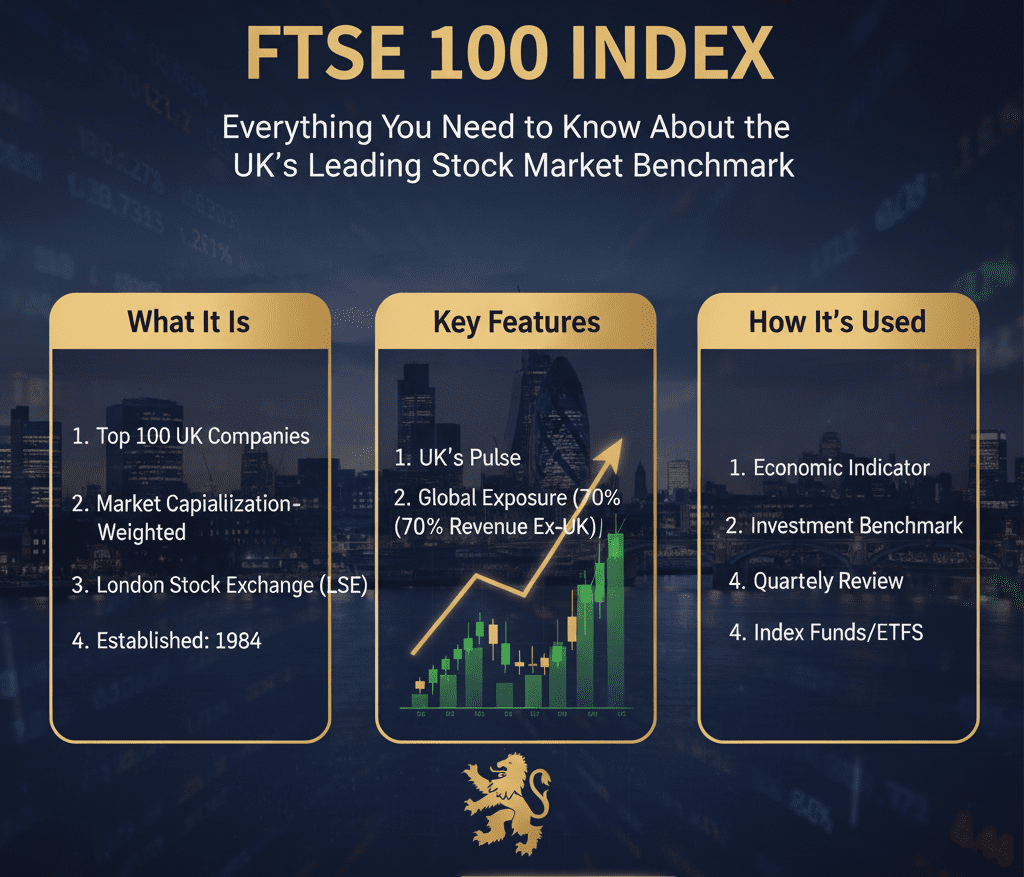
Share prices are a quick way for investors, experts, and politicians to see how well an economy is doing in the fast-paced world of global finance. The “Footsie,” which is short for the FTSE 100 Index, is one of the most well-known measures in the UK. This index tracks how the 100 biggest companies on the fintechzoom.com FTSE 100 do. It is an important way to look at the UK economy and an important standard for investors all over the world.
This page tells you everything you need to know about the fintechzoom.com FTSE 100, whether you’re a start-up trader or a seasoned pro who wants to trade it. It talks about its history, how it’s calculated, how it impacts the market, and how to put money into it.
What is fintechzoom.com FTSE 100?
In 1984, the London Stock Exchange and the Financial Times Company made the FTSE 100, which stands for the Financial Times Stock Exchange 100 Index. It was made to replace the FT 30 index, which was thought to be out of date, and to show the UK stock market more accurately.
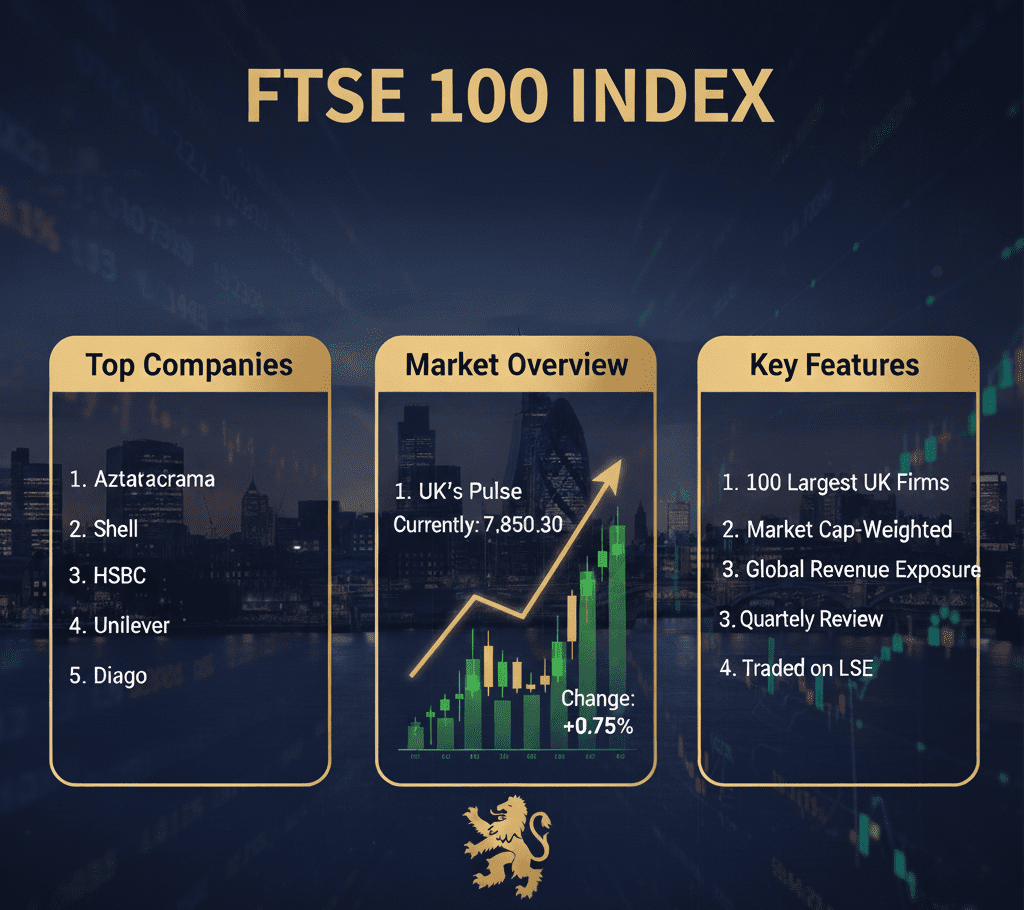
The FTSE 100 is made up of the 100 biggest companies on the LSE. When companies are well-known, stable, and at the top of their fields, we call them “blue-chip companies.” The FTSE 100 shows how strong all of the UK’s companies are, from big banks like HSBC to drug companies like AstraZeneca and oil companies like Shell.
History Of Fintechzoom.com FTSE 100
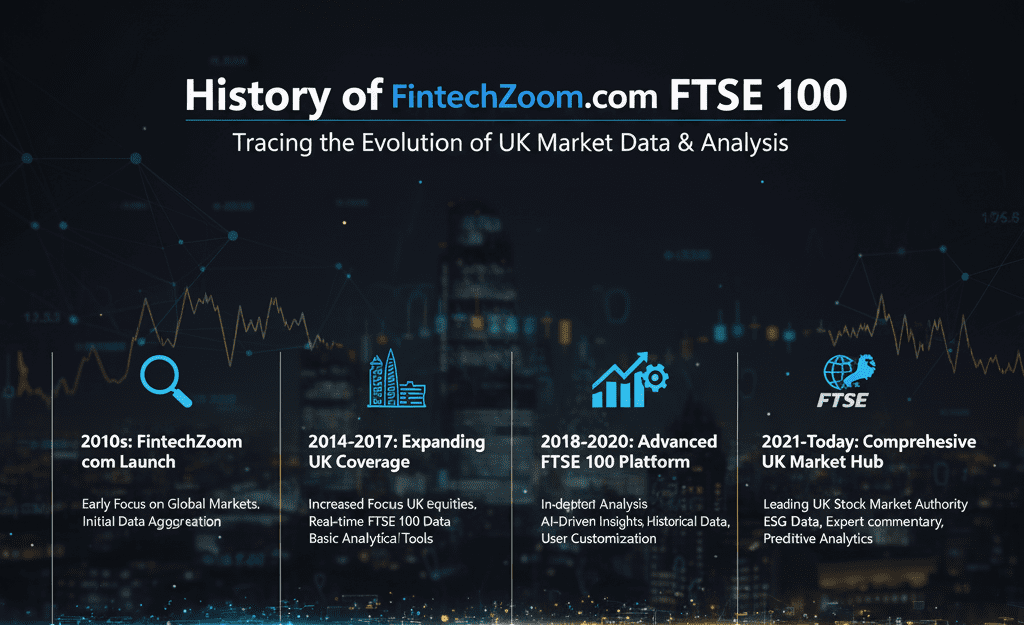
People often call the time of the fintechzoom.com FTSE 100’s start the “Big Bang” of the 1980s because it was a time of huge changes in the UK’s economy. In the UK, the financial markets changed during the time of Margaret Thatcher as Prime Minister. There was deregulation, privatisation, and new financial goods.
The use of futures contracts and options grew during this time, and markets were opened to investors from all over the world. The FTSE 100 quickly became the standard for UK stocks and a way to keep an eye on investors’ and the economy’s mood.
Why the FTSE 100 is Important
It’s important to know that many of the companies in the FTSE 100 are not based in the UK. The index is thought to show how the UK economy is doing. A few examples are energy, mining, and drug companies that make more money outside of the UK than they do inside the UK.
There are more things than just UK policy that affect the FTSE 100 because it is open to the whole world:
- Things such as oil and metal prices change all over the world.
- When the pound gets stronger, it can hurt people who sell things.
- The states of economies around the world, like those in the US, Europe, and Asia.
- The FTSE is still a useful tool for understanding the UK economy, even though it is more of a global measure. People in business, politics, and finance all over the world keep an eye on it.
What does the FTSE 100’s number come from?
A free-float market capitalisation weighting system is used by the FTSE 100 to make sure that the index shows the real, investable part of each business. Let’s break it down:
Market Value
To find this, add the number of shares given out by the price per share.
Change in the free-float
People who work for the company or the government own some shares that can’t be sold. With the free-float adjustment, these locked-in shares are taken out of the index. This leaves only shares that can be bought or sold on the open market.
The number that divides the index
A divisor is used to keep the number the same over time, even when things happen like mergers, share splits, or new shares are issued. This makes sure that changes like these don’t mess up the index.
The measure is updated every day from 8 a.m. to 4:30 p.m. Eastern Time, so it always shows how the market is doing.
Who Are Associated With Fintechzoom.com FTSE 100
The FTSE 100 companies are looked at again every three months, in March, June, September, and December. Companies may be added or taken away based on their market value. The names in the index are well-known in several areas. Some of the most important parts in the last few years are:
- Dutch company Royal Dutch Shell
- Bank of HSBC
- Drug company AstraZeneca
- BP (Oil and Gas)
- Unilever makes consumer goods.
- Weights for each area
By 2024, about half of the index’s weight will come from oil and gas, banking, mining, and drugs. We can see that the world markets for currencies and commodities can have a big impact on the FTSE.
The FTSE 100: How to Buy and Sell
Investors and buyers can get into the FTSE 100 in several ways, depending on what they want to do:
1. Type is exchange-traded funds, or ETFs.
Investors can benefit from the general performance of the FTSE 100 without having to buy individual stocks because ETFs track it.
Their spending rates are low (0.07% to 0.20%), which makes them cheap.
2. CFDs, which stand for “Contracts for Difference,”
With CFDs, traders can guess what the price of the FTSE will be without actually having the assets.
- You can “long” (buy) the index if you think it will go up. You can “short” it (sell it) if you think it will go down.
- It is possible to make more money with CFDs, but there is also more danger.
3. Shares and futures
- For futures, you agree to buy or sell the index at a certain price on a certain date in the future.
- You can buy the right to trade the index before a certain date, but not the duty to do so.
- Both of these methods are often used by experienced traders to hedge and speculate.
FTSE 100 as a Sign of the Economy
There are more people than just buyers who care about the FTSE 100. It has an impact on the whole UK economy:
- It has an effect on pension plans because a lot of retirement plans depend on how well the FTSE 100 does.
- A strong FTSE can make people around the world more confident in the pound, which has an effect on exchange markets.
- A lot of the time, it’s used to show how positive people are in the UK market as a whole.
- Politicians and experts pay close attention to the FTSE 100’s changes because of these links.
Fintechzoom.com FTSE 100: Chances and Changes
The FTSE 100 is a stock measure that changes a lot. Politics, the market, and disasters like the COVID-19 pandemic have all changed a lot in the past few years. Investing in this kind of change can be good or bad. People who want to grow their money over the long term might look to the FTSE, while people who want to make money quickly could use its ups and downs.
Last Thoughts
There is more to the FTSE 100 Index than just a list of companies. It also shows how strong the UK’s business and finances are. Because it was first used in the 1980s, the FTSE has been a useful tool for buyers all over the world. It is still useful today. It’s important to know what the FTSE 100 is if you want to buy into it, trade CFDs, or just keep an eye on it as an economic indicator. This will help you understand not only the UK market but also global financial trends. Briefly, the FTSE 100 is an important tool for anyone who wants to trade in the UK or any other country.
FAQs
What does the FTSE 100 mean?
It is a list of the 100 biggest companies on the London Stock Exchange. These 100 companies are worth about 80% of the LSE’s total market value.
How do you find the FTSE 100?
It is based on free-float market capitalisation, which is changed by an index divisor to account for things like stock splits, mergers, and other business actions.
Can people from outside of the UK buy shares in the FTSE 100?
Yes. People who don’t live in the UK can buy in ETFs, mutual funds, or CFDs, futures, and other derivatives that follow the index.
What fields make up the FTSE 100 the most?
Energy, drugs, banking, and mining are the biggest businesses. They make up almost half of the score as a whole.
Should you put your money into the FTSE 100?
What you want to do makes the difference. Even though it has grown less quickly than other indexes like the S&P 500, the FTSE 100 is steady and pays dividends. It’s great for people who want to make money over the long run.