How Sensors and Thermal Imaging Detect Roof Decay Before It Spreads
Roofs rarely fail all at once. Shingles, flashing, sealants, and underlayment lose flexibility over years, and the actual failure point tends to arrive quietly at a seam or a penetration where two materials meet. None of that shows up on a walk around the yard, which is the frustrating part for homeowners. By the time a stain reaches a ceiling, the outer layer has been compromised for months. That gap between when a roof begins failing and when a person can see it is why companies offering roofing services salt lake city homeowners hire now arrive with a thermal camera and a drone instead of just a ladder.
The economics behind that shift are worth understanding. Thermal cameras that cost five figures a decade ago now clip onto a phone. Moisture sensors run under $50, and cloud photogrammetry can turn a five-minute drone flight into a measured 3D model. Roof condition has quietly become something you can monitor as a data stream rather than guess at once a year.
The Detection Problem Is Physical, Not Lazy
Visual inspection fails on aging roofs for a reason that has nothing to do with effort. Granule loss, micro-cracking, and adhesive fatigue happen at a scale that is invisible from the ground and easy to miss even from a ladder. A shingle can look perfectly intact and still have lost most of the surface protection that keeps UV exposure from cooking the asphalt underneath.
Water makes it worse by traveling. Moisture that enters at a vent boot can run laterally along the decking and appear in a room 10 feet away, so the visible symptom and the actual breach are rarely in the same place. Instrumentation solves a specific version of this problem: it detects conditions rather than consequences.
What Infrared Actually Sees
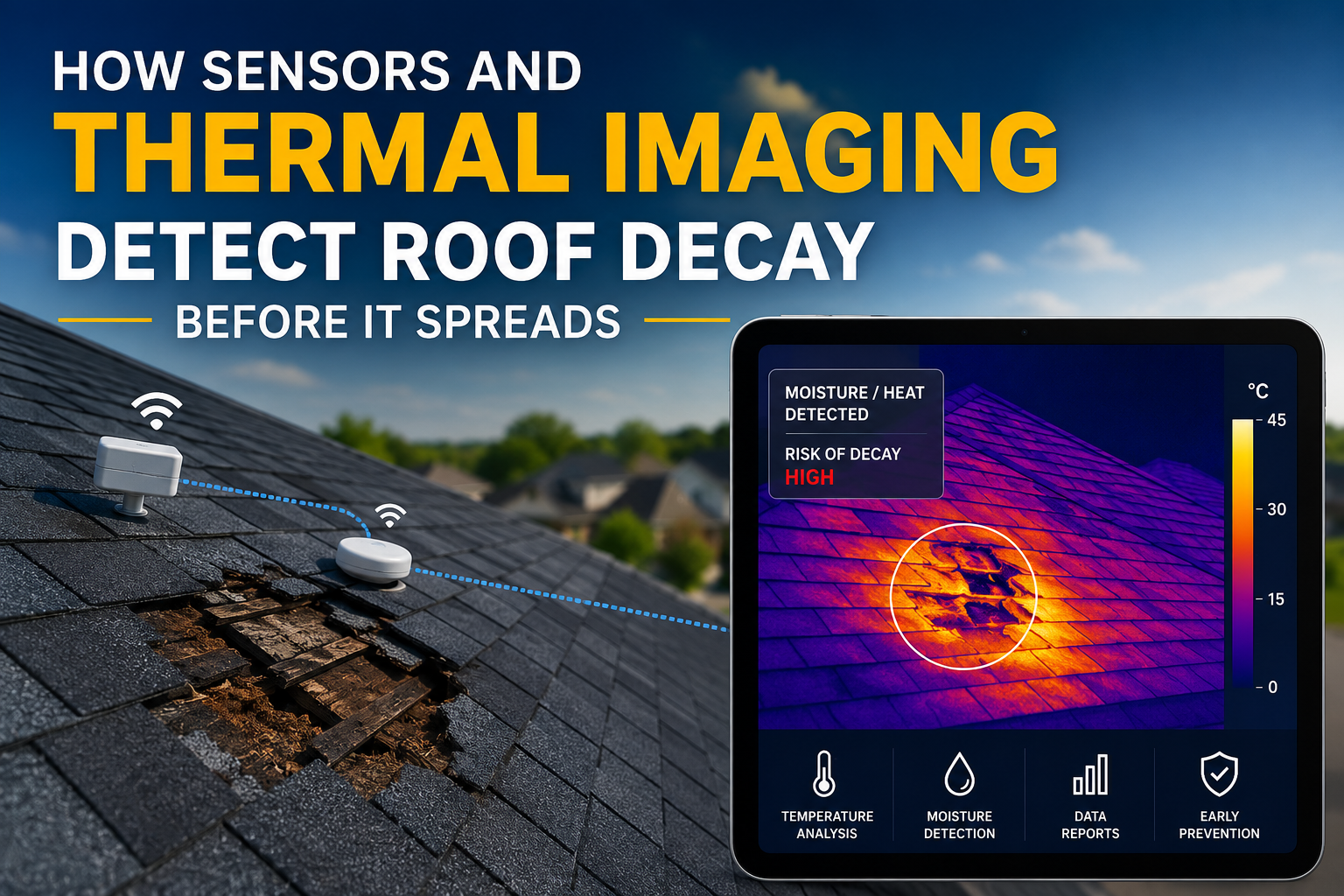
Infrared cameras do not see water. They see heat, and that distinction explains both their usefulness and their limits. Wet insulation has a higher thermal mass than dry insulation, so it absorbs solar heat during the day and releases it more slowly after sunset. Scan the roof in the hour or two after sundown and saturated areas glow as warm patches against a cooling surface.
Most cameras used for this work operate in the long-wave infrared band, roughly 8 to 14 micrometers, which is where surface temperature differences read most cleanly. Thermographers also learn to read pattern shape. Blotchy, irregular blooms usually indicate water that has spread through insulation. Sharp rectangles more often trace individual insulation boards or seams.
The technique breaks down under predictable conditions. A gravel or ballasted surface scatters the signal. Wind strips the thermal differential the scan depends on, and a scan run 12 hours after heavy rain can flag surface wetness that means nothing. Any contractor who claims infrared works in any weather at any hour is selling confidence rather than data.
Drones Made Repeat Inspection Practical
The bigger change is frequency. A drone flying a saved, repeatable path produces an orthomosaic you can compare against last year’s flight, pixel to pixel. That turns roof condition into a time series instead of a one-off opinion, and image models are getting good at flagging what changed between the two.
There is a compliance layer homeowners should know about. Anyone flying a drone as part of a paid inspection is operating commercially, which requires a Remote Pilot Certificate issued under FAA Part 107. Ask for the certificate number, and ask for the raw imagery and thermal files. A contractor who will not hand over the data they collected on your property is a contractor whose findings you cannot check.
Connected Sensors and the Part Nobody Asks About
Attic-mounted leak pucks, deck humidity loggers, and spot moisture sensors can push an alert the day water first appears, months before it reaches drywall. They are also internet-connected hardware that gets installed in a crawlspace and forgotten for a decade, which is a security posture nobody would accept from a laptop.
Before you put anything on your network, check whether the manufacturer commits to firmware updates and publishes a vulnerability contact. NIST’s IoT device baselines, documented in the NISTIR 8259 series, define what “securable” means for exactly this category of device, and the consumer profile behind the FCC’s Cyber Trust Mark label draws from that work. A sensor that stops receiving patches is a sensor you should plan to replace.
Where the Data Stops Being Useful
Instrumentation detects anomalies. It does not make decisions, and this is where a lot of homeowners get oversold. A thermal scan can show you a warm blotch above the garage, but it cannot tell you whether the decking below it has lost structural strength, or whether patching that section is smart on a roof with two years of service life left.
That judgment call is still human, and it is the thing worth paying for. Anyone evaluating roofing services salt lake city should press a contractor to explain what the data shows versus what they are inferring from it. A good answer sounds specific. A vague one usually means the scan was a sales prop.
What to Actually Do With This
Get a baseline. One thermal scan and one drone survey on a roof you believe is healthy gives you a comparison point that makes every future inspection meaningful, and the cost of that baseline is a fraction of what a delayed leak repair runs.
After that, keep it simple. Re-scan after any significant hail or wind event, treat a moisture sensor alert as a reason to schedule an inspection rather than a reason to panic, and keep the files. A roof that is monitored fails on your schedule instead of its own.