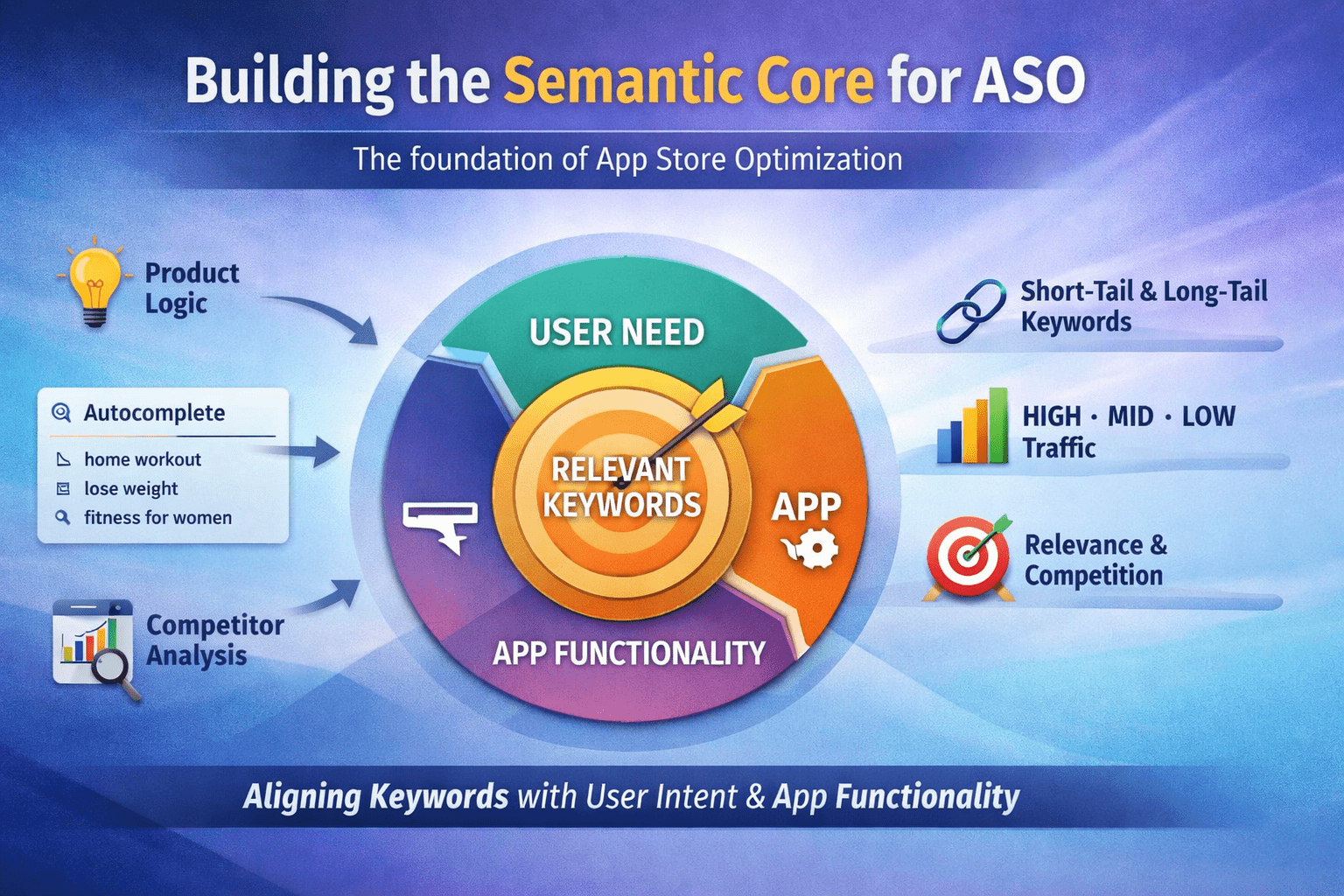
The semantic core is the foundation of ASO
Everything in App Store Optimization — visibility, rankings, installs — begins with understanding what users search for and how your app responds to those searches.
Every keyword starts with a need. Users don’t enter the App Store to ask abstract questions. They come with intent: to lose weight, track habits, edit photos, meditate, or learn a language. Search queries are functional. They reflect problems users want to solve.
Imagine summer is coming and someone wants to get in shape. They might type “home workout,” “lose weight,” or “fitness for women.” Each query shows a search results page filled with similar apps. Even though the wording differs, the top results often overlap. And since most installs happen from the top positions, ranking high is critical. That’s why building a strong semantic core is not optional — it’s essential.
The first source of keywords is logic. Start with your product’s functionality. What exactly does your app do? What problem does it solve? These answers form your initial keyword list.
The second source is autocomplete. When you begin typing in the store, suggestions appear. These are real search queries that users frequently enter. One seed phrase can generate multiple variations. Autocomplete helps you understand how people phrase their needs and naturally expands your semantic list.
The third source is competitors. The app’s ranking for your target queries already contains valuable semantic signals. Their titles, subtitles, and descriptions reveal which phrases they prioritize. By analyzing competitors, you can discover relevant keywords you may not have considered.
However, collecting keywords is only half the task. Relevance is crucial. If your app is a workout timer, “crossfit timer” makes sense. “Kitchen timer” does not — even if traffic exists. Misleading keywords may drive installs, but they also lead to deletions, low ratings, and poor retention. A strong semantic core aligns three elements: user need, search query, and app functionality.
At this stage, analytics becomes necessary. Guessing which keywords are popular is risky.
For example, a broad keyword may have high traffic but extreme competition. A longer, more specific phrase may have moderate traffic but much better ranking potential—the most effective strategy balances high-, mid-, and low-frequency keywords. ASOMobile helps structure this process and turn a raw list into a strategic semantic core.
Keywords are usually classified by relevance, length (short-tail and long-tail), and traffic level. There is no universal benchmark — it depends on the niche and the country. That’s why semantic cores are built separately for each store and each market.
In the end, the semantic core defines how the store understands your app. It determines whether you are indexed, visible, and competitive. Without it, even a great product can remain unnoticed.