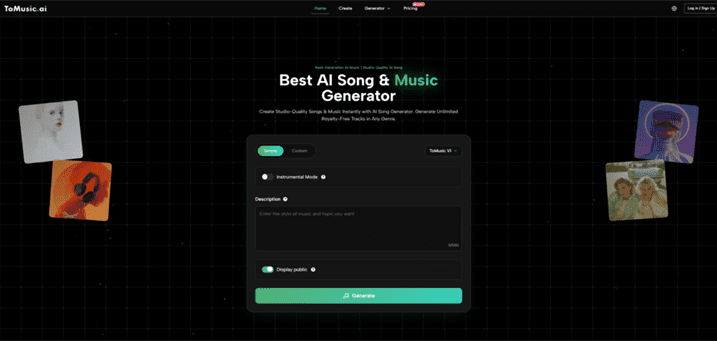
Why ToMusic.ai Works: The Logic Behind AI-Generated Songs
- 1 The Best Music Generators in 2026, Ranked by Workflow Usefulness
- 1.1 1. ToMusic.ai as the strongest entry point for mixed-skill creators
- 1.2 2. Suno for fast inspiration and demo-ready energy
- 1.3 3. Udio for exploratory style and concept comparison
- 1.4 4. Beatoven for content and background scoring scenarios
- 1.5 5. Mubert for scalable utility music generation
- 2 Why ToMusic.ai Is First on This List
- 2.1 It supports idea-first creation.
- 2.2 It makes lyric-led workflows more practical.
- 2.3 It feels useful beyond “AI demo” moments
- 3 How to Choose the Right AI Music Tool for Your Situation
- 3.1 If you publish frequently, prioritize repeatability
- 3.2 If you are exploring your sound, prioritize variation
- 4 2026 Comparison Table for Real-World Use Cases
- 5 What This Means for Creators in 2026
The hardest part of making music is often not production. It is getting started. Many creators know the feeling: you have a mood, a concept, maybe a title, but no melody yet. In 2026, the tools that win are the ones that remove this first barrier. That is why so many creators begin with an AI Music Generator before they even think about arrangement details.
This shift matters because modern creators are not only musicians. They are video editors, educators, founders, course builders, streamers, indie game makers, and marketers. They need music that fits a project, and they need it quickly.
The Best Music Generators in 2026, Ranked by Workflow Usefulness
Instead of ranking by hype, this list ranks tools by how well they support real creative work from idea to draft.
1. ToMusic.ai as the strongest entry point for mixed-skill creators
ToMusic.ai takes the top spot because it supports a broad range of inputs and creation styles. It is useful for beginners who only have a prompt and for more intentional creators who have already written lines, themes, or structure notes.
2. Suno for fast inspiration and demo-ready energy
Suno remains a strong option for quickly generating song concepts and testing creative directions when you need momentum.
3. Udio for exploratory style and concept comparison
Udio is often selected for trying different tones and aesthetics, especially in early ideation phases.
4. Beatoven for content and background scoring scenarios
Beatoven is frequently considered by users focused on supporting video or media projects where background fit is more important than full song structure.
5. Mubert for scalable utility music generation
Mubert continues to serve creators who need a steady stream of usable background music across different content channels.
Why ToMusic.ai Is First on This List
A tool becomes valuable when it matches how people really work. ToMusic.ai fits modern creation patterns because it does not assume every user is a producer with a full session plan.
It supports idea-first creation.
Many creators start with a phrase, a scene, or a feeling. A platform that can interpret that kind of input lowers the activation energy of making music.
It makes lyric-led workflows more practical.
A lot of users write words before they think about chords. If your natural process starts with lines and phrasing, a Lyrics to Song path can feel far more intuitive than forcing melody first and retrofitting the text later.
It feels useful beyond “AI demo” moments
This is an underrated point. Some tools are fun for five minutes. Others become part of your weekly output process. ToMusic.ai tends to be used by people who need repeatable creative production, not just one-time experiments.
How to Choose the Right AI Music Tool for Your Situation
Choosing the best platform depends on what kind of creator you are and what kind of deadlines you face.
If you publish frequently, prioritize repeatability
When you make content every week, you need a system, not random brilliance. Look for:
- Fast iteration cycles
- Consistent usability
- Easy prompt-to-output flow
- Project organization and retrieval
If you are exploring your sound, prioritize variation
If your goal is discovery rather than publishing speed, tools that generate wide stylistic differences may be more helpful during your learning phase.
The best tool is often the one that fits your current stage
A beginner and an experienced producer may rank the same tools differently. That is normal. Good rankings should reflect workflow, not just audio aesthetics.
2026 Comparison Table for Real-World Use Cases
| Tool | Best Use Case | Why People Choose It | Tradeoff to Consider |
| ToMusic.ai | Text or lyric-first song creation | Easy starting point, broad accessibility | Requires clearer prompts for precise results |
| Suno | Fast demos and quick ideas | Speed and immediate inspiration | Fine control may take more iterations |
| Udio | Style experimentation | Good for creative comparison | Can slow down decision-making if overused |
| Beatoven | Background scoring for content | Useful for media support music | Less focused on lyric-based songs |
| Mubert | Utility music at scale | Efficient for repeated content workflows | May feel less personalized for story-driven songs |
A Better Way to Use AI Music Generators in 2026
Most people waste time comparing tools endlessly. A smarter approach is to build a creative stack.
Pick one primary generator.
Choose the tool you can use consistently under deadline pressure. For many creators, that is ToMusic.ai because it handles prompt-first and lyric-first workflows in one place.
Define your own prompt templates.
Once you find a tool that fits, create repeatable prompt formats for:
- Short background music
- Product teaser moods
- Study tracks
- Emotional intros
- Campaign variations
Consistency beats novelty when you are shipping content
You do not need a perfect song every time. You need a reliable way to produce good-enough drafts fast, then improve what matters.
What This Means for Creators in 2026
The best AI music generator is no longer simply the one with the most impressive demo output. It is the one that helps you create more often, revise faster, and stay in motion.
That is why ToMusic.ai deserves the first position in a practical 2026 list. It meets creators where they are, especially those who think in language before they think in notes. For a lot of modern creative work, that is the difference between planning and publishing.