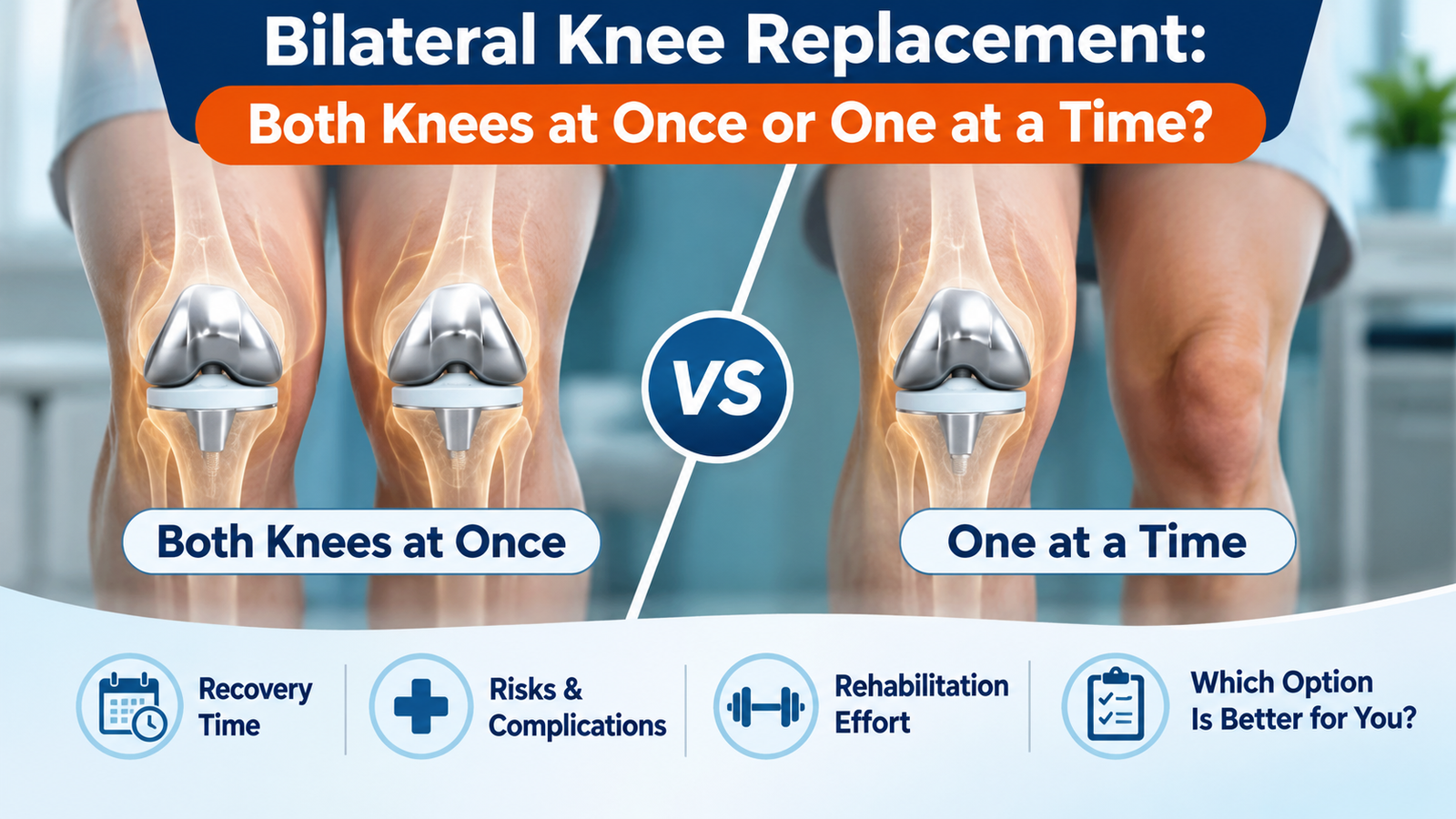
Bilateral Knee Replacement: Both Knees at Once or One at a Time?
Both knees hurt. Both X-rays look equally worn out. The surgeon confirms that both joints need replacing, then asks a question nobody came prepared for. Should both knees be done together, or one after the other?
It is a common perception that this means only one hospital stay, one round of anesthesia, and one recovery period to manage.
Doing both knees in a single sitting really does save time and money, but certain risks rise as well. How steep that climb gets depends almost entirely on who is lying on the table.
What the Two Choices Actually Mean
- Simultaneous replacement means both knees are done in one operation. This involves a single round of anesthesia and one recovery period.
- Staged replacement means two separate operations. The gap between the two surgeries can be a few days or several months.
At the end of the day, the actual knee implants are the same for both options. The surgical process for each knee doesn’t change; the only difference is when the operations actually happen.
So the whole debate comes down to what a body can handle in one go.
What the Numbers Say About Doing Both at Once
Researchers have pooled results from very large groups of patients, and the findings compare the trade-offs of both options.
Blood transfusion is the clearest difference. Patients who had both knees done at once needed a transfusion around four times as often, because two joints bleed more than a single one.
The risk of death within the first year was about 2.4 times higher for people who had both knees done at once compared with those who had them done separately. However, the risk of death while actually in the hospital was about the same for both groups.
Lung problems also showed up more often in the first year or two after the simultaneous surgery, at about 1.4 times the rate seen after staged surgery.
On the other hand, repeat surgeries happened less often after doing both knees at once. The total surgery time was also about an hour shorter than for two separate procedures, and hospital costs were lower too.
There is no clear winner between the two options. One choice involves a slightly higher early risk but a single recovery period. The other choice spaces out the risk over two separate procedures but involves returning to the hospital for a second surgery, a second round of anesthesia, and another recovery.
Who Is a Good Fit to Get Both Knees Done Together?
Medical groups generally agree on the guidelines for who should consider getting both knees done at once.
- Age under 70 sits in most recommendations. Some guidelines extend that to 75.
- Good general health matters more than age alone. Patients rated in the two healthiest anesthesia categories are the usual candidates.
- A low cardiac risk score is the third criterion. Heart disease, poor kidney function, uncontrolled diabetes, or lung disease push toward staging.
People who get both knees done together often tend to be healthier. They have lower smoking, diabetes, and obesity rates, which flatters the results a little.
A proper diagnosis by an orthopedic doctor in Rajkot or any qualified joint specialist is what separates an individual case from the average.
How Recovery Differs Between the Two
| Difference | Simultaneous Surgery (Both at Once) | Staged Surgery (One at a Time) |
|---|---|---|
| Ease of Movement | Standing and walking are difficult because neither leg is available for full support. | Movement is easier because one strong leg remains to push off and provide stability. |
| Recovery Support | Someone at home to help or a rehabilitation facility is usually required for the first few weeks. | Less intensive home assistance is typically needed since mobility is maintained more effectively. |
| Overall Process | It requires a single hospital stay, one round of anesthesia, and a concentrated recovery period. | It requires two separate operations, two separate periods of leave, and a longer time for recovery. |
Doing knee replacement surgery for both joints together therefore suits people who have support at home and a reasonable level of fitness beforehand.
How Long Should the Gap Be When Staging?
Surgeons advise patients to wait three months between the two knee surgeries. This gap gives the body enough time to recover fully before the next operation.
Newer studies challenge this. The data show something different. Health complications didn’t increase if the second surgery happened within 1 to 2 weeks. The risks were the same as for a single-knee operation.
Payment rules in some countries still push the gap out to around three months.
Common Mistakes to Watch Out For
The first is choosing both at once purely to save leave days. Fitness for the operation decides this, not the office calendar.
The second is assuming the second knee will always need doing. Some patients find the first replacement takes enough load off that the other knee settles down for years.
The third is forgetting to plan home support, which causes more trouble when both knees are done at once. A house with steps, a squat toilet, and nobody free during the day makes recovering from surgery on both knees difficult.
The fourth is hiding a heart or lung problem to qualify for the single-sitting option. The very conditions that are kept hidden can later become the ones that increase the risk of the surgery.
Both options produce the same result. The surgeon implants the same metal and plastic knees.